







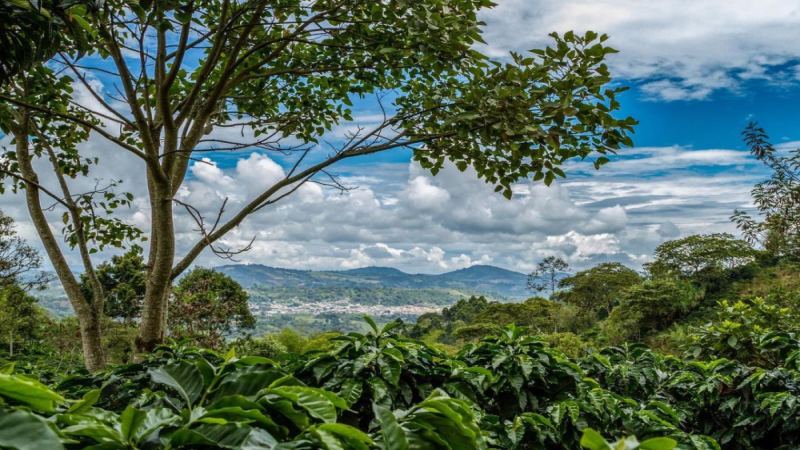
How do Colombia coffee producing regions differ in taste?
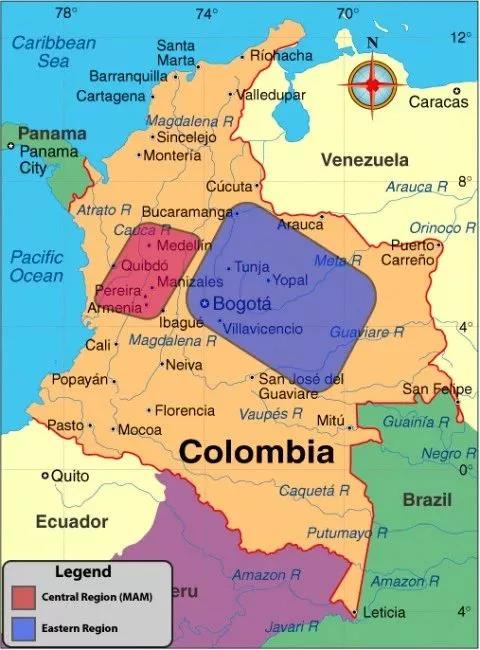
Colombia's growing areas follow the Eastern and Central Cordilleras plus the southern departments of Huila, Cauca and Nariño. Medellín beans are plump with rich coffee aroma and pleasant acidity; Santander leans toward fresh herbal notes; Huila coffee brings nutty and chocolatey tones; Cauca balances acidity and sweetness at altitude; Nariño reflects an equatorial high-mountain microclimate.
Geography supports this range. Colombia has ports on both the Atlantic and Pacific, giving it lower coffee transport costs than neighboring South American origins. Medellín, Armenia and Manizales form the MAM Coffee Golden Triangle along the Central Cordillera. The southern regions produce less volume, but altitude, terrain and soil create microclimates with excellent acidity and distinctive flavor.
Colombia, with its geographical advantage of having ports on both the Atlantic and Pacific Oceans, has become the country with the lowest coffee transportation costs in South America. Its traditional growing regions are distributed along the Eastern and Central Cordilleras and in the southern regions of Huila, Cauca, and Nariño, forming a flavor map with distinctive characteristics. From Medellín's full-bodied richness and Santander's fresh herbal notes, to Huila's nutty and chocolatey tones, Cauca's high-altitude balance of acidity and sweetness, and Nariño's equatorial high-mountain microclimate, each region displays its own unique charm. This article systematically reviews the taste characteristics of Colombia's main growing regions, Front Street Coffee's cupping evaluations and roasting suggestions, and includes brewing parameter references to help coffee enthusiasts gain a comprehensive understanding of the diversity of Colombian coffee.
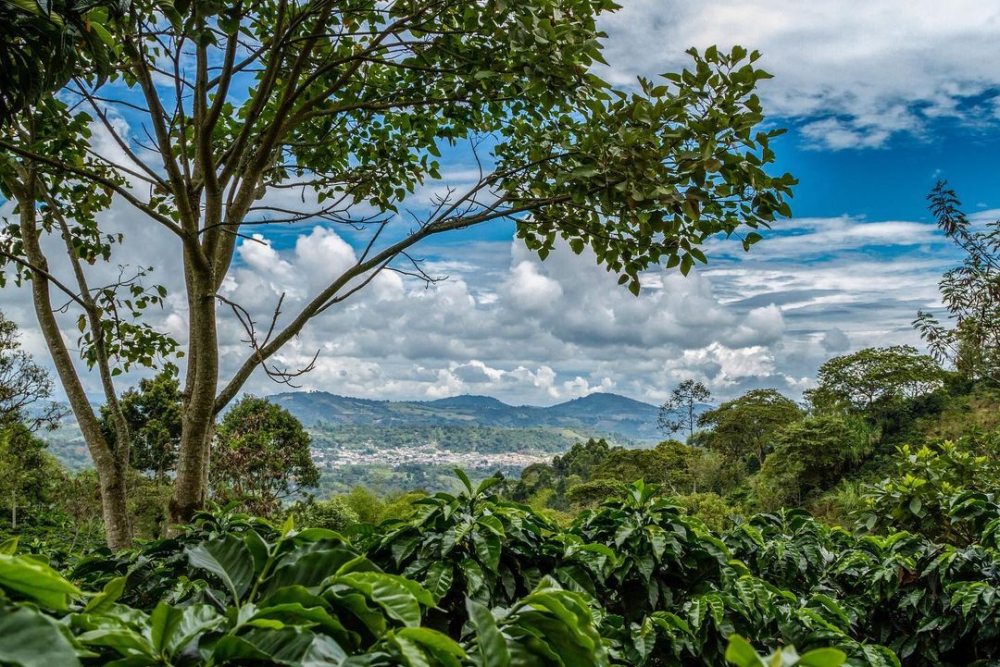
Colombia's geographical conditions can be described as extraordinarily favorable. It simultaneously has outlets to both the Atlantic and Pacific Oceans, an advantage unmatched among South American countries, giving Colombian coffee significantly lower export transportation costs than neighboring producing countries and laying an important foundation for its coffee to reach the world market. Colombia's traditional coffee-growing regions are mainly distributed along the Eastern and Central Cordilleras, as well as in the south in Huila, Cauca, and Nariño.
Along the Central Cordillera, Colombia has formed several critically important growing areas: Medellín, Armenia, and Manizales. Among them, coffee beans from the Medellín region are plump, richly aromatic, and pleasantly acidic, and it is widely recognized as the highest-quality producing region. These three places are sometimes collectively called the MAM Coffee Golden Triangle, taken from the initials of the three cities' English names. The Eastern Cordillera area is represented by regions such as Santander. In southern Colombia, Huila, Cauca, and Nariño at the southernmost end account for only a small share of production, but thanks to special microclimates formed by altitude, terrain, and soil conditions, the coffee produced in these areas has excellent acidity and uniquely distinctive flavors, with high taste quality and superior texture, and has become highly sought after by coffee lovers around the world in recent years.
Medellín Located in northern Colombia, it has rich layers of flavor, moderately balanced acidity, prominent sweetness, and a long finish. It is suitable for deep roasting, which can release a rich aroma. Medellín beans exported by the FNC association are superior to ordinary Medellín beans in cup consistency and cleanliness, so buyers willing to pay higher prices often choose products exported by the FNC association. Coffee from the Medellín region is of excellent quality, with plump beans and a rich aroma, and is deeply favored by coffee lovers.
Santander Department Located in northern Colombia, adjacent to Magdalena on its western side, with a growing altitude of roughly 1,400 to 1,600 meters and an area of 30,537 square kilometers. Santander Department occupies an important place in Colombian coffee history yet is rarely mentioned—it is in fact the country's earliest coffee-growing province, and currently accounts for about 5% of national output. FrontStreet Coffee's cupping has found that coffee beans from this region have a strong flavor, a lasting finish, and a uniquely fresh herbal aroma.
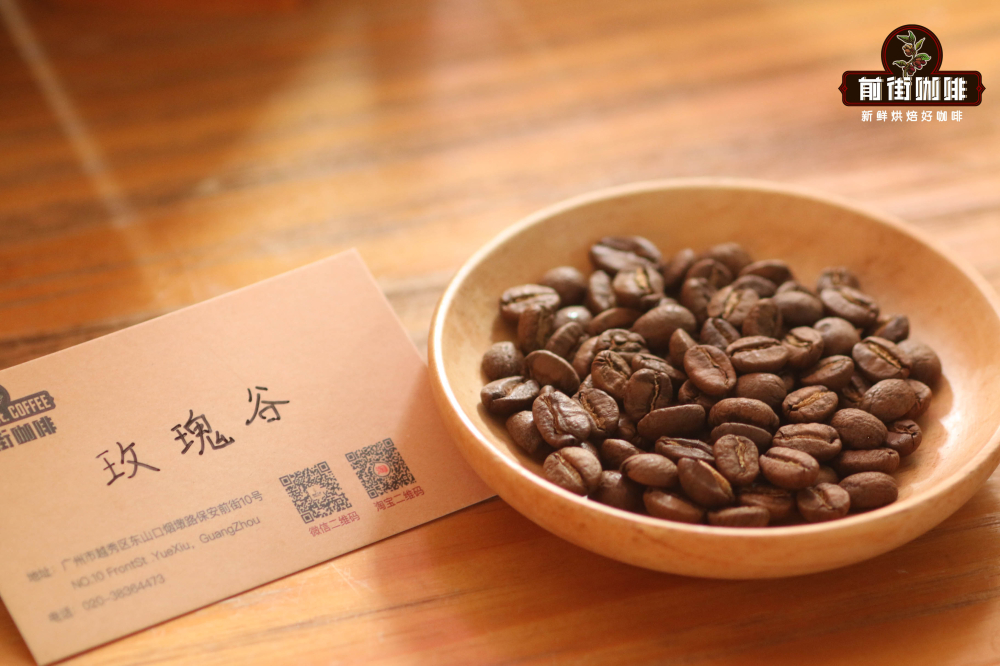
FrontStreet Coffee — Colombia Rose Valley Coffee Beans Region: Colombia, Santander Process: Anaerobic double enzyme washed Altitude: 1700m Variety: Caturra Brewing flavor: Stunning peach characteristics, accompanied by the aroma of roses and liqueur chocolate, fragrant and rich, entering the mouth like drinking peach juice. It has both the high-quality sweet acidity of black grapes and the silky mouthfeel of cream toffee.
FrontStreet Coffee Roasting Suggestions for Rose Valley Coffee Beans Yangjia 800N, bean charge 500g. Charge temperature 180°C, initial power 130, airflow 3. At 140°C, keep the power unchanged and open the airflow to 4. At this stage the beans slowly change from the original green of raw beans to yellow, the grassy smell of the raw beans gradually disappears, and the beans enter the dehydration state. 6'25" is the yellowing point, when the beans give off a sweet aroma like baking bread. At 180°C, lower the power to 100, with airflow unchanged at 4.
At 9'38", ugly wrinkles and dark spots appear on the bean surface, and the bread-baking smell clearly turns into coffee aroma, which can be defined as the prelude to first crack. At this time, listen carefully for the sound of first crack. At 10'20", first crack begins, and open the airflow to 4. After first crack, develop for 1'50 and drop at 196°C. Because this bean, Colombia Anaerobic Sun-Dried Huaye Yue, is anaerobic sun-dried, let the dehydration time extend to about 9 minutes to 9 minutes 30 seconds as much as possible, so the beans are roasted through and avoid underdeveloped conditions. After first crack, develop to 1'50 and drop at 196°C.
Huila Located in southwestern Colombia, it is one of Colombia's most important coffee-growing regions, accounting for 12% of national output. Because Huila contains many well-known coffee-producing areas, the names of various small regions have gradually evolved into brand names widely circulated in the market. FrontStreet Coffee's cupping results show that Huila coffee presents distinct flavor characteristics of nuts, chocolate, and caramel.
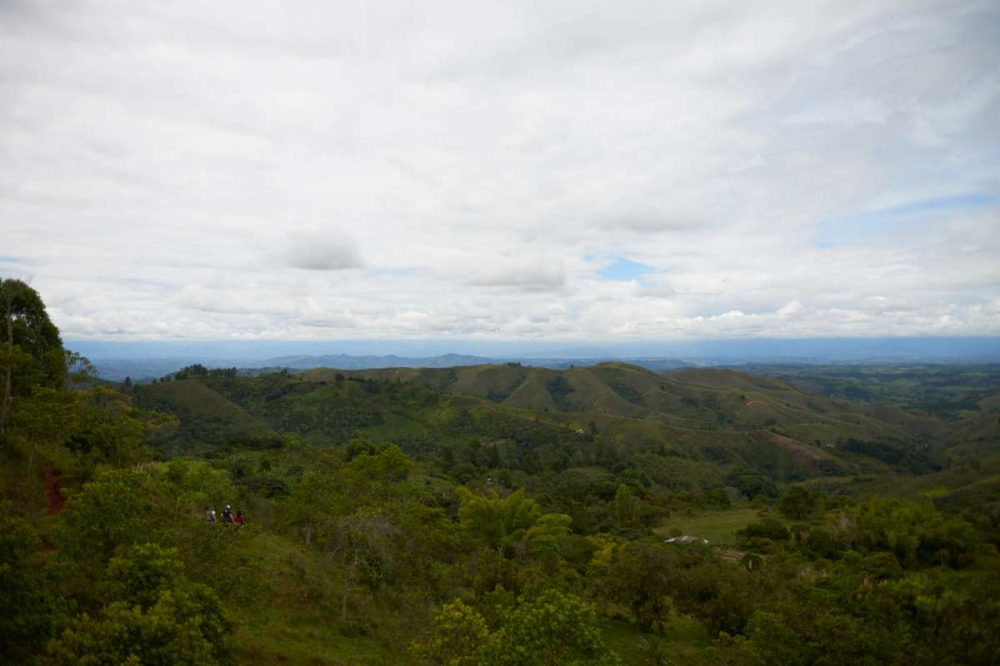
FrontStreet Coffee — Colombia Huila Coffee Beans Region: Colombia, Huila Altitude: 1500-1800 meters Variety: Caturra Process: Washed Flavor: Nuts, dark chocolate, caramel, soft fruit acidity.
FrontStreet Coffee Roasting Colombia Huila Coffee Beans Suggestions Yangjia 800N, bean charge 500g. Charge when the oven temperature reaches 185°C, set airflow to 3, power 120, turning point 1'32", 98.6°C; when the oven temperature reaches 140°C, open the airflow to 4; at this point the bean surface turns yellow, the grassy smell completely disappears, and the beans enter the dehydration stage. When the oven temperature reaches 192°C, adjust the power to 80 and open the airflow to maximum 5; at 8'30", ugly wrinkles and dark spots appear on the bean surface, and the bread-baking smell clearly turns into coffee aroma, which can be defined as the prelude to first crack. At this time, listen carefully for the sound of first crack. At 9'15", first crack begins. After first crack, develop for 3'00 and drop at 202°C.
Cauca Department Located in southwestern Colombia, it accounts for about 8% of national coffee output and is one of the regions certified for Colombian coffee origin. The average altitude of the area is 1,758 meters, reaching up to 2,100 meters, and 80% of its territory is mountainous. Cauca's most notable climatic difference from other regions is its large temperature variation—the day-night temperature difference reaches 11°C, while the average daytime temperature is 18°C. The day-night temperature difference is one of the key factors creating high-quality coffee. Low nighttime temperatures combined with higher altitude together slow the growth of the coffee, allowing the beans to absorb nutrients from the coffee fruit more fully. Front Street believes it is precisely this high-altitude growing environment that gives Cauca coffee its more outstanding acidity and admirable unique sweetness.
FrontStreet Coffee — Colombia Cherry Blossom Coffee Beans Region: Colombia, Cauca Altitude: 2050m Variety: Castillo Process: Double anaerobic washed Flavor: Berry juice-like mouthfeel, strawberry jam, mint tea tea-like sensation, lingering finish of mugwort and basil.
FrontStreet Coffee Colombia Cherry Blossom Coffee Bean Roasting Suggestions Yangjia 800N, bean charge: 480g. Charge when the oven temperature reaches 165°C, set airflow to 3, power 120; turning point 1'32"; when the oven temperature reaches 115°C, open the airflow to 4; when the oven temperature reaches 152.9°C, yellowing point 6'00", at which point the bean surface turns yellow, the grassy smell completely disappears, and the beans enter the dehydration stage.
At 8'27", ugly wrinkles and dark spots appear on the bean surface, and the bread-baking smell clearly turns into coffee aroma, which can be defined as the prelude to first crack. At this time, listen carefully for the sound of first crack. At 10'10", first crack begins, fully open the airflow, and at 178°C lower the power to 50; after first crack, develop for 1'30" and drop at 193°C.
Nariño Located at the southwesternmost end of Colombia, it accounts for only about 3% of national output. Nariño has the natural conditions for producing high-quality coffee: close to the equator, located near 1 degree north latitude, with abundant sunshine year-round; mostly above 1,600 meters in altitude, with snow-capped peaks found within its territory. Steep high mountains and long, narrow, precipitous slopes create temperature diversity. Warm, moist air rising in the valleys protects high-altitude coffee from frost damage, allowing coffee to be successfully cultivated even at 2,300 meters; volcanic soil provides ample nutrients for coffee growth. Nariño's rainfall shows a peak-shaped distribution throughout the year, with a rainy season extending from October of the current year to May of the following year, while the dry season consists of June, July, and August.
However, even in the dry months, coffee farmers need not worry excessively—the trade winds from the southern continent carry warm currents that, upon meeting the cool nights, produce water vapor, replenishing the water needed by the coffee trees. Usually, after a period of continuous dry weather, a rainfall causes the coffee trees to enter the flowering season. In Nariño, after the first rainfall in September, the coffee flowering season arrives, and correspondingly, from April of the following year the harvest season begins one after another, with the harvest period in higher-altitude regions possibly extending to August.
FrontStreet Coffee Brewing Notes Dripper: Hario V60 #01 Water temperature: 90-91°C Dose: 15 grams Coffee-to-water ratio: 1:15 Grind size: Medium-fine grind / fine granulated sugar size (80% passing through a No. 20 sieve)
Front Street recommends using freshly roasted coffee beans for brewing , so you can experience the coffee's rich flavors to the greatest extent . The coffee beans shipped by FrontStreet Coffee are all within 5 days of roasting , because Front Street knows well that the freshness of coffee beans has a great impact on flavor . Front Street's roasting philosophy is " Freshly roasted good coffee " , so that every customer who places an order receives the freshest coffee when it arrives . The resting period for coffee is about 4-7 days , so when the customer receives it, it is exactly at its best flavor .
FrontStreet Coffee uses segmented extraction, also called three-stage brewing: use 30 grams of water for a 30-second bloom, pour in a small stream in circles until 125 grams for the first stage, then when the water level drops and is about to expose the coffee bed, continue pouring until 225 grams and stop pouring. When the water level drops and is about to expose the coffee bed, remove the dripper. (Timing starts at the beginning of the bloom.) The extraction time is 2'00"-2'10".
The above content is compiled by CoffeeHunters, a coffee news website.


