







How Does Coffee From Java Differ From Sumatra and Sulawesi?
Indonesia's three main producing islands give distinctly different cups. Coffee from Java is known for delicate aroma and balanced finesse, generally from large farms using modern washed processing with the S795 variety, which locals call Jember. Sulawesi keeps an older semi-washed tradition and a fuller, layered body, while Sumatra's Mandheling is associated with bold, rich black coffee.
Where does java coffee come from matters for understanding the style: the island's growing belt splits into West, Central, and East Java, with farms mostly around 1,400 meters among mountains, hills, and volcanoes. Coffee reached the area near Jakarta from India in 1696, and the Dutch East India Company shipped the first commercial batch in 1711. Sumatra's wet-hulling gives its coffee steady wood, herb, and earth notes.
Indonesia stretches across the equator and is made up of numerous islands, among which the three major producing regions of Java, Sumatra, and Sulawesi, with their unique terroir, give rise to coffees of strikingly different styles. Java coffee once wrote a glorious chapter in the history of the coffee trade, and today it is known for its delicate aroma and balanced finesse; Sulawesi preserves an ancient semi-washed tradition, with a full-bodied and layered flavor; and the Mandheling produced in Sumatra is practically synonymous with rich, bold black coffee, its signature wet-hulling process giving the coffee a steady aroma of wood, herbs, and earth. This article will go through the varieties, processing methods, and flavor characteristics of these three major producing regions one by one, and share Front Street Coffee's roasting approach for Mandheling, so you can gain a comprehensive understanding of the diverse face of Indonesian specialty coffee.
Among the many coffee-producing countries in Asia, Indonesia is undoubtedly a presence that cannot be ignored. This archipelago nation scattered across the Indian Ocean spans both sides of the equator, and among its islands, Java, Sumatra, and Sulawesi are renowned throughout the global coffee scene for producing coffees with a typical and pure flavor. In this article, Front Street Coffee will talk with you about these important Indonesian producing regions.
Java
Java is the fifth-largest island in Indonesia and occupies an extremely key position in the history of coffee development. What is usually called "Java coffee" refers to the Arabica beans produced on this island. Unlike most other Indonesian producing regions, which use smallholder workshop-style primary processing, Java coffee often comes from large farms or plantations, most of them managed by official institutions, and generally uses modern washed processing techniques. The dominant variety is S795, which locals call Jember, a cultivated variety.
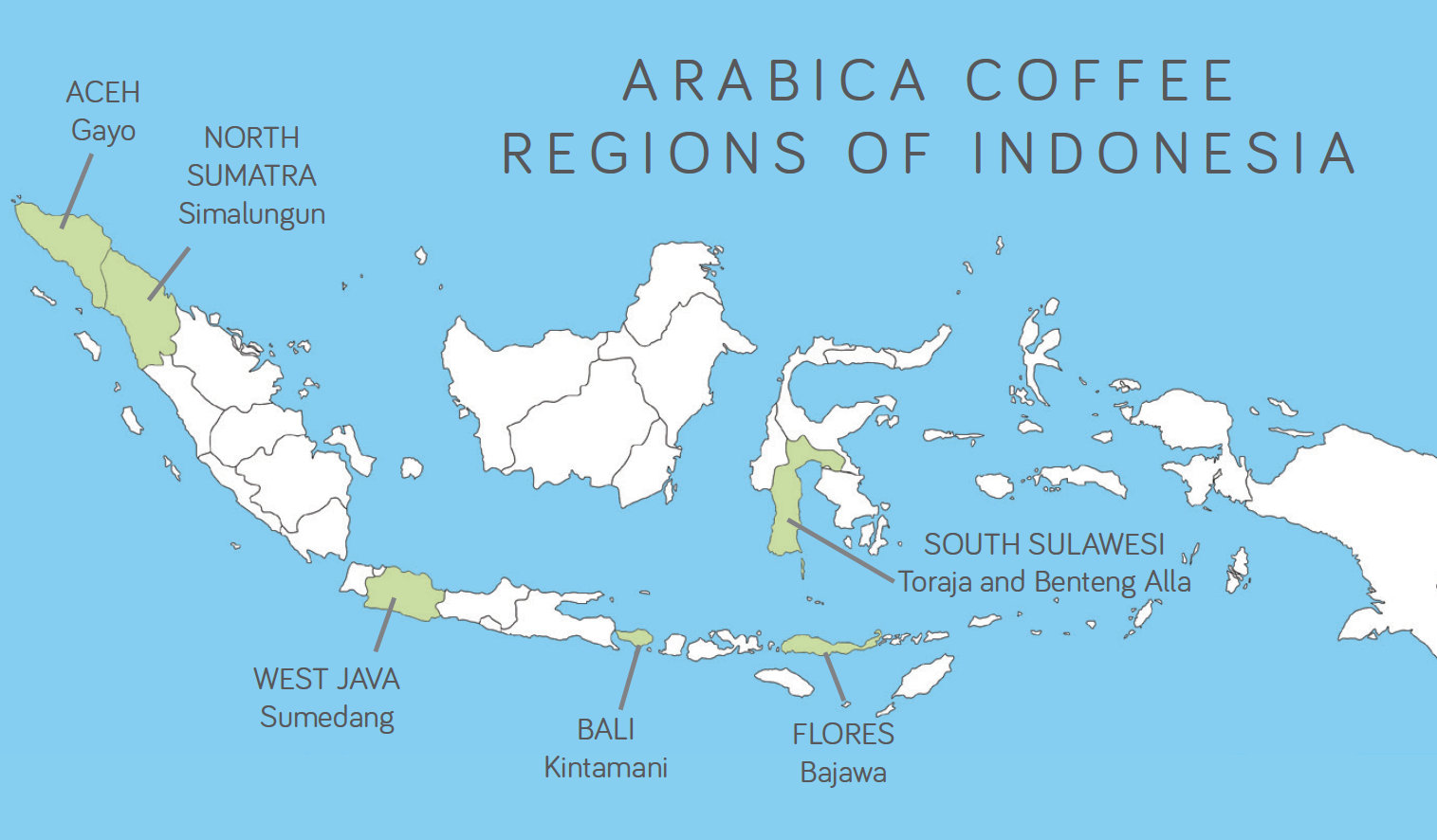
The coffee-growing belt of Java can be divided into three regions: West Java, East Java, and Central Java. The island's terrain includes mountains, hills, and volcanoes, and coffee farms are mostly distributed at elevations of about 1,400 meters. As early as 1696, coffee was introduced from India to the area around Jakarta in western Java; in 1711, the Dutch East India Company shipped the first batch of coffee from Java to Europe, and this trade continued into the 20th century. Today, Java's former glory has gradually faded, and Sumatra and Sulawesi are the current mainstays of Indonesian coffee. Coffee produced in Java is known for its delicate aroma, relatively low acidity, and a smooth, well-balanced cup. The most famous local plantations include Blawan, Jambit, Kayumas, and Pankur, among others.
Sulawesi
Sulawesi, formerly called Celebes, is one of the geologically oldest islands in the archipelago, with exposed rocks dating back more than a million years. In the coffee-growing areas, yellow-red podzolic soils can be seen, and beneath the surface of these soils there are often multiple layers of clay rich in iron. The island's best-known producing region is Toraja, in the highlands of South Sulawesi.
Kalosi, south of Toraja, is the main city in this area. There are a small number of washed beans with a distinctive style, quite interesting to explore and worth trying. The more common processing method on Sulawesi is semi-washed, and the island also produces quite a few Robusta beans. People often use "Sulawesi coffee" to refer to the signature flavor of this producing region—full-bodied, layered, with low but lively acidity.
Sumatra
If you prefer rich, full-bodied black coffee, you have probably heard of Indonesian Mandheling, also called "Sumatra coffee," whose beans come from the island of Sumatra. The island is divided into eight provinces in total, but only the high-altitude provinces of Aceh and North Sumatra grow Arabica on a large scale. Sumatra lies in a tropical rainforest climate zone, with mist and clouds shrouding the forests and mountains year-round, adding a touch of mystery to this island.
Sumatra is one of the earliest regions in the world to carry out large-scale coffee cultivation, and the vast majority of its coffee comes from Aceh province in the north and North Sumatra province (abbreviated as North Sumatra) south of Aceh. The two main producing areas are distributed around the area's famous volcanic lakes, namely around Lake Toba and Lake Tawar, traditionally known as the Lintong producing region and the Aceh producing region respectively. Volcanoes have given Sumatra fertile soil, and the coffee produced here usually carries aromas of spices, nuts, chocolate, and vegetation, and is deeply favored by many coffee lovers.
It is said that during World War II, when Japan occupied Indonesia, a Japanese soldier drank an extremely aromatic cup of coffee in a certain café and asked the owner what kind of coffee it was. The owner mistakenly thought he was asking "Where are you from," and so answered "Mandailing." After the war, the soldier recalled the "Mandheling" he had drunk in Indonesia and asked someone to ship 15 tons from there to Japan, where it turned out to be hugely popular, and the name Mandheling spread from that point on.
Sumatra, located on the equator, has a typical tropical rainforest climate, rainy and humid all year round, with frequent typhoons and relatively scarce freshwater resources. At the time, coffee farmers had limited economic means and could not use the traditional washed method to process large quantities of coffee beans, so in order to sell the beans as quickly as possible, they worked out the wet-hulling method, which takes only four days. Wet hulling means that while the parchment layer wrapping the green beans is not yet completely dry, it is "forcibly" hulled away, allowing the green beans to complete their final drying in an "exposed" state.
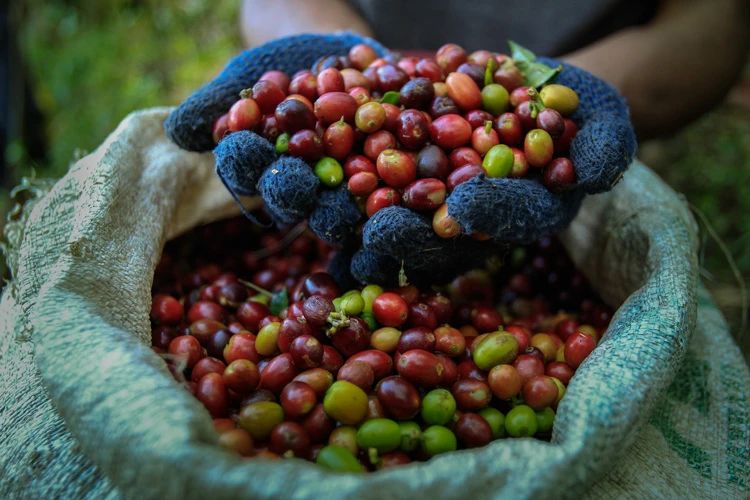
After harvesting, the coffee cherries are first pulped with a depulper, then poured into a water tank for a short fermentation of several hours. At this point a small amount of mucilage still remains on the parchment, which needs to be removed by scrubbing. Next, the parchment beans are spread out to dry, and when the green beans first dry to a moisture content of 30%–40%, the coffee farmers sell the beans to a collector.
After buying these semi-dry parchment beans, the collector uses a special machine to hull them directly with greater friction, removing the mucilage and parchment to obtain the green beans. After that, drying continues, a process that takes 2 to 4 days, with the moisture content finally dropping to 12%–13%. Although the time required for each step is greatly shortened, the "naked beans" still absorb moisture from the hot, humid air, so the resulting Mandheling coffee has a bit more of a "muted aroma" interwoven with wood, herbs, and earth. Several of the Mandheling coffees Front Street Coffee has sourced are precisely produced by the wet-hulling method, and in order to present their typical rich mouthfeel, Front Street Coffee uses a medium-dark roast.
Professional coffee knowledge exchange For more coffee bean information, please follow Coffee Workshop (WeChat public account cafe_style)
For more specialty coffee beans, please add the private WeChat of Front Street Coffee (FrontStreet Coffee), WeChat ID: qjcoffeex
The above content is compiled by CoffeeHunters, a coffee news website.


