







What is kopi luwak coffee and what drives its price?
Kopi Luwak is coffee made from beans that a civet swallows as whole coffee cherries and later excretes; collectors gather the droppings and sift out the undigested beans. Prices range widely: about US$1,200 per kilogram in the American market, £50 a cup in London, and 396 RMB a cup at the 2010 Shanghai World Expo, while Taobao sells 100 grams for roughly 200 RMB.
The gap comes down to origin and how the civet lived. Wild beans command more, and Indonesian luwak coffee costs more than Vietnamese, which costs more than Yunnan. Cheaper lots come from captive-bred civets. By definition there is no counterfeit luwak bean, since it is simply coffee excreted by a civet; wild beans are generally considered to carry the purest flavor.
Kopi Luwak is hailed as one of the most expensive coffees in the world, once selling for US$1,200 per kilogram in the American market, at £50 a cup in London, and during the 2010 Shanghai World Expo it was even priced at a staggering 396 RMB per cup. Yet on Taobao, 100 grams of Kopi Luwak coffee beans sell for only around 200 RMB. This stark price gap leaves many coffee lovers puzzled. What is the real market price of Kopi Luwak? Are the products on Taobao trustworthy? This article will take an in-depth look at the price structure of Kopi Luwak, from the differences between wild and farmed civets and the unique digestive mechanism of the civet, to how prices vary by region of origin, revealing the truth behind this cup of the "royalty of coffee."
Among visitors to Bali, there is virtually no one who has not heard of Kopi Luwak. It can rightly be called the most expensive coffee variety in the world today!
Exported to the American market, it sells for as much as US$1,200 per kilogram; in London, a single cup costs £50; during the 2010 Shanghai World Expo, a cup of Kopi Luwak was priced at 396 RMB. Yet on the Taobao platform, 100 grams of Kopi Luwak coffee beans cost only about 200 RMB. This inevitably raises doubts: what is the actual price of Kopi Luwak? Are the Kopi Luwak coffee beans sold on Taobao reliable?
In fact, there is no such thing as counterfeit Kopi Luwak beans, because by its very nature it is simply the coffee beans excreted by a civet after it has swallowed coffee cherries. The higher-priced product is wild Kopi Luwak, but the price also depends on the region of origin; for example, Indonesian Kopi Luwak is more expensive than Vietnamese, and Vietnamese is more expensive than Yunnan. The relatively cheap Kopi Luwak comes from captive-bred civets. In theory, all of these are genuine Kopi Luwak—it is just that wild Kopi Luwak is generally considered to have the purest flavor.
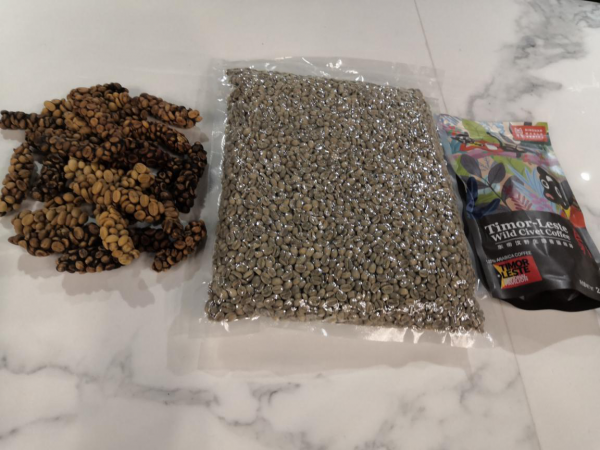
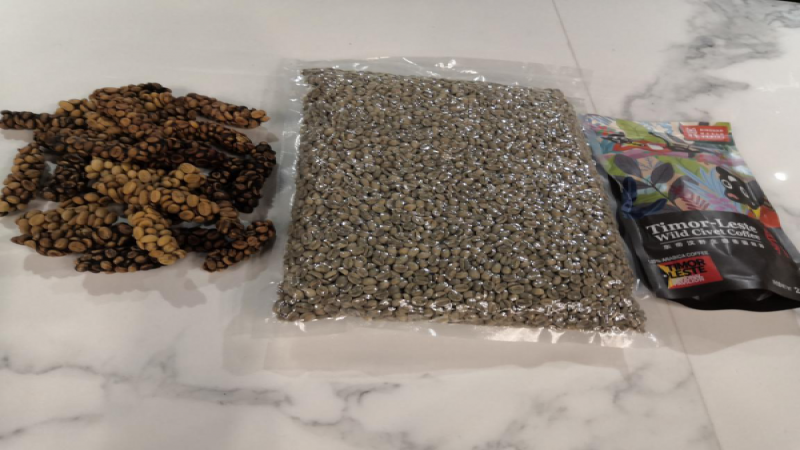
The method of obtaining wild Kopi Luwak beans is quite unusual: dedicated collectors gather civet droppings, and from the strongly odorous excrement—though locals in Indonesia do not consider it smelly—they sift out the undigested coffee beans.
This animal is not an ordinary house cat but the civet, which actually belongs to the viverrid family. Its head and face are patterned in alternating black and white, its body is gray-black, and its size and tail resemble those of a cat. Some Chinese people, upon seeing it, mistake it for a masked palm civet. The civet is usually nocturnal. Therefore, at first light each day, workers must go into the mountains to collect the droppings, because if they wait until noon, the coffee beans are prone to over-fermentation and spoilage. So the Kopi Luwak beans must be collected before dawn, then washed and dried.
The civet's digestive tract contains a unique digestive fluid rich in large amounts of lactic acid bacteria. Under the action of these lactic acid bacteria, together with suitable temperature and environment, the coffee beans begin to ferment; the proteins in the beans are broken down into tiny particles—these particles are small-molecule enzymes. When the coffee beans subsequently enter the roasting stage, the small-molecule enzymes react chemically with the carbohydrates or sugars in the beans, ultimately not only eliminating the coffee's bitterness but also producing a peculiar, rich aroma.
The civet's stomach and intestines are like a magical processing plant, and countless experiments have confirmed that no processing technique in the world can match it. Precisely because of this, once coffee beans pass through the civet's digestive tract and are excreted with the droppings, they are elevated to the aristocracy of coffee, with extraordinary value!
The reason wild Kopi Luwak commands such a high price, aside from its unforgettable, unique aroma, lies most crucially in its extremely limited output and unstable supply. According to the pricing logic that "things are precious when they are rare," wild Kopi Luwak is naturally easy to speculate up to astronomical prices.
By contrast, Kopi Luwak produced under captive farming has a relatively stable supply, but because the food sources of captive civets are greatly reduced, their digestive systems function in a narrower way, and the resulting Kopi Luwak has a relatively inferior flavor—hence its more affordable price.
For professional coffee knowledge exchange and more coffee bean information, please follow Coffee Workshop (WeChat public account: cafe_style). For more specialty coffee beans, please add the private WeChat of Front Street Coffee (FrontStreet Coffee), WeChat ID: qjcoffeex
The above content is compiled by CoffeeHunters, a coffee news website.


