








How to make coffee with a coffee machine for a balanced latte?
A good latte rests on three things: the choice of coffee beans and milk, the ratio of coffee to milk, and the extraction and fusion steps. Beans steer the flavor direction, milk texture shapes the mouthfeel, and a skewed ratio either buries the coffee under milk or lets bitterness dominate. Poor fusion gives uneven sips.
Most espresso blends bring nutty, chocolatey notes to an iced latte with a heavier coffee taste. One example combines Costa Rica Tarrazu and Ethiopia coffee with Colombian Huila beans that carry a chocolatey sweet aroma, giving good crema and a dense texture with strawberry gummy-like acidity. For milk, full-fat fresh milk varies widely, and heavy milky flavor can mask the coffee.
To make an excellent latte, the key lies in three aspects: the selection of coffee beans and milk, the ratio of coffee to milk, and the specific operations of extraction and fusion. Different coffee beans directly affect the flavor direction of the latte, and the texture of the milk also influences the final taste. If the ratio is off, too much milk means no coffee flavor, while too little milk makes the bitterness prominent. And if the fusion step is not handled well, you'll get one sip that's milky and the next that's strongly coffee. Starting from Front Street's practical experience, this article breaks down material selection, milk-coffee ratio, and fusion techniques one by one, helping coffee lovers consistently produce a delicious latte at home.

Front Street has always believed that a satisfying latte is rooted in the quality of the coffee beans and milk themselves, plus the ratio of coffee to milk and the operational details during extraction and fusion.
Point one: Choose suitable materials
The method for making a latte doesn't seem complicated—it can be found on the menu of almost every coffee bean brand—yet lattes from different shops taste quite different. One core factor causing this difference is that the milk and coffee beans they choose are not the same.
The flavor of coffee beans can directly steer the taste direction of a latte. Most espresso blends give iced lattes a distinct nutty, chocolatey character, with a heavier coffee taste. Some coffee beans can also make the milk's sweetness and richness in an iced latte more prominent.
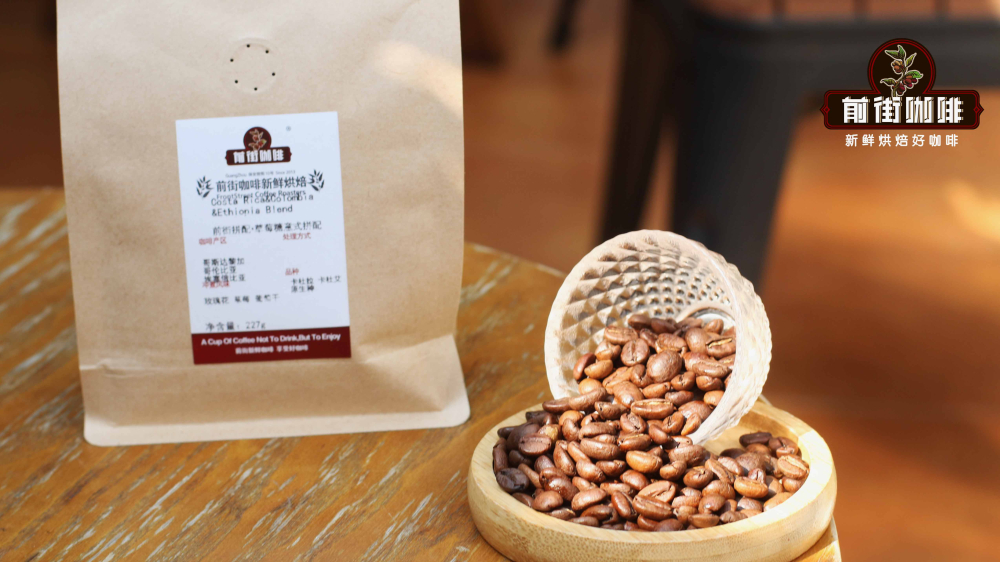
Based on coffee from two major producing regions, Costa Rica Tarrazu and Ethiopia, Front Street. Strawberry Candy Espresso Blend adds Colombian Huila coffee beans with a chocolatey, sweet aroma. The espresso made this way is not harsh; after extraction by the coffee machine, it shows good crema and a dense texture, while also carrying a strawberry gummy-like sweet-tartness.
Milk selection should not be overlooked either. For full-fat fresh milk alone, there are more than a dozen common types on the market. Some have a stronger milky taste and a thick mouthfeel, while others are as light as water. When choosing milk, one should not blindly pursue richness and a pronounced milky flavor, but rather find the one that pairs harmoniously with the coffee. Too heavy a milky taste will mask some of the coffee's own flavors, while milk that is too watery will make the latte as a whole taste bland.
Point two: A reasonable milk-coffee ratio
Once the ratio of coffee to milk is unbalanced, it is hard to achieve the ideal taste. Add too much milk, and the coffee flavor will be drowned out; add too little milk, and the bitterness will emerge. So when making a latte, it is essential to master the ratio between coffee and milk.
Front Street's view is that a latte does not have a fixed, unchanging ratio; it needs to be adjusted according to the flavor performance of the espresso and how well it matches the milk. However, the approximate range can be referenced as between 1:5 and 1:8.

Front Street's current best-selling Front Street Classic Blend is a tribute to the once-popular "Mamba Coffee." This bean combines Indonesian Mandheling beans with Brazilian espresso beans, retaining both the wild aroma of Mandheling and the smooth mouthfeel of Brazilian beans, complementing and balancing each other in flavor. Front Street Classic Espresso Blend builds on the Mamba recipe by adding Robusta, significantly enhancing the coffee's crema and making the espresso's body more substantial. It is suitable for home brewing and can also be used for latte art.
This coffee bean has an old-school espresso taste, and when paired with milk in the right ratio, it yields a dense milk chocolate flavor. When Front Street uses this bean to make a latte, the coffee-to-milk ratio is set at 1:6, meaning 40 grams of espresso liquid with 240 milliliters of steamed milk.
Point three: Specific operations
Extracting a qualified espresso and producing fine, dense milk foam are fundamental to making a good latte. Front Street's recommended espresso extraction parameters are: 20 grams of coffee grounds to extract 40 grams of coffee liquid, with the time controlled between 25 and 30 seconds. For milk steaming, steam milk at a 5-point fullness to 6-point fullness, and the temperature is recommended to be kept between 55 and 60 degrees Celsius.
Next is the fusion step. Only when the milk and espresso are fully fused can the coffee's flavor remain consistent. If the fusion is uneven, you may get one sip that is too milky and the next that is too strongly coffee-flavored.
Good fusion first shows as an even mix of the surface crema and the milk foam, reflected in the consistency of the liquid surface color—what is commonly called the "golden ring." Second, the coffee surface should be fine and smooth, with no large bubbles.
Fusion techniques
① First, the "hardware" must be up to standard. That is, the quality of the espresso and milk foam must be good enough: the espresso should have rich, viscous crema, and the milk foam should be fine and highly fluid. Many times, poor fusion is because the milk foam was steamed too thick, reducing its fluidity so the foam floats on the surface. Before fusion, swirling the coffee cup and milk pitcher a bit to increase the fluidity of the liquid inside also helps improve the success rate of fusion.
② During fusion, the height of the pitcher spout also matters. When pouring latte art, you need to lower the spout close to the coffee surface so that white milk foam appears. The principle for fusion is similar: too low a spout will let a large amount of milk foam float on the surface, causing uneven fusion; too high will cause the problem mentioned earlier, with bubbles appearing on the surface.
Usually, the distance between the pitcher spout and the coffee surface is kept at about 5 to 10 centimeters. Everyone's habits differ, so there is no completely fixed standard for height and distance.

③ As for the fusion technique, a common method is stirring in one direction. Hold the coffee cup in your left hand and the milk pitcher in your right, and move the two hands half a circle apart in opposite circular motions; the alternating high-and-low stirring force easily allows the coffee and milk to mix fully. As for the size of the circles, Front Street suggests making them as large as possible without hitting the wall. The hand holding the coffee cup should slowly straighten the cup.
The above content is compiled by CoffeeHunters, a coffee news website.


