







What Coffee-to-Water Ratio Makes a Delicious Coffee Pour-Over?
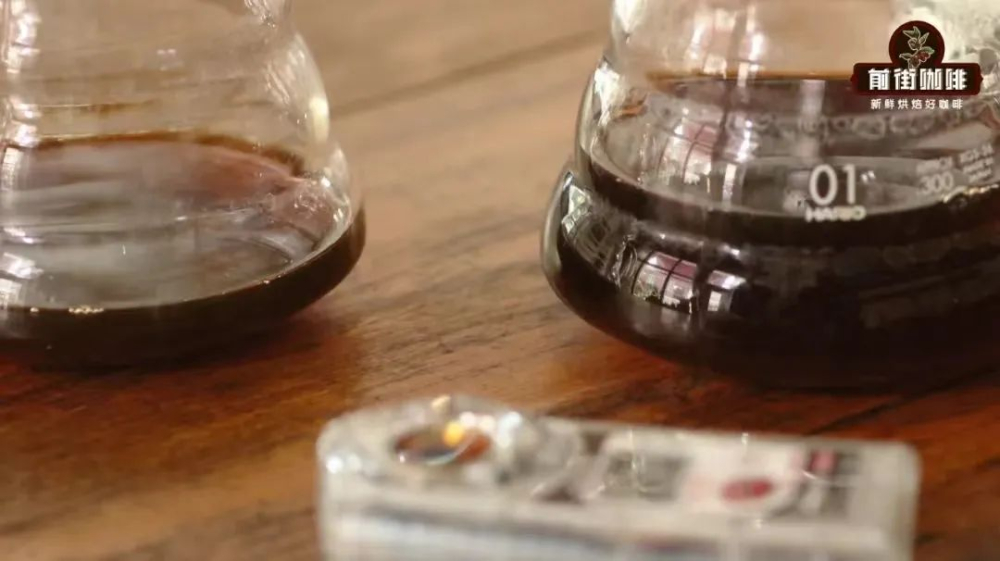
The Golden Cup extraction chart marks an ideal zone of 18 to 22 percent extraction yield and 1.15 to 1.45 percent concentration, reached with ratios from about 1:14 to 1:20, with 1:17 easiest to hit. In practice most pour-over brewers use tighter ratios than that, which is why the chart often seems to disagree with real recipes.
The chart came from experiments run by Dr. Lockhart's team between 1952 and 1975, when large drip brewers held the water at one liter and the dose was adjusted instead. Extraction depends on far more than ratio: grind size, water temperature, pour pattern and contact time all shift the result. Light and dark roasts therefore call for different ranges to reach a delicious coffee.
The coffee-to-water ratio for pour-over coffee has always been a hot topic among enthusiasts. Faced with the classic Golden Cup extraction chart, many people wonder: why is the recommended 1:17 not commonly seen in actual brewing? Can a 5ml difference in water volume really be tasted? And what ratios should be used for light-roast and dark-roast coffee beans respectively? This article will take you through a fresh understanding of the origins of the Golden Cup extraction chart, analyze the impact of subtle differences in water volume on flavor, and, combined with Front Street's brewing experience, provide practical ratio ranges for light-roast and dark-roast coffee, helping you find the cup of good coffee that truly suits you.
Finding the golden ratio from the Golden Cup extraction chart?
When it comes to pour-over coffee ratios, everyone will definitely think of that classic "Golden Cup Extraction" chart. In the center of the chart there is an ideal zone—extraction yield 18-22%, concentration 1.15-1.45%; coffee falling within this range performs better in flavor. And those diagonal lines on the chart represent precisely the coffee-to-water ratio.
From the chart, it can be seen that the ratios capable of falling into this ideal zone are roughly between 1:14 and 1:20, with 1:17 being the easiest to hit. If recommendations were based purely on this chart, then the answer would seem to be 1:17. But among the ratios commonly used in pour-over coffee today, 1:17 is instead not very common. Many enthusiasts look at this chart and see that it does not match the ratios commonly used in reality, which has given rise to quite a few questions.
The reason is that we are familiar with this chart, yet rarely understand its origins. This Golden Cup extraction chart was derived by Dr. Lockhart's team between 1952 and 1975 through a large number of "crude experiments." In that era, pour-over coffee was not popular in the United States. If you look carefully at the way the coffee-to-water ratio changes in the chart, you will find that it adjusts the ratio by changing the coffee dose, while the water amount always remains at 1L. Therefore, the equipment used in the experiments at that time was very likely a large-capacity drip brewing device popular at the time.
Moreover, the factors affecting extraction yield and concentration are far more than just the ratio; parameters such as grind size and time also play a role. The grind size in the experiments at that time was about the size of coarse granulated sugar, the water temperature was about 96°C, and the extraction time was between 4 and 8 minutes. These parameters differ considerably from the actual practice of pour-over brewing.
The division of the Golden Cup zone was based on feedback from nearly ten thousand members of the public who tasted it on the street, and was later revised by professional research institutions. In addition, the coffee quality at that time was vastly different from today's. The significance of this chart being passed down to this day lies more in helping everyone understand the relationship between ratio, extraction yield, and concentration. The Golden Cup zone in the chart can simply be taken as a reference.
If you pour 5ml more or less water when brewing coffee, is there a difference?
Many friends are also curious: with 15g of coffee, pouring 220, 225, or 230ml of water—just how big is the difference? This involves the question of a threshold. For example, 1:15 is a standard ratio, and when brewing coffee it is impossible to pour precisely to 225ml every time; ±2ml is only human nature.
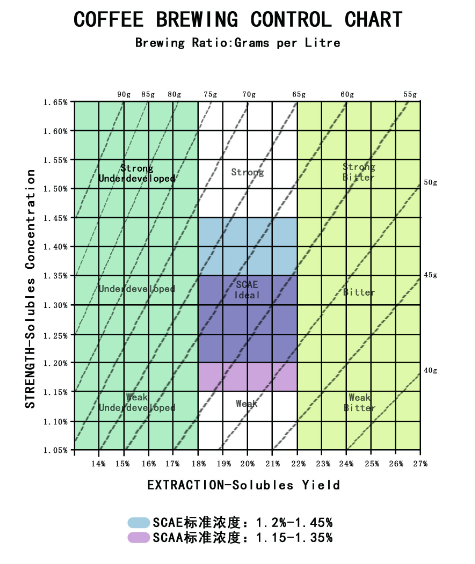
But once the difference reaches 5ml, we can taste the difference. Front Street also once brewed these three water amounts simultaneously in-store and had customers taste them. There were 5 customers in total, and all of them could accurately distinguish the order of the water amounts of the three cups. Among them, 4 customers said all three cups were acceptable, while 1 customer felt that 220ml was too strong and the latter two were acceptable.
Of course, this experiment was informal, with a small sample size and a lack of rigor. But it at least shows that under a 1:15 ratio, a 5ml difference in water volume can be distinguished by people. Although the taste changes, it still remains within an acceptable range.
Is there a golden ratio for pour-over coffee?
Actually, the brewing ratio for coffee is not that strict. It is not that 1:15 brews something delicious while 1:16 is necessarily undrinkable. When brewing coffee, you must find a brewing ratio with a relatively large threshold. For example, when brewing light-roast coffee beans and highlighting flavor, Front Street recommends setting the threshold at 1:15-1:16. Although the coffee brewed at these two ratios differs noticeably—1:15 is richer and fuller, while 1:16 has richer flavor layers—it is easy to brew delicious coffee within this range.
For brewing dark-roast coffee, Front Street recommends using a ratio of 1:13-1:15. For example, some regular customers at Front Street like strong coffee, so Front Street will brew at a ratio of 1:13. The high-concentration coffee liquid can make bitterness converge rather than spread, and the higher concentration also adds a bit of fullness to the mouthfeel.
If other parameters are paired appropriately, ratios such as 1:17 and 1:20 are not necessarily undrinkable. Front Street once tasted a light-roast coffee with a ratio of 1:20; it gave off waves of light floral fragrance, had very low acidity when drunk, and the berry sweetness was very full, and it did not feel at all that the coffee was very weak or thin in mouthfeel.
The ratio is one link integrated into the parameters. For example, grind size affects the threshold of the ratio. When the coffee grounds are ground relatively fine, water more easily extracts flavor substances, and it also affects the flow rate. Then it may happen that brewing at 1:15 performs very well, but brewing at 1:16 produces unpleasant flavors. If the grind size is adjusted slightly coarser, both 1:15 and 1:16 perform excellently. Therefore, when discussing the ideal coffee-to-water ratio, it cannot be discussed independently in isolation; it must be paired with other parameters to find the truly ideal ratio.
The above content is compiled by CoffeeHunters, a coffee news website.


