







What Grade Is Jamaican Blue Mountain Coffee?
Genuine Blue Mountain coffee must meet the Jamaica Coffee Industry Board's standards, and only certified lots may carry the name. Blue Mountain No. 1 designates the largest screen size in the grading system, so it is not a separate quality tier above the rest. The coffee ranks among the most expensive coffee sold, and its price reflects limited certified supply and steady demand.
The article examines the growing environment of the Blue Mountain range in eastern Jamaica, where sunlight striking the Caribbean Sea and refracting off the peaks gives the mountains their blue appearance and their name. It also reviews the variety's characteristics, processing methods and practical brewing parameters, and explains why so many products borrow the Blue Mountain label without meeting certification.
Blue Mountain coffee enjoys a stellar reputation in the specialty coffee world. Although Geisha has been more prominent in recent years, Blue Mountain's rich and balanced taste is still regarded by many enthusiasts as a classic. There are no shortage of products on the market under the Blue Mountain banner, but genuine Blue Mountain that truly meets the Jamaica Coffee Industry Board's standards is rare. Just what tier does Blue Mountain coffee occupy? Does Blue Mountain No. 1 represent the highest quality? And what makes its price stay so high? This article, from Front Street's perspective, will provide a detailed interpretation of Blue Mountain coffee's origin and terroir, grading system, variety characteristics, and processing methods, while also sharing practical brewing parameters to help everyone gain a more comprehensive understanding of this coffee hailed as the cream of the crop.
Blue Mountain coffee is truly famous in coffee circles. Although Geisha's reputation seems to have overshadowed it in recent years, this in no way prevents Blue Mountain from holding its place as a classic thanks to its incredibly rich and smooth taste. All kinds of coffees bearing the Blue Mountain name can often be seen on the market, yet they are not necessarily the real deal. It is precisely because Blue Mountain coffee commands a high price and delivers outstanding flavor that so many products borrowing its name have emerged.
So, what tier is genuine Blue Mountain coffee really in? And what exactly is Jamaica Blue Mountain No. 1? Perhaps everyone is familiar with Blue Mountain coffee beans, but not necessarily deeply knowledgeable about genuine Blue Mountain coffee. Today, Front Street will provide a detailed introduction to this cream of the crop — Blue Mountain coffee.
The Growing Environment of Jamaica Blue Mountain Specialty Coffee
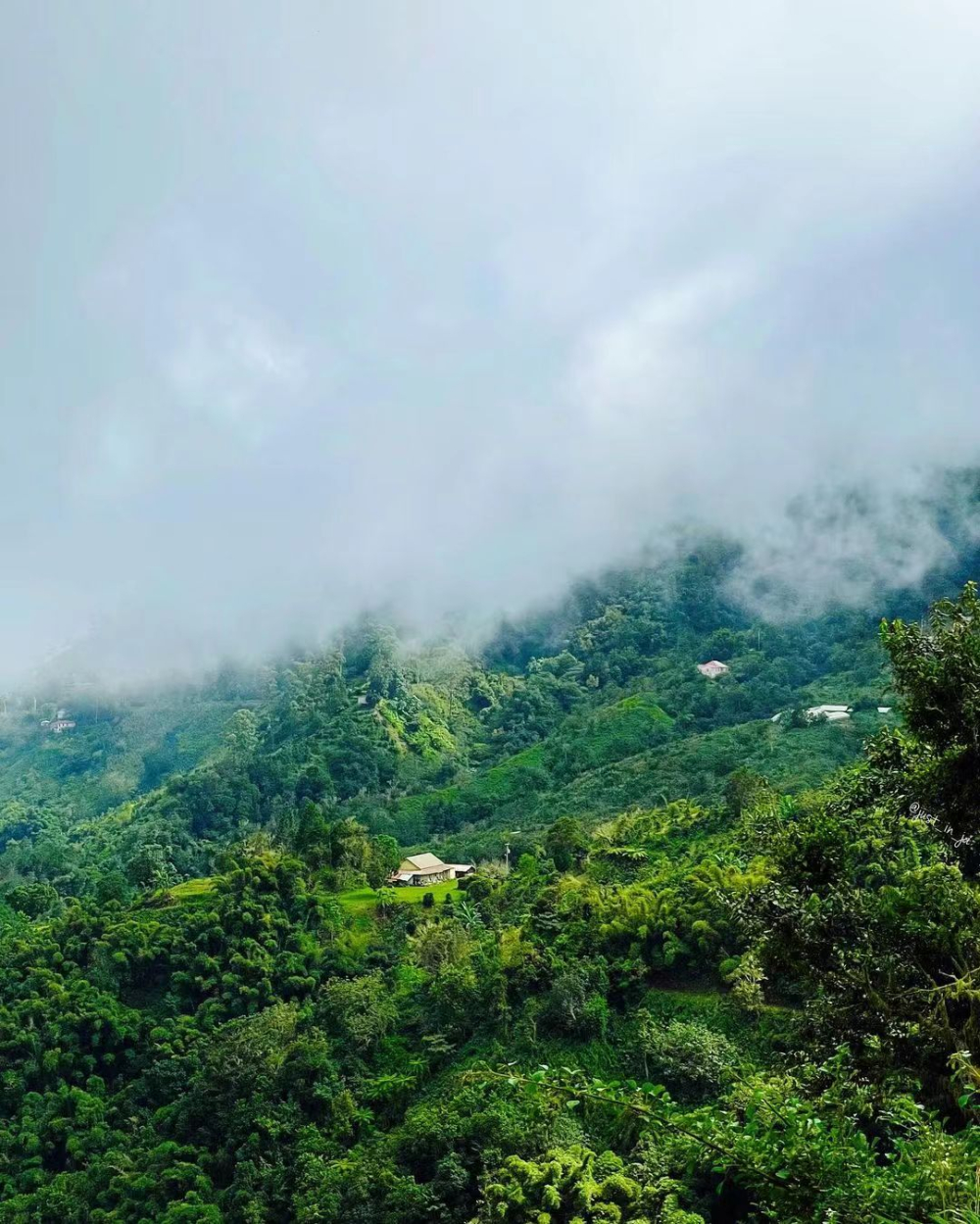
Blue Mountain coffee is one of the most expensive coffees in the world and is also recognized as the world's most exceptional coffee. Front Street has mentioned many times that coffee flavor is closely tied to the local climate and environment — for example, Geisha transformed into a top-tier coffee under Panama's special terroir. The Blue Mountain range is located in eastern Jamaica, surrounded by the Caribbean Sea. On clear days, sunlight strikes the azure sea surface directly, and the peaks refract a brilliant blue glow — hence the name Blue Mountain. The main peak of Blue Mountain stands at 2,256 meters, the highest point in the Caribbean region and a famous tourist destination. This area sits on a seismic belt, with fertile volcanic soil, fresh and pollution-free air, and a humid climate with year-round fog and rain. Average annual rainfall is about 1,980 millimeters, and temperatures remain around 27 degrees. Front Street believes it is precisely these unique natural conditions that nurture the world-renowned Jamaica Blue Mountain coffee and create its high price tag.
Grading of Blue Mountain Coffee Beans
As Front Street just mentioned, many products labeled as Blue Mountain coffee on the market are not necessarily genuine Jamaica Blue Mountain coffee. Blue Mountain coffee has its own grading system — let's see which level the coffee we usually drink falls into.
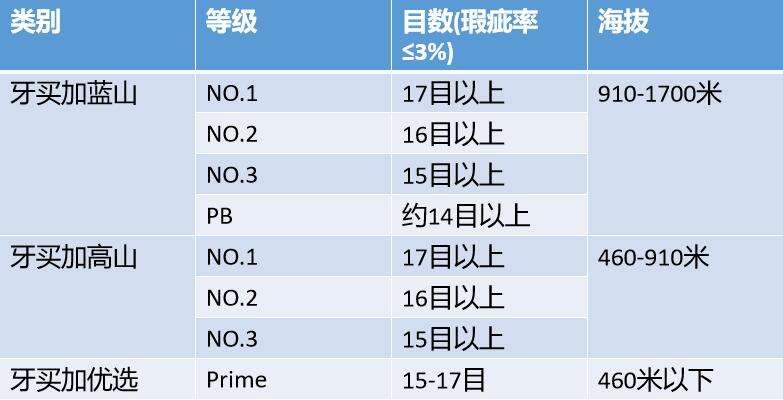
Jamaica Blue Mountain Coffee — both Blue Mountain coffee and High Mountain coffee are each divided into four grades. From highest to lowest quality: NO.1, NO.2, NO.3, and PB, where PB refers to peaberry. According to CIB standards, only coffee grown above 666 meters in elevation can be called Jamaica Blue Mountain coffee.
Jamaica High Mountain Supreme Coffee Bean — coffee produced in the Jamaica Blue Mountain region below 666 meters in elevation is called High Mountain coffee, second only to Blue Mountain coffee in quality.
Jamaica Prime Coffee Beans — coffee grown outside the Blue Mountain range is collectively called Jamaica coffee. In the past, Chinese coffee professionals generally held a misconception that only coffee produced in the Blue Mountain region above 1,800 meters in elevation could be called Blue Mountain coffee. In fact, there is only one estate in the crown zone above 1,800 meters in the Blue Mountain range, called Amber. The estate owner is of Chinese descent, surnamed Lin, with ancestral roots in Guangdong. The estate covers only 30 hectares, and its output is extremely limited. Blue Mountain coffee is mainly distributed across five mountain areas of the Blue Mountain range: John Crow, St. John's Peak, Mossman's Peak, High Peak, and Blue Mountain Peak.
It is precisely thanks to these exceptional growing conditions that Blue Mountain coffee develops its unique flavor and ranks among the finest coffees. All 100% pure Blue Mountain coffee worldwide refers to coffee produced in specific areas of the Blue Mountain range in eastern Jamaica. Every step of its cultivation and processing must pass the rigorous quality control standards of the Jamaica Coffee Industry Board before it can be certified as pure Jamaica Blue Mountain coffee.
In addition, Blue Mountain's terrain is extremely rugged, making harvesting quite difficult, and nearly all pickers are women. The coffee trees all grow on steep slopes, and the picking process is exceptionally arduous — only skilled local female workers can handle it. During picking, only perfectly ripe cherries must be selected; underripe or overripe ones will affect coffee quality.
The best Blue Mountain coffee beans are NO.1 peaberry — that is, Jamaica Blue Mountain No. 1 coffee, also known as pearl beans. These are small round beans carefully selected from products grown at 2,100 meters in elevation, truly the cream of the crop. Therefore, Jamaica Blue Mountain No. 1 coffee commands the highest price among all Blue Mountain coffees.
The Variety of Blue Mountain Coffee Beans
The deliciousness of Jamaica Blue Mountain coffee is partly related to its variety. Blue Mountain coffee belongs to the oldest Typica variety. Typica trees are tall and slender, with new leaves at the top that emerge in a reddish-copper color, earning it the nickname "red-topped coffee." Typica has a pure and elegant flavor, but it is physically weak, has poor disease resistance, and produces very low yields per tree. This is also why Typica is becoming increasingly rare today. Typica was introduced to Blue Mountain for cultivation in the 18th century, and it has been over two hundred years since. Blue Mountain's Typica has also adapted to the local island terroir and evolved stronger disease resistance — particularly much greater resistance to coffee berry disease than ordinary Typica.
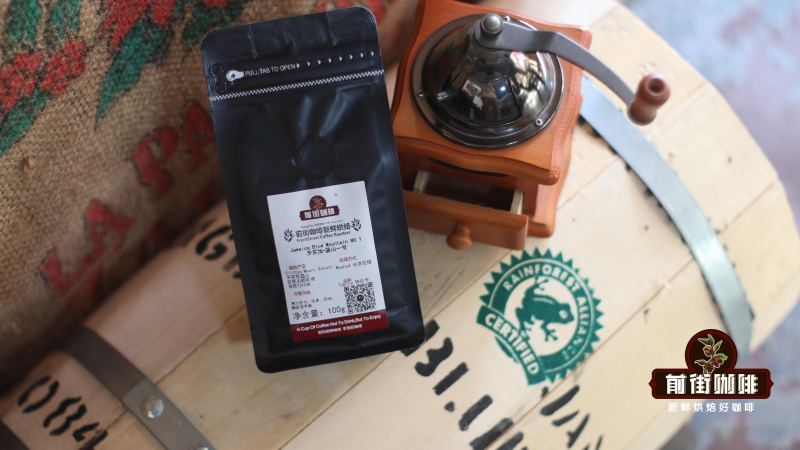
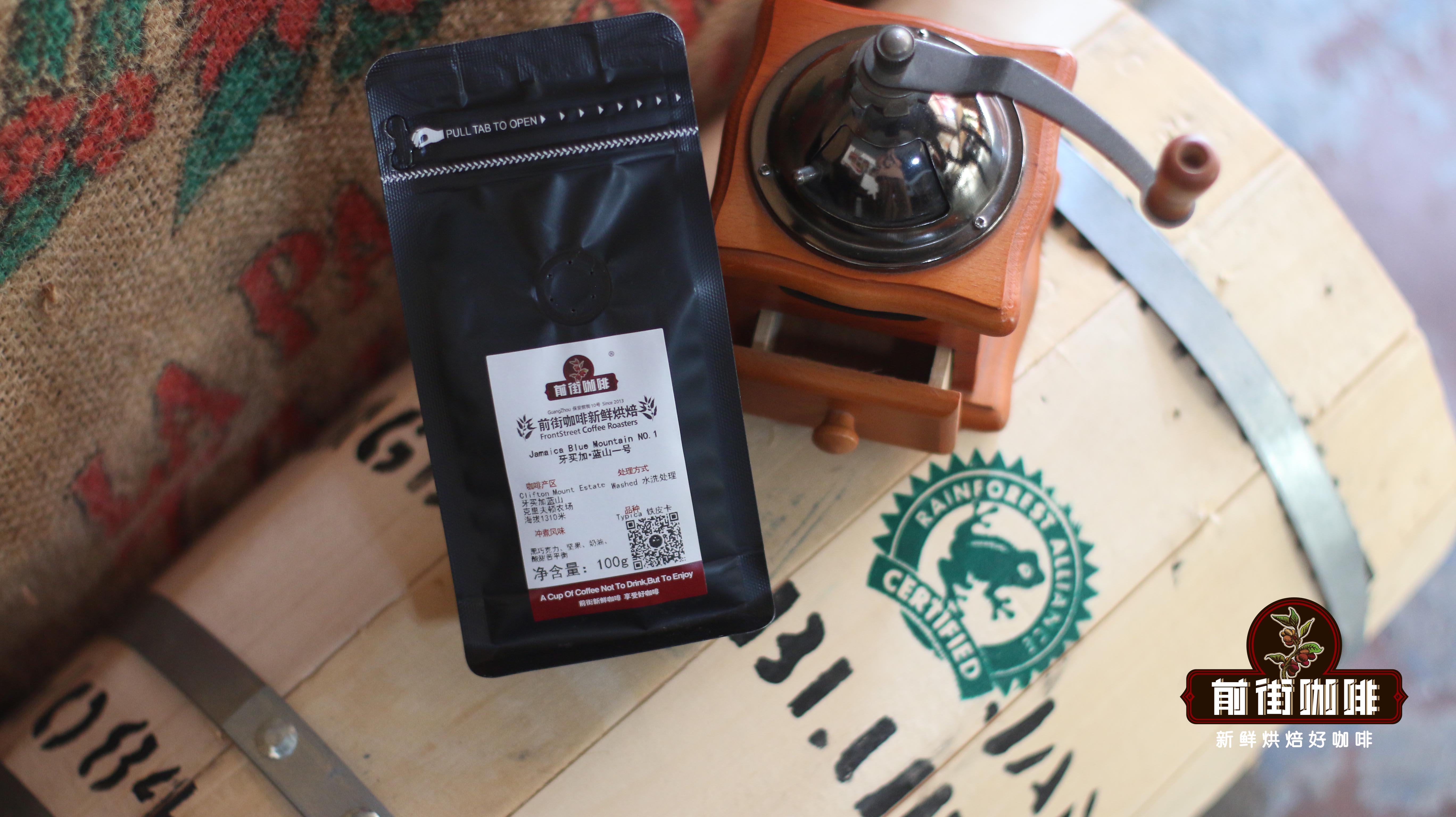
The Blue Mountain No. 1 coffee beans sold by FrontStreet Coffee come from the Clifton Estate, which has the longest coffee-growing history in the Jamaica Blue Mountain range. The green coffee beans are exported in wooden barrels and come with a certification certificate issued by the Jamaican government. Blue Mountain coffee is the only coffee-producing region in the world that uses wooden barrels for green bean export; all other regions use burlap sacks. The green frog logo represents the Rainforest Alliance. The Rainforest frog logo means Clifton Estate meets sustainable agriculture system standards and has obtained Rainforest Alliance certification.
The Processing Methods of Jamaica Blue Mountain Coffee Beans
Blue Mountain coffee was originally processed using the washed method. Front Street has always believed that washed processing better highlights coffee's true flavor, so most of Front Street's everyday beans are washed. In 2019, Clifton Farm attempted for the first time to release a naturally processed Blue Mountain batch.
Washed Processing Method:
After picking, fresh coffee cherries are first manually sorted to remove underripe and overripe fruit, then the skin is removed and the beans are directly fermented for 12 to 18 hours. Next, they are scrubbed in clean water to remove the mucilage layer from the green beans. Finally, the semi-dry green beans are spread out to dry until moisture content drops to 12-14%. After drying is complete, the green beans undergo one more rigorous sorting before being packed and stored. Every step requires strict control, otherwise Blue Mountain coffee's quality can easily be affected. Front Street believes that washed processing includes an extra step of removing defective beans, so the resulting Blue Mountain coffee has a brighter, cleaner flavor.
Front Street's Brewing Suggestions:
Some may ask, how should such an excellent coffee bean be brewed to showcase its flavor? Actually, when it comes to coffee brewing, Front Street has always believed that bean freshness is the most critical factor — freshness allows you to experience coffee's rich flavors to the fullest. Coffee beans shipped by FrontStreet Coffee are all within 5 days of the roast date, because Front Street deeply understands the enormous impact of freshness on flavor. Front Street's roasting philosophy is "freshly roasted good coffee," ensuring every customer receives their coffee in the freshest possible state. Coffee's resting period is about 4-7 days, so when customers receive it, it is at its optimal flavor.
Of course, some customers need Front Street to grind the beans for them, which is no problem. But Front Street must remind you: once coffee beans are pre-ground, they no longer need resting, because during shipping the pressure from carbon dioxide inside the packaging also rounds out the coffee's flavor. So once you receive ground coffee, you can immediately brew a cup. However, ground coffee needs to be brewed promptly, because it oxidizes quickly upon contact with air, and the flavor dissipates faster, making the taste less enjoyable. Therefore, Front Street recommends buying whole beans and grinding fresh for each brew — this way you can better appreciate the coffee's flavor.
Front Street's Blue Mountain Coffee Brewing Parameters:
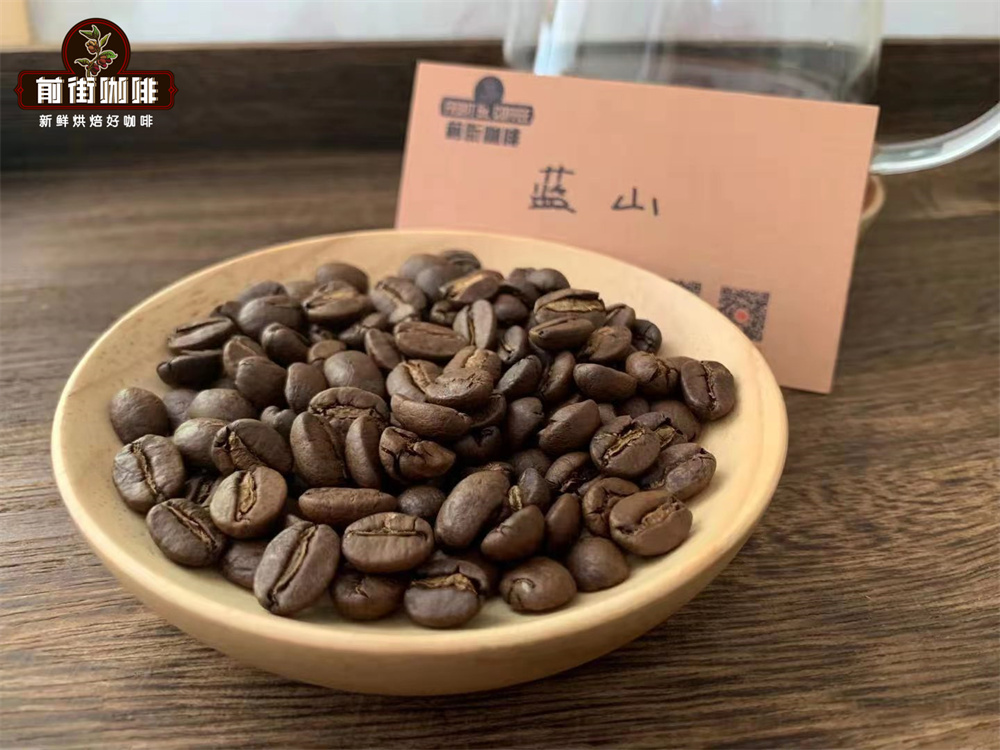
Front Street believes Blue Mountain coffee's fine flavor lies in its balance of acidity, sweetness, and bitterness, high body, and full aroma. For roasting, Front Street chooses a medium-dark roast, which highlights the beans' nutty and cocoa aromas. Using a KONO dripper brings out better body.
Dripper: Kono dripper, Water temperature: 88°C, Coffee dose: 15 grams, Coffee-to-water ratio: 1:15
Grind size: fine granulated sugar coarseness (75% passing through Chinese standard No. 20 sieve)
First, rinse the KONO dripper to help the filter paper adhere better, pour out the water from the server, then add 15g of coffee grounds. Bloom with 30g of water for 30 seconds, then begin pouring in a slow, small stream in circles from the center until reaching 125g, at which point begin分段. When the coffee bed drops to halfway down the dripper, pour the second stage using the same technique until reaching 225g. Once all dripping is complete, remove the dripper. Start timing from the beginning of pouring; extraction time is 2 minutes 00 seconds. Next, pick up the entire cup of coffee, swirl to mix, then pour into cups and enjoy.
[Front Street Natural Blue Mountain Coffee Flavor] Slight berry acidity, reminiscent of dried plums and mulberries. Overall excellent balance, with rich dark chocolate and nutty flavors, and a slight fermented note.
[Front Street Washed Blue Mountain Coffee Flavor] Rich dark chocolate and nutty flavors, creamy smooth mouthfeel, balanced acidity, sweetness, and bitterness
In the past, Blue Mountain coffee was truly hard to find — and even then, it wasn't guaranteed to be genuine Jamaica Blue Mountain coffee. But now, Blue Mountain coffee is no longer hard to come by. At Front Street, Jamaica Blue Mountain coffee is 158 yuan/100G, very economical and affordable. Of course, although Blue Mountain coffee is rich and balanced, you can also try coffees from other regions! Front Street has over fifty varieties of coffee beans from different origins — everyone is welcome to come and taste!
For professional coffee knowledge exchange and more coffee bean information, please follow Coffee Workshop (WeChat public account: cafe_style)
For more specialty coffee beans, please add the personal WeChat of FrontStreet Coffee. WeChat ID: qjcoffeex
The above content is compiled by CoffeeHunters, a coffee news website.


