







How does lungo coffee differ from espresso?
Lungo is espresso pulled with more water over a longer time, so the same dose of coffee yields a larger, less concentrated cup. Espresso, Ristretto, and Lungo all start from an identical dose, grind, and tamp; only the ratio of coffee liquid to grounds changes. Ristretto restricts the volume, while Lungo extends it.
Ristretto is effectively an under-extracted espresso: less liquid, higher concentration, lower extraction yield, and a flavor that is intense but short. Lungo moves the other way, lowering concentration while raising extraction yield. The style traces back to 1950s Italy, when espresso machine how does it work became a question of making coffee available to a wider public.
Lungo coffee, like Espresso and Ristretto, is a basic coffee produced directly by an espresso machine, but its positioning and flavor often leave people confused. This article examines the core differences between Lungo, Espresso, and Ristretto from the perspectives of extraction ratio, concentration, and extraction yield, and traces back to the history of coffee becoming accessible to the masses in 1950s Italy to explain why Lungo came into being. Front Street Coffee also presents Lungo's actual taste performance through real extraction tests, and explores what this extraction approach can inspire for today's coffee brewing.
For more specialty coffee knowledge, please follow: Front Street Coffee (Frontsteet Coffee)
Lungo coffee is a member of the espresso family, but its status is somewhat more special than ordinary espresso drinks. Like Espresso and Ristretto, it is coffee extracted directly through an espresso machine—it's just that from today's perspective, many people don't quite understand the reason for its existence.
First, let's talk about what Lungo actually is. Coffee extracted in the standard way using an espresso machine is called "Espresso," and the espresso machine is also called an "Espresso machine." If you go the opposite way and reduce the extraction volume to get a more concentrated coffee, that is "Ristretto" (meaning restricted); while extending the extraction time and increasing the amount of coffee liquid to ultimately obtain a large cup of coffee is called "Lungo" (meaning extended).
If we understand these three coffees using the concepts of extraction yield and concentration, the dose, grind size, and tamping operation before extraction are completely identical—the only difference lies in adjusting extraction yield and concentration through ratio. Ristretto and Lungo are both relative to Espresso. Assuming Espresso is in a "Golden Cup extraction" state, then Ristretto is equivalent to an "under-extracted" Espresso: it reduces the coffee liquid volume to increase concentration, and its extraction yield is also lower than Espresso—the flavor is intense but short-lived. Ristretto is often used as the base for coffee drinks like Flat White.
Lungo is the opposite: it lowers the overall concentration by extracting more coffee liquid, making the coffee less pungent, but extracting more liquid also means a higher extraction yield, so it can be seen as an "over-extracted" Espresso.
Lungo differs from the previous two: Ristretto and Espresso, due to their high concentration, can serve as the base for other espresso drinks, whereas Lungo is a terminal beverage that can be drunk directly. If extracting 30 ml of coffee liquid from 7-9 g of grounds is considered 1 serving of Espresso, then Lungo's volume is approximately 120 ml. Taking a 1:2 grounds-to-liquid ratio as the standard ratio for Espresso, Lungo's grounds-to-liquid ratio is about 1:4 to 1:5.
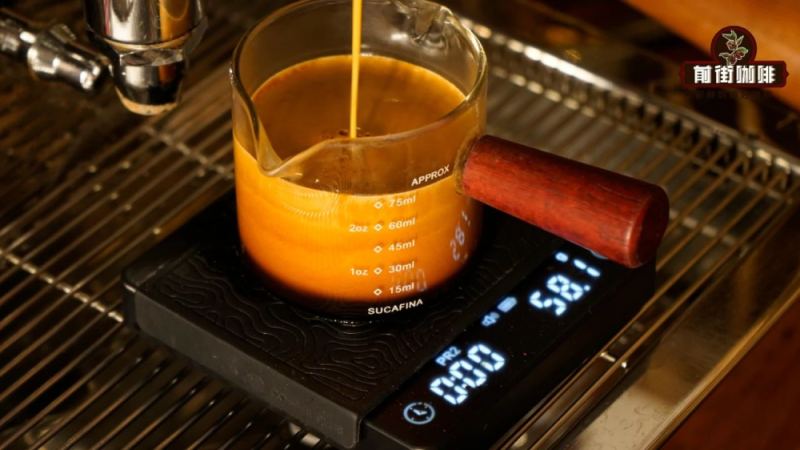
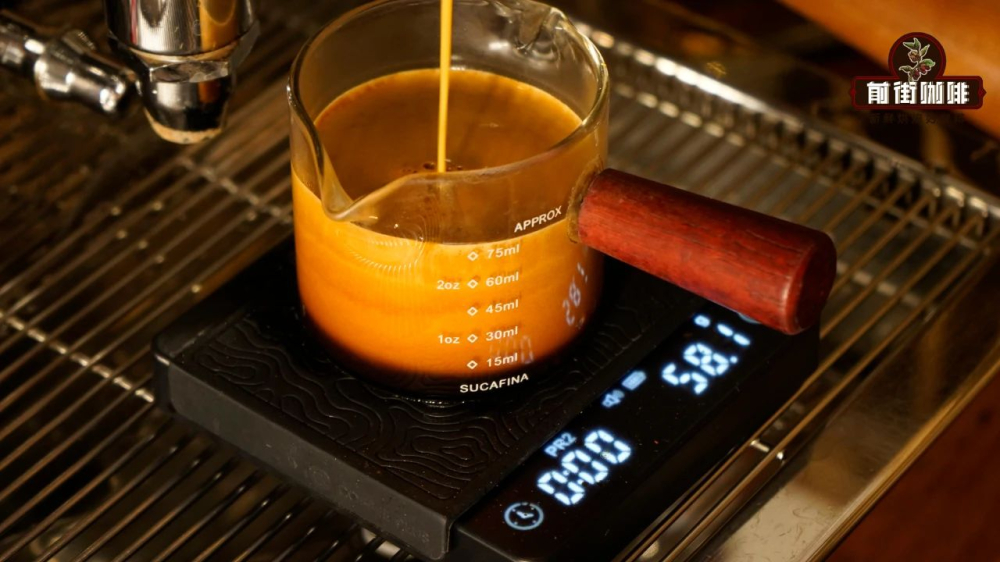
So how does Lungo actually taste? Front Street made a cup to try: extracting 100 g of coffee liquid from 20 g of grounds, taking 62 seconds. In fact, after 35 seconds, the coffee liquid flowing out was already as thin as water. Upon tasting, the concentration was moderate, not as pungent as espresso, and the flavor was relatively soft, but overall it wasn't particularly good—especially the burnt bitterness in the tail end that lingered in the throat and was hard to dispel.
Looking at Lungo through today's lens, it is indeed hard to understand why such a not-so-delicious cup of coffee ever appeared. But if we cast our view back to 1950s Italy, perhaps we can understand where Lungo's advantages lay. What we now commonly refer to as the recipe of extracting 30 ml of espresso from 7 g of grounds in 30 seconds was exactly formed in the 1950s. The first truly meaningful 9-bar coffee machine only appeared in 1938, capable of extracting a serving of Espresso in 30 seconds, but the patent was not sold to Faema until 1948, and it was not until the 1950s that espresso changed from a luxury item to a daily beverage that the working class could afford.
It was precisely during this period that Lungo appeared, for a very simple reason: more quantity without a higher price. A serving of Espresso is only 30 ml, finished in two or three sips, leaving you unsatisfied; ordering another cup means paying for another serving. The most direct solution was to extend the extraction volume to get a cup of standard size. You might ask, wouldn't the coffee become very burnt and bitter? Actually, that was exactly what people at the time recognized as the taste of coffee. For a long time, bitterness was equated with coffee flavor—whether the coffee was flavorful enough was the same as whether it was strong enough and bitter enough. (Early 1.5-bar espresso machines required 1 minute to extract coffee, produced no crema, and had a heavy burnt bitterness.)
You might also ask, why didn't they just add water to the Espresso? From a God's-eye view, Americano is indeed easier to drink than Lungo. But at the time, adding water to coffee would be suspected of cutting corners. A similar situation would be if you went to a shop today to drink pour-over coffee, and the barista added water to the coffee in front of you and told you this is bypass, which would make the coffee more drinkable and tastier.
Although Italians may not be good at fighting wars, they stand proudly above the rest in food culture—how could they lower themselves to the level of the "Yankees" from a culinary desert. So Lungo coffee was a fine beverage in Italy.
And today, when everyone is talking about flavor, from pour-over to espresso, if you now bring up an authentic Lungo, people will think you're trying to fool them. Of course, Lungo also offers a way of thinking: an espresso machine doesn't necessarily only have to produce espresso—try grinding the coffee coarser and increasing the grounds-to-liquid ratio, and you might just get a pretty good-tasting cup of coffee.
The above content is compiled by CoffeeHunters, a coffee news website.


