








How is australian white coffee made?
Australian white coffee is the flat white under a different name, and it uses roughly two-thirds espresso to one-third milk with about half a centimeter of foam. Some baristas instead build it from half highly concentrated ristretto and half milk. Either way the coffee, not the milk, dominates the cup, which is why it is usually served hot in a smaller glass.
By comparison, a latte runs one-third espresso to two-thirds milk with about a centimeter of foam, and a dirty latte layers iced milk under hot espresso and is drunk without stirring. For home brewing, blended coffee beans built for milk drinks give the chocolate and nut base that keeps the espresso readable under milk.
Flat White and Australian White actually both refer to the same classic milk coffee originating from Australia—the Flat White, which the domestic coffee community habitually calls "Australian White." Although it shares similar ingredients with latte and Dirty, the ratios and production techniques are completely different. This article will start with the ingredient proportions, dissect the differences among these three Italian milk coffees one by one, and explain around the espresso extraction methods for Australian White coffee: the respective characteristics of double Espresso and double Ristretto, and the key points for controlling the powder-to-liquid ratio and extraction time. At the same time, combined with Front Street Coffee's production experience, it introduces the blended bean choices suitable for making Italian milk coffees, as well as the complete process and flavor layer changes when using "Warm Sun Blend" to make Australian White, helping coffee enthusiasts recreate a cup of Australian White with clear flavor at home.
For more specialty coffee knowledge, please follow: Front Street Coffee (Frontsteet Coffee)
Luckin's Australian White and Starbucks' Flat White, although named differently, point to the same drink—Flat white. This coffee originated in Australia and is made from espresso and milk, so most cafes simply call it "Australian White."
Many people wonder: isn't this similar to latte and Dirty? The three indeed all use milk and espresso as ingredients, but the ratios and production methods each have their own particularities, and the differences in the finished products are quite obvious.
A latte is composed of 1/3 espresso plus 2/3 milk, and the hot version is topped with about 1cm of milk foam. It is smooth on the palate, with a stronger presence of milk, and is a typical Italian milk coffee.
Australian White coffee consists of 2/3 espresso, 1/3 milk, and 0.5cm milk foam (another method is 1/2 highly concentrated ristretto paired with 1/2 milk, plus 0.5cm milk foam). On the market, it is mostly served hot, with a smooth mouthfeel, and coffee flavor dominates.
Dirty coffee, on the other hand, uses 2/3 iced milk to directly receive 1/3 espresso, and is only made as a cold drink. Its appeal lies in the natural layering of coffee and milk. When drinking, do not stir; take a big sip to experience the gradual transition from espresso to the lactose sweetness of iced milk.
What coffee beans should be chosen for making Italian milk coffee?
The Italian coffee produced daily by Front Street Coffee (FrontStreet Coffee) all uses blended coffee beans for extraction. The significance of blending is that roasters can combine beans from different origins according to their characteristics and in proportions to create formula beans suitable for pressurized extraction.
This can reduce the risk of single-origin beans exposing defects and performing unstably under extremely fine grinding and pressurized extraction conditions, making the flavor and quality of each cup of espresso more guaranteed.
At the same time, blended beans also have a cost advantage over directly using single-origin beans, which has a considerable impact on coffee pricing. To meet the diverse needs of different types of coffee shops for Italian blend beans in terms of price and flavor, Front Street Coffee (FrontStreet Coffee) has launched 4 medium-dark roasted Italian blend beans, all shipped within 5 days after roasting to ensure freshness.
"Warm Sun Blend Coffee Beans," suitable for home/office and specialty coffee shops. Ethiopian natural red cherry coffee beans (30%) + Honduran sherry barrel coffee beans (70%), with rich wine aroma, vanilla cream, berry sweet-tartness, and roasted nut flavor performance.
"Specialty Blend Coffee Beans" suitable for home/office and specialty coffee shops. Colombian washed coffee beans (30%) + Brazilian semi-washed coffee beans (70%), with nut, dark chocolate, and caramel flavor performance.

"Commercial Blend Coffee Beans" suitable for all types of coffee shops. Robusta washed coffee beans (10%) + Colombian washed coffee beans (30%) + Brazilian semi-washed coffee (60%), with nut, cocoa, and caramel flavor performance.
"The Italian coffee beans recommended by many baristas - Front Street Black Cocoa Blend Coffee Beans" suitable for all types of coffee shops, bakeries, and beverage shops. Yunnan washed small-bean coffee (30%) + Brazilian semi-washed coffee beans (70%), with soft fruit acidity, caramel, and nut flavor performance.
How is the espresso for Australian White coffee extracted?
Currently, the mainstream methods for Australian White coffee fall into two types: one is using double Espresso, and the other is using double Ristretto. Both involve grinding coffee beans into extremely fine particles, tamping them into the portafilter basket of a pressurized espresso machine, and extracting under high pressure in a sealed state to obtain a highly concentrated coffee liquid.
The key difference between ristretto and regular espresso lies in the smaller extraction ratio. Taking double Espresso as an example, Front Street Coffee (FrontStreet Coffee) uses 20g of extremely finely ground coffee powder for store production, extracting 40g of coffee liquid at a 1:2 ratio, with extraction time controlled at 25-30 seconds.

The powder-to-liquid ratio of ristretto is about 1:1.6. It should be noted that the "concentration" of ristretto does not mean richer flavor; rather, the overall taste (acidity, sweetness, bitterness) is compressed. When too concentrated, it easily presents sharp acidity or burnt bitterness. Therefore, when making ristretto, adjustments to powder amount and extraction time are necessary when needed.
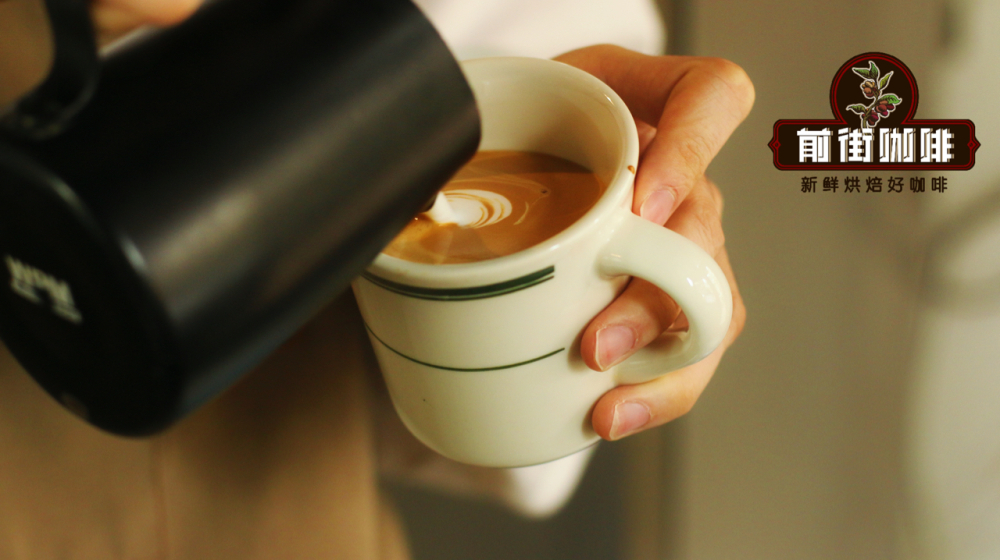
For its daily Australian White coffee, Front Street Coffee (FrontStreet Coffee) selects "Sunflower Warm Sun Coffee Blend Beans" to make double Ristretto. Using a 200ml cup, add double Ristretto (35g), and pour the steamed hot milk with thin milk foam from the center while dispersing the espresso, so that a gradual flavor can be presented. The first sip is the rich fermented wine aroma of espresso, the second sip is the strawberry milkshake flavor produced after the coffee and milk combine, and the third sip is the roasted nut flavor brought by a small amount of coffee combined with milk.
The above content is compiled by CoffeeHunters, a coffee news website.


