







What does the average startup cost for a coffee shop include?
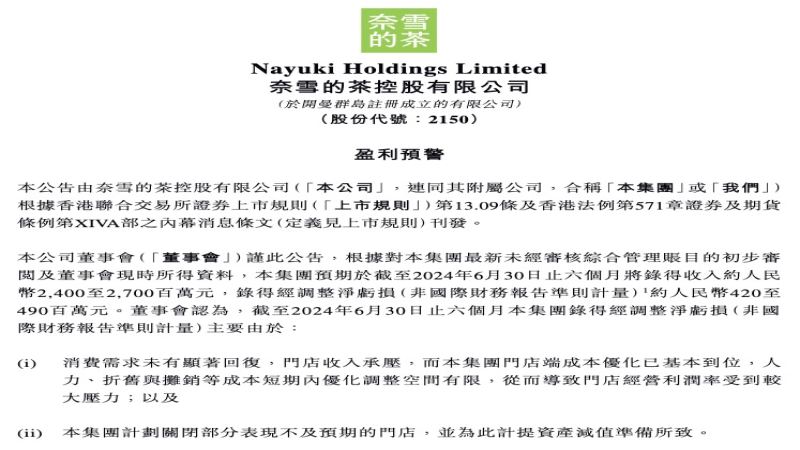
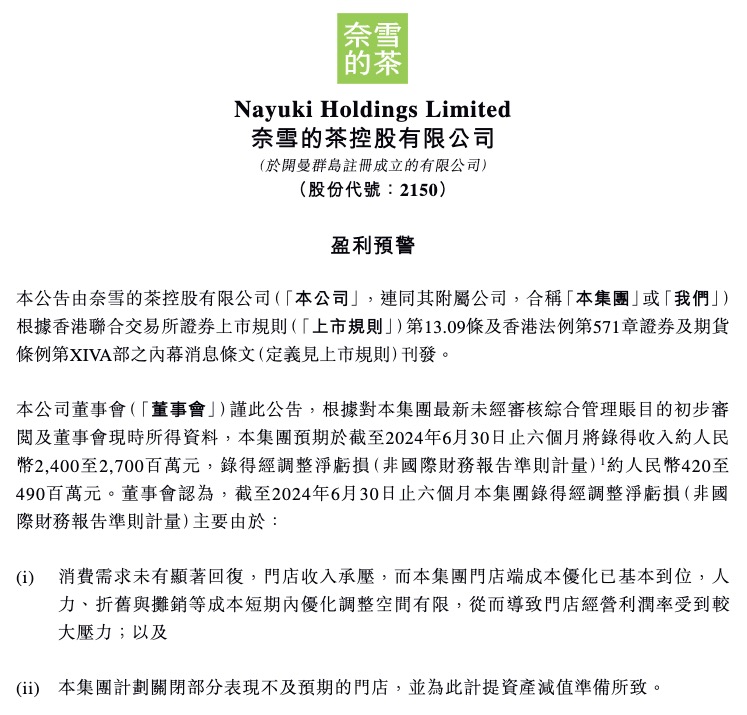
Nayuki issued a profit warning expecting first-half 2024 revenue of roughly 2.4 to 2.7 billion yuan and an adjusted net loss of about 420 to 490 million yuan. The company cited weak consumer demand, pressure on store revenue, and limited room for cost optimization in labor, spoilage, and selling costs. It plans to close underperforming stores.
The slowdown also reflects Nayuki's own strategy: slow store expansion, a high-end image that complicates moves into lower-tier markets, and price cuts that hurt product quality. It had already closed Taigai sub-brand stores and its first Hong Kong store at The Peak Galleria. Overseas expansion is one avenue the brand may explore.
Nayuki recently issued a profit warning, expecting revenue of approximately 2.4 to 2.7 billion yuan in the first half of 2024, with an adjusted net loss of approximately 420 to 490 million yuan. Facing weak consumer demand and limited room for cost optimization, this tea beverage brand once known for its high-end image is planning to close underperforming stores to cut losses and survive. Notably, Nayuki's performance slowdown stems not only from the market environment but is also closely related to its own business strategies—severely lagging store expansion, a high-end positioning that hinders its push into lower-tier markets, and price cuts that have led to declining quality and loss of fans. This article will delve into the challenges Nayuki currently faces and whether it can reverse its brand crisis through avenues such as overseas expansion.
Recently, Nayuki's Tea (hereinafter referred to as "Nayuki"), as a Hong Kong-listed company, formally issued a "profit warning" announcement in accordance with information disclosure requirements, quickly becoming a focal point of industry attention.
The announcement shows that Nayuki expects revenue of approximately 2.4 to 2.7 billion yuan (RMB, same below) in the first half of this year, with an adjusted net loss (a non-IFRS measure) of approximately 420 to 490 million yuan. Regarding such a significant loss, Nayuki explained that the main reasons are "consumer demand has not significantly recovered, store revenue is under pressure, and the Group's store-level cost optimization has basically reached its limit, with limited room for short-term adjustment in labor, spoilage, and selling costs, thereby putting considerable pressure on store operating profit." Simply put, in a milk tea market characterized by consumption downgrading and 9.9-yuan deals everywhere, Nayuki's product sales have fallen short of expectations while costs are difficult to compress. This brand, once known for its "bai fu mei" (white, rich, and beautiful) image, now appears somewhat at a loss amid fierce competition.
The document also revealed that Nayuki plans to close underperforming stores, prompting observers to sigh that it may be facing a new wave of store closures. Previously, Nayuki had successively closed stores of its sub-brand Taigai, as well as its first store at The Peak Galleria in Hong Kong, in an attempt to minimize losses.
In fact, aside from the external factor of overall weakness in the domestic consumer market, Nayuki's performance slowdown is also inseparable from a series of its own business strategies. The foremost issue is the number of stores. It is reported that in the second quarter of this year, Nayuki opened 48 new directly-operated stores and closed 48, resulting in zero net growth. One year after opening franchising, fewer than 300 franchised stores have been added. As of June 30, Nayuki had only 1,894 directly-operated and franchised stores combined. In the first half of 2024, Nayuki added a net of 320 stores, averaging 53 per month. Such slow expansion stands in stark contrast to the land-grabbing pace of store openings by other milk tea brands.
Nayuki's lagging store expansion is, to some extent, dragged down by its early high-end positioning, having failed to promptly lower its stance and embrace the franchise model in lower-tier markets. After all, Nayuki initially offered quite harsh terms to franchisees—an investment amount of up to one million yuan, with store area requirements of 90 to 170 square meters. Even after later lowering the franchise threshold in response to the market, a single-store investment still required 580,000 yuan, with a store area requirement of 40 square meters—standards still far higher than those of other tea beverage brands.
The contradiction lies in the fact that while Nayuki insists on its high-end positioning and slows its expansion pace, it is also forced by revenue pressure to be swept into the industry's wave of price-cutting fire sales. According to financial reports, Nayuki's average sales per order has dropped from 34.3 yuan in 2022 to 29.6 yuan in 2023. Although price cuts drove milk tea sales for a period, enabling a profit of 2.1 billion yuan in 2023, the stock price plummeted after the earnings report was released, reflecting the market's skepticism toward such short-term behavior.
At the same time, after substantial price cuts, Nayuki inevitably made adjustments in raw material procurement, production processes, and other areas, all of which affect product quality and provoke consumer dissatisfaction. As a result, not only did it fail to attract more customers, but even its original loyal fans are gradually drifting away. Some netizens said they feel Nayuki hasn't launched new fruit tea products in a long time, and the brand has fallen into mediocrity, with product strength even inferior to its subsidiary Lelecha. Many others, when discussing Nayuki, always fondly recall the limited-edition soft European bread from its stores, and complain that the current pre-made bread is getting smaller and smaller, with a taste far worse than before. Some netizens even bluntly stated that Nayuki's decision to cancel in-store freshly made soft European bread was a mistake—originally the European bread could drive tea beverage sales, but after cutting it, they don't even want to drink its tea anymore.

Nayuki, which has been frequently closing stores domestically, has also followed the industry trend of going overseas. On the 23rd, Nayuki opened its Thailand flagship store at Central World, a top-tier shopping mall in Thailand, and it is said that business is quite good. However, some netizens pointed out that Nayuki's trend-following overseas expansion will likely struggle to turn the tide and reverse the brand crisis caused by brand aging and lagging operations.
Image source: Internet
The above content is compiled by CoffeeHunters, a coffee news website.


