







How Was Coffee Made Consistent in Pour-Over Brewing?
Unstable pour-over flavor usually comes from three variables rather than the beans: water temperature, grind size, and pouring technique. When hot water pulls out too much, the cup turns bitter; too little leaves it thin and bland. Matching these parameters to the bean's roast level gives even extraction and a more consistent taste from brew to brew.
Light-roasted beans are denser and need hotter water and a finer grind, while dark roasts extract faster and prefer cooler water. Pouring in stages controls contact time, so a steady, even pour matters as much as the coffee-to-water ratio. Adjust one variable at a time to see how the hand brew coffee meaning shifts in the cup.
Many friends who are just getting into pour-over coffee encounter the same confusion: with the same beans and the same equipment, why does it sometimes taste sweet and smooth, and other times bitter and hard to swallow? In fact, the fluctuating flavor of coffee is often not a problem with the beans, but rather a few key extraction parameters not being matched properly. This article, based on Front Street's practical experience, focuses on the three core variables—water temperature selection, grind size adjustment, and pouring technique—analyzing one by one the factors that affect pour-over coffee's taste, and providing specific parameter recommendations and adjustment ideas. Whether you're using light-roast or dark-roast beans, you'll find practical methods to make your coffee perform more consistently.
On ordinary days, Front Street often encounters friends who are just starting out with pour-over coffee, and the question they ask most is: why is the coffee I brew sometimes quite tasty, and sometimes hard to swallow? In most cases, it's because an ideal extraction state wasn't reached, and then they start doubting their own skills. Today Front Street will share a few practical tips to help you say goodbye to the trouble of "coffee turning into medicine soup."
Why is pour-over coffee sometimes good and sometimes bad?
No matter what method you use to brew coffee, the fundamental prerequisite for good taste is proper extraction. If hot water brings out too many substances, the coffee tends to taste bitter; if it brings out too few, the flavor seems thin and bland. Only with even extraction and moderate concentration can you get a delicious cup of coffee.
In Front Street's view, the flavor of a cup of pour-over coffee is first determined by the coffee beans themselves, with the influence of human operation coming second. During extraction, there are three key variables that can directly change the taste: the coarseness of the coffee grounds, the water temperature, and the amount and technique of pouring (the latter affects extraction time). When coffee swings back and forth between "tasty" and "undrinkable," you can basically conclude that the problem lies in these parameters.
Wrong water temperature chosen
When you get a bag of beans, the first thing to do is confirm its roast level. Light-roasted beans have a shorter heating time and a harder texture, usually requiring a higher water temperature (92℃-94℃) to extract more soluble substances; dark-roasted coffee has a greater expansion rate, a loose structure, and rich caramelized substances, so the water temperature is better lowered by 5~6℃, brewing at 86~88℃ to better avoid bitterness.
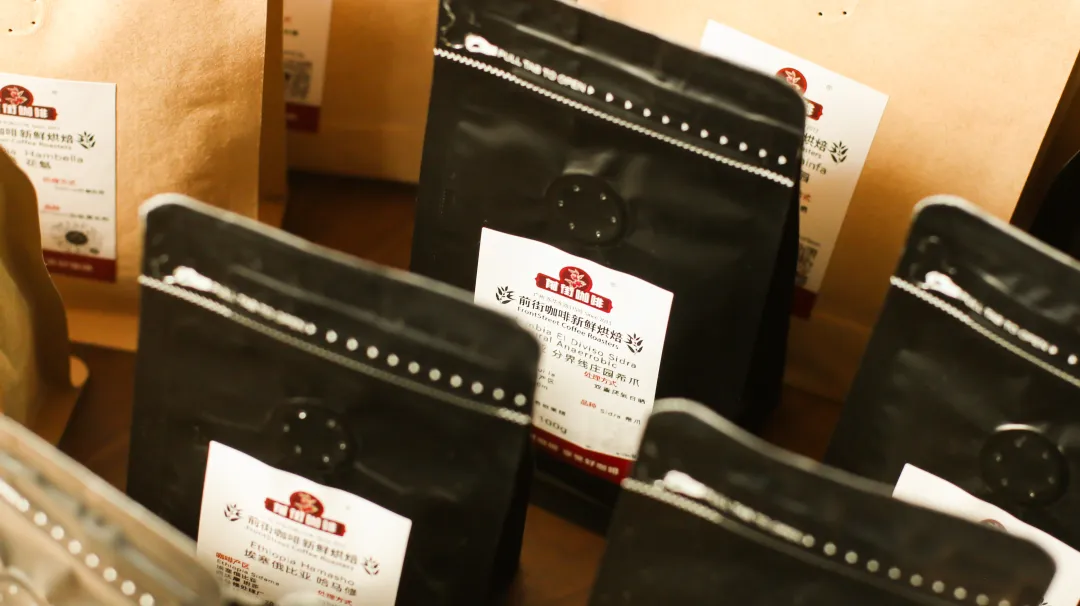
Friends who often buy Front Street coffee beans may have noticed that Front Street never marks the roast level on the bean bag. This is because on the production side, the industry has a dedicated classification system covering 8 different roast levels, each corresponding to a different color value, far beyond what the three words "light, medium, dark" can summarize, and it's easy to cause misunderstandings when passed on to consumers.
Front Street believes the simplest way to judge roast level is to look at the sweet-sour-bitter leaning in the flavor description: those with lemon, citrus, or blueberry flavors belong to medium-light roast leaning light, for example Front Street Yirgacheffe is recommended at 93℃; those mainly featuring sweet notes like melon, grape, and peach belong to medium-light roast leaning medium, for example Front Street Blackberry uses 90~92℃;
Those mainly featuring obvious sweetness like maple syrup, sugarcane, chocolate, and almond can be classified as medium-dark roast leaning medium, for example Front Street Queen's Estate uses 86~88℃; those with flavor descriptions heading toward bittersweet like roasted hazelnut, dark chocolate, and caramel belong to medium-dark roast leaning dark, for example Front Street PWN Golden Mandheling uses 85~86℃.
A problem with the grind size
For beginners, the first step can be to adjust by referencing the coarseness of granulated sugar (use finer sugar granules for medium-light roast, medium sugar granules for medium-dark roast). But compared to other solid parameters, grind size is highly uncertain, because we not only have to judge the coarseness of the grounds and find the corresponding setting, but also can't ignore the uniformity of the particles, making it more difficult to handle.
Taking the brewing combination Front Street commonly uses as an example (15g grounds, 1:15 coffee-to-water ratio, 88~93℃, three-stage pouring of about 30ml+100ml+95ml, time controlled at 1 minute 50 seconds to 2 minutes 10 seconds), if the total time exceeds two and a half minutes, it means the flow rate is too slow and the taste is too strong, so you can make the grind coarser; conversely, if the time is under one and a half minutes, the flow rate is too fast and the taste is too weak or too sour, meaning the grind is too coarse and needs to be made finer.
If you brew according to Front Street's formula and the time also falls within the reference range, but the coffee still often doesn't taste right, then it's likely that the grinder's hardware quality isn't sufficient (poor fines control). Without changing equipment, if you want to make the coffee tastier, you can balance the overall flavor by adjusting other parameters.
For example, if a medium-light roast coffee has a sharp acidity and weak aroma, and you determine there are too many extremely fine particles, you can appropriately lower the water temperature by 2~3℃ to reduce the release of substances in the final stage; when a medium-dark roast coffee, for fear of over-extraction, isn't ground fine enough and comes out with only monotone roasted aroma and coffee taste, you can raise the temperature by 2℃, aiming to obtain more nutty sweet aroma components, making the layers and mouthfeel richer.
Pouring too casually
There are two cases here: one is the coffee-to-water ratio, and the other is the pouring technique. Regarding the coffee-to-water ratio, Front Street has always brewed at 1:15—not that only this ratio can brew good coffee, but that it more easily achieves a suitable extraction rate and concentration.
Front Street once had a customer who said they had prepared all kinds of equipment for pour-over, including a pouring kettle, dripper, filter paper, grinder, and so on, and also extracted according to the technique we shared, but the coffee still varied from good to bad. Only after asking further did we find out that this friend hadn't bought a scale at all. In other words, the so-called "water amount" was entirely by feel, and the time could only be left to fate, so the coffee-to-water ratio naturally had no credibility.
If you've already applied the above parameters and still feel the coffee is lacking something, then you can look for the reason in your pouring technique. Besides being unfamiliar with how to distribute the water, beginners actually face quite a few difficulties in the various details of pouring, including the pouring point, the flow size, the circling amplitude and speed, the pouring height… these all affect the final flavor. So rather than rushing to study special brewing methods, it's better to first solidify the basics, which will be more helpful for advancing.
The method is actually very simple: still apply the basic formula, then practice pouring a "perfect coffee bed"—the coffee grounds form an evenly distributed, thin-on-top-thick-at-bottom, smoothly-lined "bowl" shape—using this to check which step wasn't done properly. For the specific steps, everyone can refer to this Front Street article "How should you pour water for three-stage pour-over brewing?"
The above content is compiled by CoffeeHunters, a coffee news website.


