







How Is Yunnan Coffee Grown and Brewed?
Yunnan arabica coffee comes mainly from Baoshan, Lincang, Pu'er and Dehong, each with its own terroir. Baoshan beans are exported overseas, while Lincang is home to a self-built estate growing sun-dried Typica. The cup shows preserved-fruit sweetness, plum acidity and nutty notes, finishing with brown sugar and black tea.
For brewing, a Hario V60 pour-over works well: 90 degrees Celsius water, 15 grams of grounds and a 1:15 coffee-to-water ratio. Let the beans rest after roasting and grind just before brewing. Yunnan's altitude, rainfall and position near the Tropic of Cancer give the arabica grown there distinct regional character.
Yunnan coffee has performed impressively in the international market in recent years, with producing regions such as Baoshan, Lincang, Pu'er, and Dehong each having their own characteristics. Starting from the terroir of the producing regions, this article reviews the cultivation distribution and variety evolution of Yunnan arabica coffee, with a focus on Front Street Coffee's self-built estate in Lincang and its sun-dried Typica. This bean uses traditional sun-drying processing and presents preserved-fruit sweetness, plum acidity, and nutty notes, with a finish of brown sugar and black tea. The article also provides Hario V60 pour-over parameters: 90 degrees Celsius water temperature, 15 grams of grounds, and a 1:15 coffee-to-water ratio, and shares practical suggestions on bean resting and grinding to help coffee lovers fully appreciate the charm of Yunnan specialty coffee.
To learn more about specialty coffee, you are welcome to follow Front Street Coffee (Frontsteet Coffee).
When coffee comes to mind, the first image for many people is probably the cup of Blue Mountain that appeared frequently in Hong Kong dramas in the 1980s and 1990s. As a child, watching elders take just a gentle sip, their faces revealing a satisfied and enchanted expression, that scene is still unforgettable today. By the time you grow up and truly taste that captivating aroma, you can no longer stop. From initially refusing to drink anything but foreign beans to now enthusiastically embracing China's Yunnan specialty coffee, this journey of change would have been unimaginable in the past.
Today's Yunnan coffee has long made a name for itself on the international stage, and Chinese people have begun to look at it with new eyes. Next, Front Street will introduce several well-known Yunnan arabica coffee producing areas. As the country continues to promote Yunnan arabica coffee, more and more producing area names have entered the public eye. People then discovered that Pu'er not only produces tea, but also coffee; Baoshan's arabica coffee is even exported overseas and has won considerable praise.
Yunnan Coffee Producing Regions
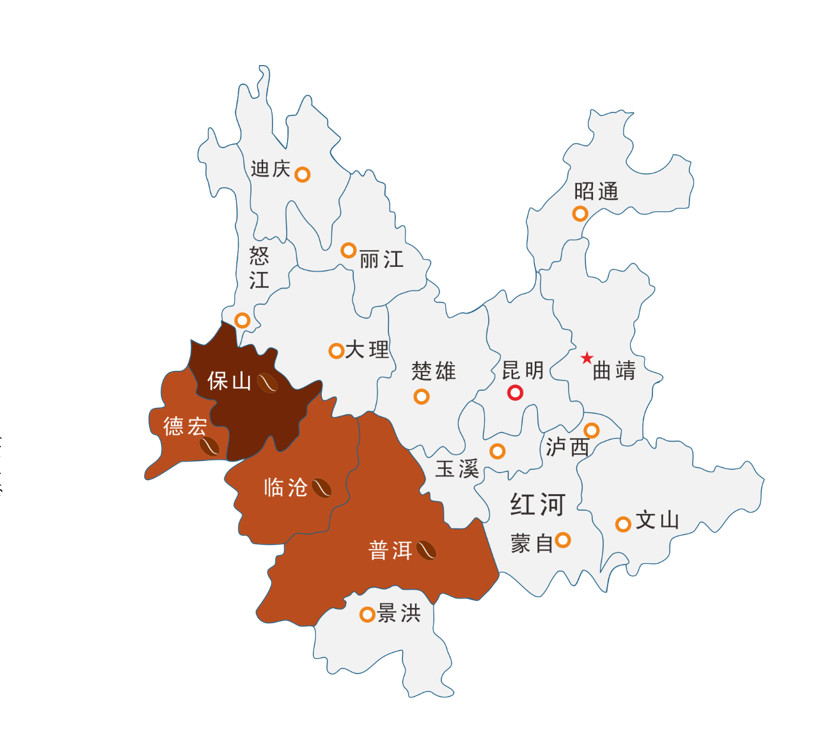
Yunnan has a high forest coverage rate, fertile soil, abundant rainfall, varied terrain, relatively high altitude, and a relatively mild annual temperature. In addition, it is located near the Tropic of Cancer, making it a rare favorable place for growing coffee in China. The province's coffee producing regions are not only the familiar Pu'er and Baoshan; Dehong, Lincang, and other places also grow coffee. However, the Yunnan arabica coffee produced in each region has subtle differences in taste.
[Pu'er]
In Pu'er City, all 9 counties and districts under its administration, including Simao, Ning'er, Mojiang, Jinggu, Jingdong, Zhenyuan, Jiangcheng, Lancang, Menglian, and Ximeng, grow Yunnan arabica coffee. The local average annual temperature is between 17 and 20 degrees Celsius, and the growing altitude ranges from 700 meters to 1,600 meters.
[Baoshan]
In Baoshan City, the five counties and districts of Longyang, Longling, Shidian, Changning, and Tengchong all produce products bearing the Baoshan arabica coffee geographical indication. The growing altitude is between 1,000 meters and 1,500 meters, and the average annual temperature is 21 degrees Celsius. Coffee produced in Lujiang, Baoshan, was rated first-class on the London market in the United Kingdom as early as the late 1950s.
[Dehong]
Dehong is one of the earliest regions in China to introduce coffee. In 1914, arabica coffee was introduced from Myanmar, and large-scale commercial cultivation began in 1953. Lincang's average annual temperature is between 18 and 20 degrees Celsius, with no severe cold in winter and no intense heat in summer, a marked temperature difference between day and night, fertile soil, and abundant rain. When coffee cherries are still in the ripening stage, such conditions are conducive to the accumulation of proteins, sugars, caffeine, and other substances, making Dehong coffee's flavor fuller.
[Lincang]
Coffee cultivation has been carried out in Gengma, Zhenkang, Yunxian, Cangyuan, Yongde, and other towns in Lincang City. Lincang has a special geographical location, bordering Myanmar to the west; it has superior climatic conditions, a significant temperature difference between day and night, abundant rainfall, and a mild average annual temperature, thus becoming a hotspot of attention for many coffee companies. Front Street Coffee (FrontStreet Coffee) recognized Lincang's potential and established its own coffee cultivation estate in this producing region.
Coffee Varieties
Most Yunnan coffee beans seen on the market today are the Catimor variety. In fact, Yunnan's early coffee variety was not Catimor, but Typica, the oldest and most primitive branch of Arabica.
As reform and opening up advanced, international coffee brands such as Nestle and Starbucks listed Yunnan as one of their raw material origins. In order to obtain large quantities of raw materials from a single producing region, they promoted the cultivation of Catimor. Catimor contains Robusta genes; in addition to being more resistant to coffee leaf rust than Typica, its yield is also as much as three times that of Typica.
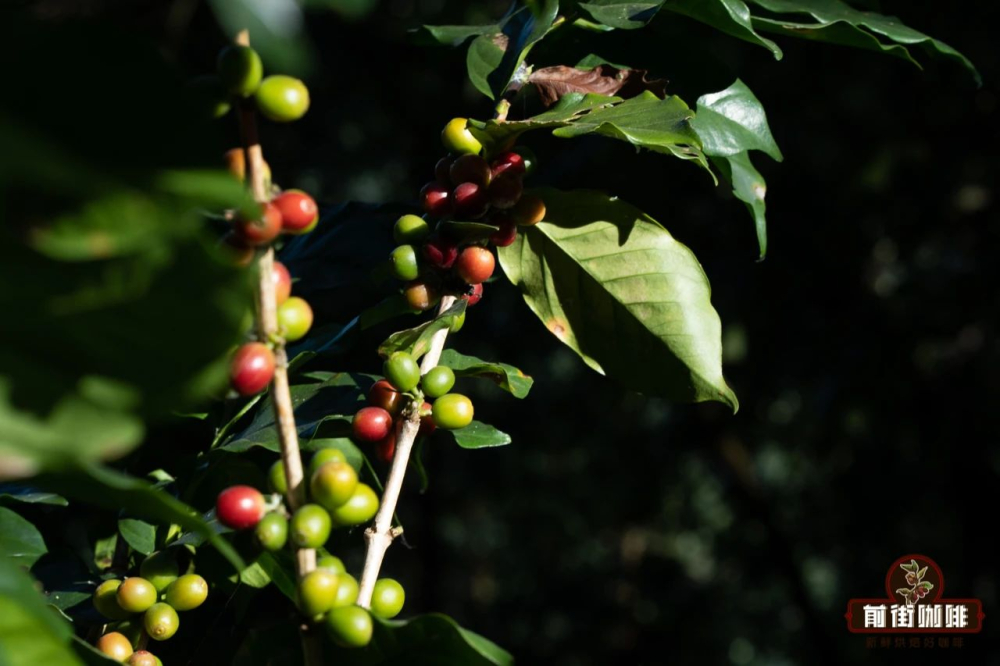
Higher yield means more considerable returns. Many local coffee farmers in Yunnan did not understand the ins and outs of coffee varieties and flavor; what they worried about was income, so they reluctantly cut down the elegantly flavored Typica and switched to planting the higher-yielding but slightly inferior-flavored Catimor.
The benefits brought by Robusta genes are many, and the drawbacks also exist. Robusta coffee beans usually have a bitter taste, and because Catimor contains some Robusta genes, it also carries that "devil-like finish."
Front Street Coffee (FrontStreet Coffee) Estate
Front Street Roasted Coffee has now passed its 10th year, and its involvement in coffee cultivation began half a year earlier than roasting coffee beans. "Dazhen Coffee," as the predecessor of Front Street, initially wanted to grow coffee in a place in Guangdong called Dazhen. At that time, Catimor seedlings had already grown to 20 centimeters before we truly understood the relationship and sequence among variety, altitude, and processing method in specialty coffee. Therefore, Front Street abandoned the planting plan in Guangdong, turned to Yunnan to study coffee cultivation in depth, and by chance found suitable land.
Back then, Front Street chose the most difficult path: selecting highlands, cultivating Arabica varieties, and planting rationally.
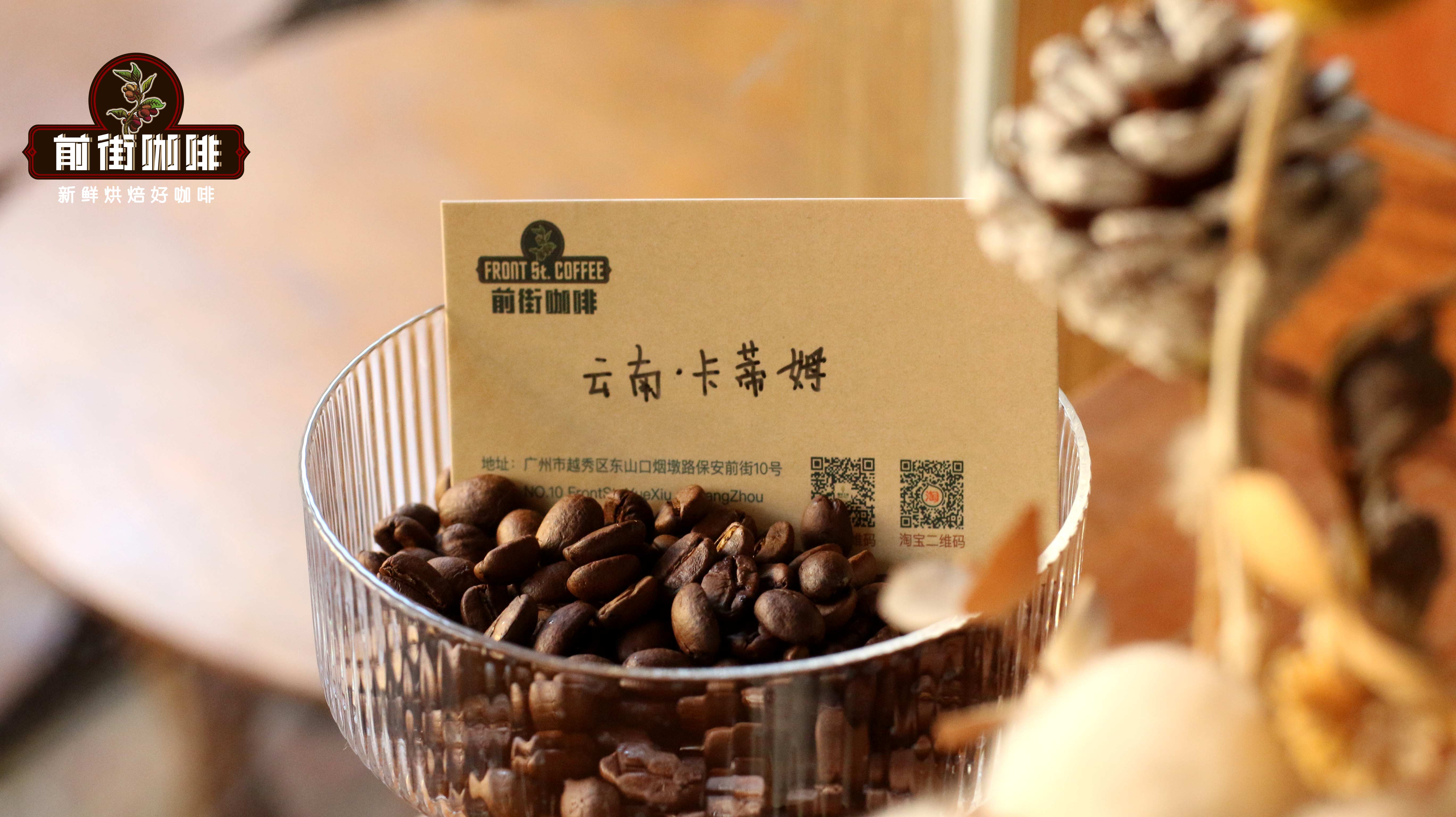
Yunnan is not a place with four distinct seasons; here there are only the dry season and the rainy season. In cultivation, Front Street adopted extremely high standards to create a natural and comfortable growing environment for the coffee trees. Typica is more difficult to manage in the field than Catimor, and it is sensitive to prolonged direct sunlight, so Front Street deliberately maintained the diversity of plant species and the ecological environment within the estate.
From seedling cultivation to harvest, at least three to four years are needed. Now, Front Street Coffee (FrontStreet Coffee) Estate has welcomed its second coffee harvest season. Everything done is only to earn one sentence from coffee connoisseurs: this is the taste of Yunnan specialty coffee.
Front Street's latest batch of coffee beans uses the most traditional and most primitive post-processing method for green coffee beans, namely the sun-drying method. Fully ripe coffee cherries of just the right maturity are evenly spread on drying beds for sun drying. Because the complete skin and pulp layer are retained, the drying process is more complex and takes longer. To avoid over-fermentation, workers need to turn each coffee cherry frequently and on schedule.
Front Street Coffee (FrontStreet Coffee) Estate Yunnan Sun-Dried Typica
Origin: Lincang, Yunnan
Estate: Front Street Coffee (FrontStreet Coffee) Estate
Altitude: 1,300 meters
Variety: Typica
Processing method: Sun-drying
This Front Street sun-dried Typica uses a Japanese-style processing method, with abundant aroma and especially prominent sweetness, carrying preserved-fruit-like sweetness, soft plum acidity, and rich nutty notes, while the finish presents brown sugar sweetness and black tea body. Many friends, when purchasing this Front Street Yunnan coffee bean, ask Front Street's baristas: how should it be brewed to best bring out its flavor? Front Street sun-dried Typica is fragrant without being harsh, rich without being bitter, and has the taste of traditional Yunnan arabica coffee.
If you want to drink the best flavor of this Front Street Yunnan coffee bean, Front Street recommends brewing with freshly roasted coffee beans, as this is the best way to experience the coffee's rich flavor to the fullest. The coffee beans sent out by Front Street Coffee (FrontStreet Coffee) are all roasted within 5 days, because Front Street deeply understands the huge impact of freshness on flavor. Front Street's roasting principle is "freshly roasted good coffee," so that every customer who places an order receives the freshest beans when the coffee arrives. The bean resting period is about 4 to 7 days, so by the time customers receive it, it is exactly at its best flavor stage.
Dripper: Hario V60
Water temperature: 90 degrees Celsius
Dose: 15 grams
Coffee-to-water ratio: 1:15
Grind size: 75% passing through China standard No. 20 sieve
Pour 30 grams of water for blooming for 30 seconds, then pour from the center in a thin stream while slowly circling to 125 grams. When the water level in the dripper drops to the point where the coffee bed is about to be exposed, continue circling and pouring to 225 grams. Total extraction time is about 2 minutes.
Some friends, after seeing Front Street's grinding equipment at a Front Street Coffee (FrontStreet Coffee) store, are not very confident in their own grinder, so they want to ask Front Street to grind the beans for them. Of course, Front Street provides this service both online and offline, but once coffee beans are ground into powder, degassing becomes more intense and flavor compounds dissipate faster, so grinding fresh and brewing immediately gives a better flavor.
The above content is compiled by CoffeeHunters, a coffee news website.


