







How Do Panama Geisha and Gesha Village Gold Label Differ?
Hacienda La Esmeralda Red Label and Gesha Village Gold Label sit at the top of their estates but differ in naming logic, variety origin, terroir, and cup flavor. Front Street lists them separately at 75 yuan and 60 yuan per pour-over cup, and the green bean cost explains the gap. The Red Label beans sell at 350 yuan per 100 grams against 158 yuan for the Gold Label.
Both trace back to the Gesha variety, with Gesha Village's Gold Label built on Gesha 1931. The estates sit in different terroir: Hacienda La Esmeralda in Boquete, Gesha Village in Bench Maji. Brewing comparisons show distinct dry aroma and flavor profiles, and the label naming itself only exists in the Chinese market. A gesha latte is one way to taste the difference, though the pour-over comparison is more revealing.
Geisha enthusiasts often see two "labels" on Front Street Coffee's blackboard: Hacienda La Esmeralda Red Label and Gesha Village Gold Label, the former priced at 75 yuan per cup for pour-over, the latter at 60 yuan per cup. Both represent the top-tier Geisha of their respective estates, yet few delve into the differences in naming logic, variety origins, terroir, and cup flavors. This article starts from the two beans currently sold at Front Street Coffee, sorting out the origins of the Chinese terms "Red Label" and "Gold Label," tracing the varietal relationship between Panama Geisha and Gesha Village's "Gesha 1931," comparing the terroir conditions of Hacienda La Esmeralda in the Boquete region and Gesha Village in the Bench Maji region, and through actual brewing comparisons, presenting the specific dry aroma and flavor performances of these two top-tier Geishas.
For more specialty coffee content, follow: Front Street Coffee (Frontsteet Coffee)
Many customers chatting about Geisha at Front Street Coffee always have their eyes drawn to the two "labels" on the blackboard—one is Hacienda La Esmeralda's Red Label Geisha, the other is Gesha Village's Gold Label Geisha. Due to the high cost of green beans, Front Street Coffee specifically lists them separately and marks their respective pour-over prices: "75/cup" and "60/cup." This also sparks curiosity among many friends, especially those who have long heard of Geisha's fame but haven't yet had the chance to seriously try a cup.
If you're trying Geisha for the first time, which one is more suitable? Or rather, which "label" offers better value for money?
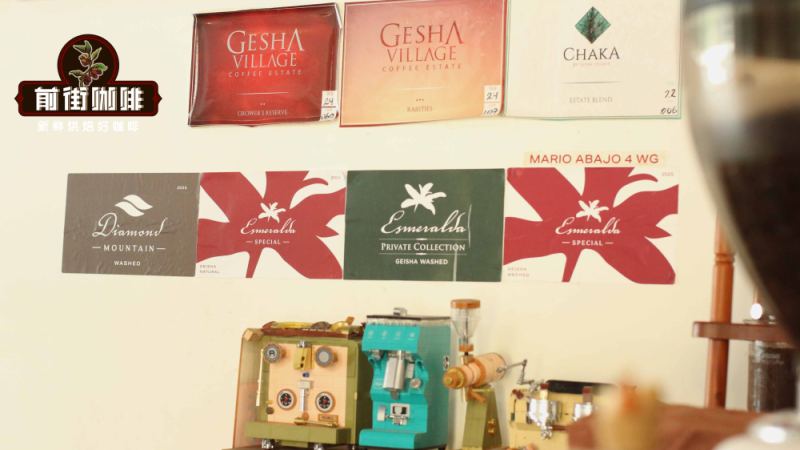
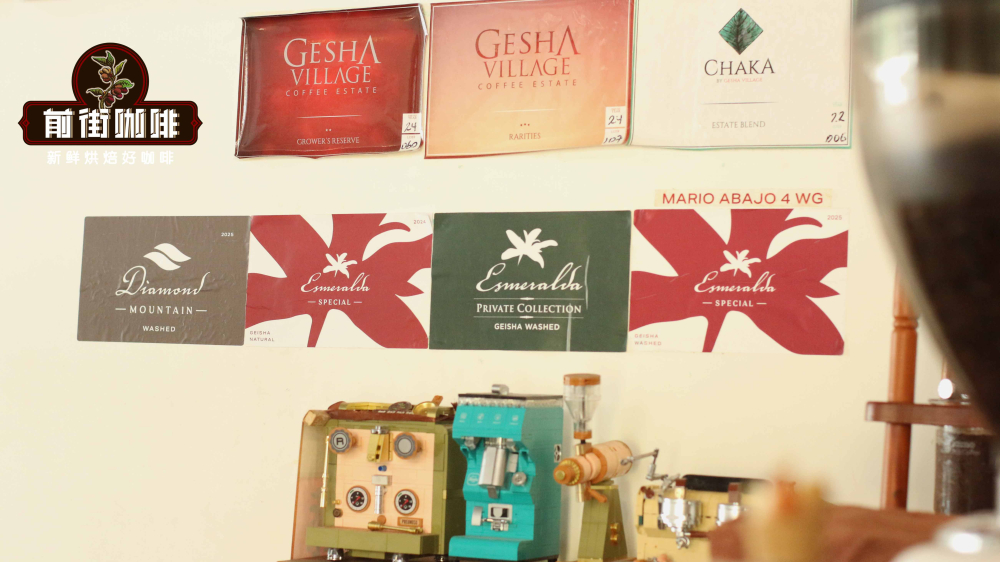
Let's start with the colors of those "labels."
It's not hard to see that these Geishas with "labels" that baristas mention are named to emphasize their grade. Whether it's the Red Label, Gold Label discussed today, or the lower-ranked Green Label, Blue Label, even if you can't tell the order just from the prefix, one thing is clear: this Geisha from a certain estate with a certain label should be of higher grade than ordinary Geisha, and often priced higher. Front Street Coffee's Gesha Village Gold Label coffee beans come in 100g specifications, priced at 158 yuan; the same specification of Hacienda La Esmeralda Red Label coffee beans is priced at 350 yuan per bag, making the difference obvious at a glance.
In fact, this "label" naming only exists in the Chinese context. In other words, if you switch back to their English names, you might not be able to tell who is who or which is more premium.
Hacienda La Esmeralda's Red Label Geisha is originally named "Esmeralda Special," which can be translated into Chinese as "翡翠特选" (Esmeralda Special), and is the highest-quality Geisha coffee bean sold by the estate. It not only requires a cupping score of 91 or above, but each batch also comes with detailed "birth information." The "red" in Red Label comes from the background color of the product's trademark, and the same applies to Hacienda La Esmeralda's Green Label and Blue Label, aimed at making it easier for domestic consumers to remember and distinguish.
Gesha Village's Gold Label Geisha also has a corresponding English name "Rarities," meaning "rare treasures," simply put, the highest-grade Geisha launched by Gesha Village (non-auction batches), and the "gold" in Gold Label also comes from the background color of the product's trademark. According to Gesha Village's official website, this grade of Geisha coffee accounts for only 10% of the estate's total production, and like Hacienda La Esmeralda's Red Label, each batch includes plot information for buyers' reference.
This naming method circulating in China does make different grades of Geisha more accessible and memorable, but it can sometimes cause confusion due to "color clashes." For example, in the Geisha production and sales systems established by these two estates, both have grades with red and green backgrounds, leading to two "Red Labels" and two "Green Labels" on the market. When ordering, remember to be more attentive, or directly ask the barista which estate this cup of Geisha comes from and what grade it belongs to.
Although both are called Geisha, they are actually "distant relatives" in terms of variety
The fact that "Geisha comes from Ethiopia" is almost universally known in the coffee industry. Going back to 2004, the Geisha that won the BOP competition and amazed everyone was found, after sample comparison, to actually be "geisha T2722," collected in the 1930s near the Gesha area in southwestern Ethiopia's Kaffa forest, and later cataloged by Costa Rica's CATIE as a fungal-resistant variety.
The variety name of Gesha Village's Gold Label has an extra year after it, called "Gesha 1931." The selection work at Gesha Village was led by Willem Boot (one of the judges amazed by Geisha in 2004, and owner of Mule Estate and Sophia Estate). Due to the lack of gene comparison technology at the time, estate owner Adam, by referring to the plant morphology and flavor performance of Panama Geisha, screened and found two Geisha varieties in the vast Gesha area, one of which had a flavor remarkably similar to Hacienda La Esmeralda's Geisha, and was thus named "Gesha 1931," symbolizing the year 1931 when Geisha was discovered.
From this, it can be confirmed that the Panama Geisha now highly sought after by the public (including Hacienda La Esmeralda) comes from the coffee variety recorded as "T2722" in the notebook back then. As for Gesha Village's "Gesha 1931," it is a similar variety found in the vast Kaffa forest using Panama Geisha as a reference template, so it cannot be proven whether it shares the same origin as Panama Geisha.
Different origins mean different terroir flavors
For ordinary consumers, specialty coffee mainly emphasizes the taste of the region, so in addition to varietal distinctions, where it is grown is also crucial.
Hacienda La Esmeralda is located in the Boquete region of Chiriquí Province, Panama, a place with high altitude, volcanic soil, and a unique microclimate, allowing the T2722 variety to fully express its floral and honey notes without losing creamy, nutty aromas. Good coffee cannot be separated from an excellent growing environment, and Front Street Coffee believes that the Boquete region is indispensable for Panama's land being able to continuously produce high-quality Geisha year after year.
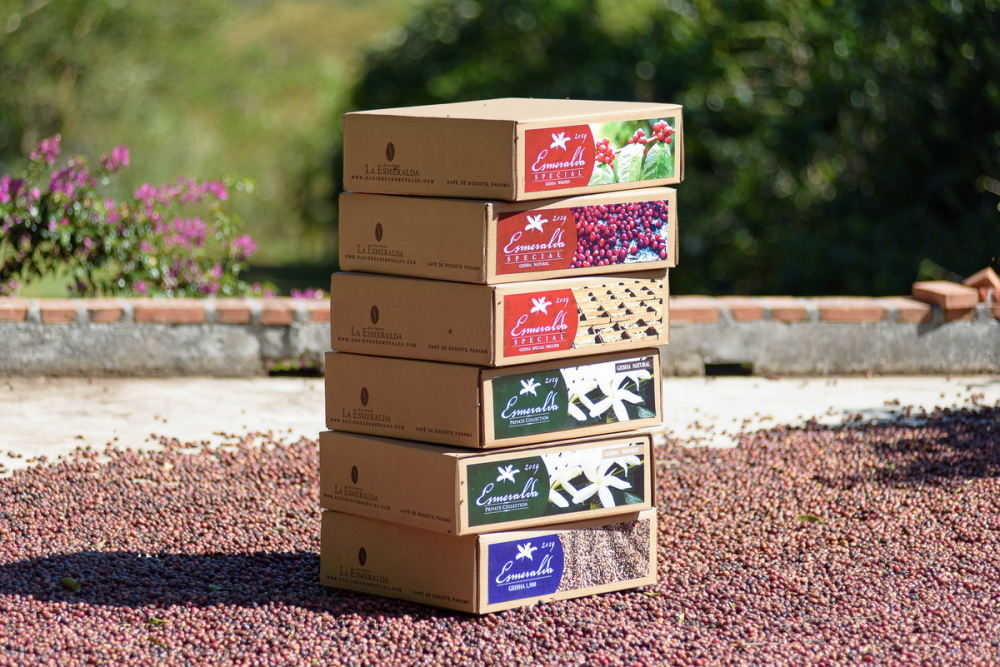
The left image is Hacienda La Esmeralda, and the right image is Gesha Village
Gesha Village is located in southwestern Ethiopia near South Sudan, nestled within the densely forested Bench Maji (班其玛吉), and from within Gesha Village, one can directly gaze upon the beautiful scenery of ancient forests. This is a typical Ethiopian highland terrain, where even the lowest-altitude plots exceed 1900 meters, and the advantage of high altitude is providing coffee cherries with conditions for slow ripening at low temperatures, allowing them to accumulate more flavor compounds.
Both are top-tier Geishas, which one tastes better?
Currently, the "Gesha Village Gold Label" and "Hacienda La Esmeralda Red Label" on Front Street Coffee's bean list are both natural process batches, with the most expensive Red Label from Hacienda La Esmeralda's Buenos Aires (布宜诺斯艾利斯) plot in Jaramillo, and the Gold Label from Gesha Village's Oma (欧玛) plot, both natural process batches.
Next, let's temporarily set aside the price and compare and brew these two top-tier Geishas representing the two estates, then through tasting, see whose flavor comes out on top. The brewing parameters are: 15g coffee, EK43 grinder at setting 10, 80% pass-through rate with a No. 20 sieve, 1:15 coffee-to-water ratio, 92°C water temperature, three-stage brewing, V60 dripper.
Dry aroma: The coffee grounds of the Gold Label Geisha have a very bright citrus fruit aroma, with a fresh scent resembling orange peel that is very appealing; the Hacienda La Esmeralda Red Label Geisha, on the other hand, wins with a rounded sweet aroma of roses, dried fruit, and apricot, accompanied by a bit of nut and toffee characteristics, emphasizing the word "sweet."
Flavor: The freshly brewed Gold Label Geisha exhibits uplifting notes of blueberry, sweet cherry, honeydew, and magnolia, with bright overall acidity, clean and elegant, and as the temperature drops slightly, it begins to show a unique aftertaste like small green tangerine tea. The Hacienda La Esmeralda Red Label Geisha, on the other hand, has a pleasant floral scent upon smelling, and immediately upon tasting, one feels rich tropical fruit aromas, with careful reflection revealing flavors of jasmine, cranberry, dried mango, and fruit candy, and a fragrant finish that is full without being astringent, very comfortable to drink. Through direct comparison, Front Street Coffee believes that in terms of flavor complexity, the Hacienda La Esmeralda Red Label Geisha is indeed slightly superior.
The above content is compiled by CoffeeHunters, a coffee news website.


