







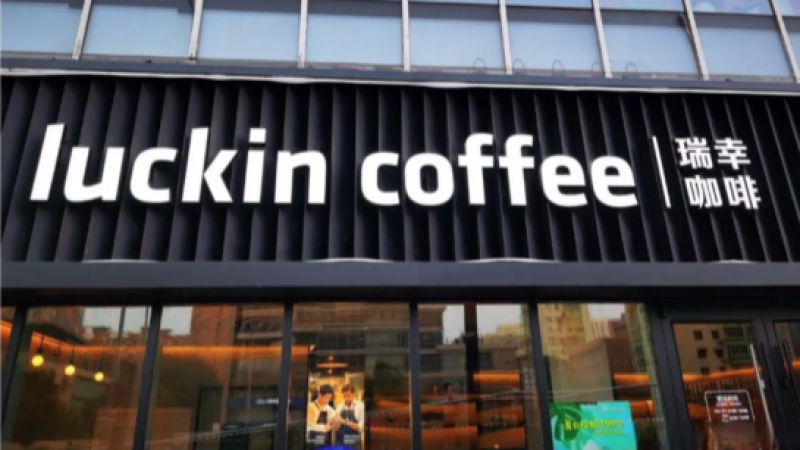
What Does Luckin's Store Growth Mean for the Coffee Industry?
Luckin Coffee added a net 10,000 stores in one year, reaching 19,961 outlets by June 30, 2024: 13,056 self-operated and 6,905 franchised. That pace, about 27 openings a day, surpasses Mixue Bingcheng, which added just over 7,000 stores in the same period. Scale, however, has not translated into steady profit.
The financial picture shows the strain. Luckin swung to a first-quarter loss, its second-quarter net margin narrowed, and same-store sales at directly operated outlets fell year on year. The 9.9-yuan promotion cut average spend per customer, leaving revenue up but profit flat as rivals like Cotti and Starbucks keep discounting.
Luckin Coffee is smashing records in the chain coffee industry at an astonishing pace, adding a net 10,000 stores within a single year and pushing its total store count close to 20,000 — an expansion rate that even outpaces Mixue Bingcheng. Yet alongside this runaway growth, problems have come thick and fast: a swing from profit to loss in the first quarter, a declining net profit margin in the second quarter, and a year-on-year drop in same-store sales at directly operated outlets. The 9.9-yuan promotion has dragged down average spend per customer, making "revenue up, profit not" a real challenge. As Luckin grapples with price wars against rivals like Cotti and Starbucks, how it balances scale against profitability will be the key question for its future operations.
Recently, media reports cited Luckin's disclosed data showing that on June 5, 2023, Luckin celebrated the opening of its 10,000th store, and by June 30 of this year, its total store count had reached 19,961 — 13,056 self-operated stores and 6,905 franchised stores. This means that in just one year, Luckin added a net 10,000 stores, equivalent to an average of 27 new openings per day.
The data reveals that Luckin's store-opening momentum over the past year has been extremely aggressive, with an expansion rate even surpassing Mixue Bingcheng, long known as the "store-opening maniac" — after all, between June 2023 and June 2024, Mixue Bingcheng added only just over 7,000 stores.
Notably, Luckin took five years to go from zero to 10,000 stores, but only one year to go from 10,000 to 20,000. In July this year, Luckin's flagship store in Beijing's Zhongguancun officially opened, marking its entry into the "20,000 club" of chain brands. By contrast, its closest industry rival Cotti Coffee has yet to surpass 10,000 stores.
It is understood that within the new tea beverage chain sector, Luckin's 20,000-store scale is roughly equivalent to the combined store counts of competitors Starbucks, Cotti, Lucky Cup, and Huka, with Cotti and Lucky Cup operating at only one-third and one-seventh of Luckin's scale, respectively.
Furthermore, across domestic food and beverage chain enterprises, only four brands currently rank ahead of Luckin in store scale: Shaxian Delicacies, Wallace, Mixue Bingcheng, and Lanzhou Beef Noodles.
Yet financial reports reveal another side: in the first quarter of this year, Luckin ended a six-quarter streak of profitability, swinging to a net loss of 83.2 million yuan; in the second quarter, although revenue increased by 2.2 billion yuan year-on-year, the net profit margin was only 10.4%, far below the 16.1% recorded in the same period last year.
In other words, despite Luckin opening more stores and growing revenue, same-store sales at directly operated outlets declined year-on-year in both the first and second quarters of this year, dragging down per-store profitability.
Regarding the decline in store performance, Luckin explained in its two quarterly earnings reports that the notable drop in profit was mainly attributable to its ongoing 9.9-yuan high-quality coffee promotion, which pulled down average product pricing.
The root cause of "revenue up, profit not" lies in the price war — the ongoing 9.9-yuan campaign keeps suppressing Luckin Coffee's average price per cup.
Luckin has clearly recognized this problem and is gradually narrowing the scope of its price subsidies. Some 9.9-yuan subsidized drinks have now been raised to 11.9 yuan; in February this year, Luckin's "9.9 yuan per cup every week" promotion still covered 8 drinks, but by March, the weekly 9.9-yuan section in its mini-program had only 5 drinks left.
But the 9.9-yuan price war isn't something Luckin can stop unilaterally just because it wants to. In April this year, Cotti announced it would extend its store subsidy policy through December 31, 2026; in May, Cotti strategy officer Li Yingbo said the company was "prepared" to sustain a "9.9-yuan across-the-board promotion" for three years; even Starbucks, which has been reluctant to "bow its head," was forced to join the discounting ranks, rolling out limited-time offers this year such as "three cups for 49.9, two cups for 39.9, and a 30% off single-cup voucher."
It is not hard to see that in the fiercely competitive new tea beverage market, although Luckin Coffee already holds the top spot in domestic coffee brand store counts, how to maintain sustained and stable profitability will be the core challenge it must tackle on its future business path.
Image source: Internet
The above content is compiled by CoffeeHunters, a coffee news website.


