







What Does the Dongpeng Special Drink Test Say About Nutritional Value of Coffee?
A third-party test of 12 functional beverages found a 500mL bottle of Dongpeng Special Drink contains 66.5 grams of sugar, about 15 sugar cubes, the highest in the group. Nescafe, Rijaman and Monster fell into the low-sugar category, while Dongpeng, Red Bull and others were classed as high sugar. Dongpeng said its formula is state-approved and recommended one bottle per day.
The result matters because high sugar intake is linked to obesity, chronic disease and faster aging, yet sugar is hard to remove from functional drinks without losing taste. For readers weighing the nutritional value of coffee or whether there is granulated sugar for coffee, the comparison is useful: unsweetened coffee has almost no sugar, while sweetened ready-to-drink products can carry a full day's worth in one bottle.
A 500mL bottle of Dongpeng Special Drink contains as much as 66.5 grams of sugar, equivalent to eating about 15 sugar cubes. A third-party testing agency's evaluation of 12 functional beverages on the market shows that Dongpeng Special Drink leads by a wide margin in sugar content, even surpassing carbonated drinks known for their high sugar levels. In response to this result, Dongpeng replied that its formula has been approved by the state and recommended drinking only one bottle per day. High sugar intake is closely linked to obesity, chronic diseases, and even accelerated aging, yet the sugar in functional drinks is difficult to completely remove. When late-night overtime workers treat Dongpeng Special Drink as a "life-renewing miracle," do they realize they are being "stabbed in the back" by high sugar? This article will deeply analyze this test report and explore the high-sugar dilemma of functional beverages.
The sugar content per bottle is roughly equivalent to 15 sugar cubes. As a functional beverage, Dongpeng Special Drink's sugar content is shockingly even higher than carbonated drinks, which are famously known as "happy fattening water"!
Recently, a functional beverage ingredient evaluation report released by an authoritative third-party testing agency pushed Dongpeng Special Drink into the center of public opinion. As the brand with the highest sales and market share among functional beverages, the fact that Dongpeng Special Drink's sugar content seriously exceeds standards immediately triggered widespread concern across all sectors of society.
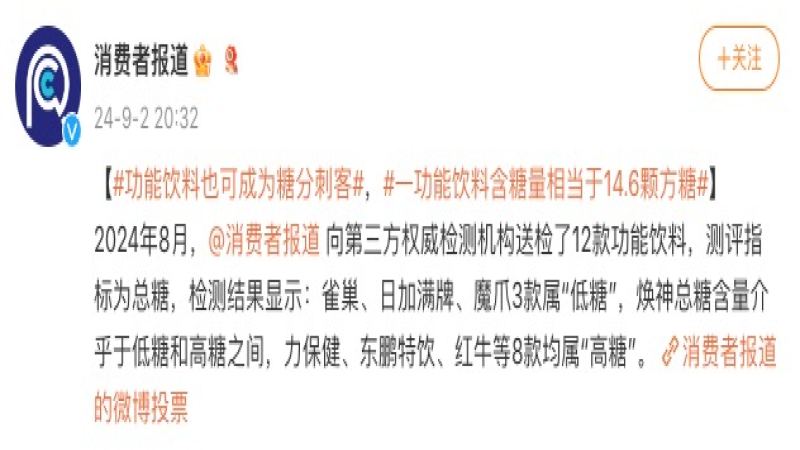
According to Consumer Reports, the media sent 12 functional beverages currently on sale in the market to an authoritative third-party testing agency, with total sugar content as the core evaluation indicator. The test results showed that three products—Nescafe, Rijaman, and Monster—fell into the "low sugar" category, Huanshen's total sugar content fell between low sugar and high sugar, while eight products including Livzon, Dongpeng Special Drink, and Red Bull were all classified as "high sugar."
Among these products, Dongpeng Special Drink ranked first in sugar content, with each bottle (500mL) containing up to 66.5g of sugar. Drinking one bottle is equivalent to consuming 14.6 sugar cubes (calculated at 4.54g of sugar per cube).
In response to this test result, Dongpeng Beverage replied: "The safety and functionality of the formula have been evaluated and approved by relevant national authorities. At the same time, our product label clearly states that it is recommended to drink one bottle per day."
As is well known, a high-sugar diet can easily lead to obesity. A high-sugar diet causes blood sugar to rise rapidly, and the pancreas then secretes large amounts of insulin to regulate blood sugar. Insulin's regulation of blood sugar is not limited to accelerating sugar metabolism; it also converts excess sugar into fat for storage. Through accumulation over time, our body shape gradually becomes "rounder."
In recent years, as public attention to health has continued to rise, more and more people have begun to value the nutritional and health attributes of beverages. Various drinks have moved toward sugar reduction and sugar-free formulations to cater to contemporary consumers' pursuit of healthy eating.
However, in functional beverages, sugar is an indispensable part of the formula. Sugar can provide energy and, after being absorbed by the body, can be converted into glucose, thereby raising blood sugar levels in the human body and alleviating symptoms of low blood sugar.
The Hong Kong Department of Health believes that if a beverage contains more than 7.5g of sugar per 100mL, it should be regarded as a high-sugar beverage. The test results showed that every 100g of Dongpeng Special Drink contains 13.3g of sugar, far exceeding the "high sugar" beverage standard defined by the Hong Kong Department of Health.
The Chinese Residents' Dietary Guidelines recommend that adults' daily intake of added sugar should not exceed 50 grams, and is best kept within 25 grams. Excessive sugar intake not only increases the risk of obesity and chronic diseases, but may even accelerate aging.
Dongpeng Special Drink's best-selling 500mL product has a sugar content as high as 66.5g. In other words, even if consumers drink only one 500ml bottle of Dongpeng Special Drink per day, their sugar intake will greatly exceed the recommended standard.
The 2024 semi-annual report shows that physical laborers such as truck drivers and food delivery riders are no longer Dongpeng's only consumer group; white-collar workers in first- and second-tier cities are becoming its new growth point. When exhausted workers doing late-night overtime place their hopes on Dongpeng Special Drink to "stay alive," they are stabbed in the back by high sugar.
According to Dongpeng's prospectus, white granulated sugar has already become the most expensive part of Dongpeng's raw material costs, and its price fluctuations are even the main factor behind gross margin volatility. Taking 2020 data as an example, the procurement cost of white granulated sugar was 22.7034 million yuan, accounting for 23.7% of all raw materials; the second-largest raw material was flavoring, accounting for 16.62%.
Image source: Internet
The above content is compiled by CoffeeHunters, a coffee news website.


