







What makes Yunnan coffee different from other Arabica origins?
Yunnan small-bean coffee is Arabica, named for its smaller beans and distinguished from the medium-bean Robusta grown in Hainan. Cultivation began in 1904, when missionary Tian Deneng planted seedlings in Zhugula Village, Binchuan. Today Baoshan, Pu'er, Dehong and Lincang are the four main growing regions, each with its own climate and planting scale.
Most Yunnan coffee is Catimor, though some producers also grow Typica in Lincang and sell washed and natural lots. Lincang sits on the Tropic of Cancer with ample sun, rainfall and fertile soil, giving its arabica bright acidity, sweetness and layered complexity. Growing conditions there resemble those of Jamaica and Colombia.
Yunnan small-bean coffee actually refers to the Arabica species, named for its smaller beans, in contrast to the medium-bean Robusta grown in Hainan. The story of Yunnan coffee begins in 1904, when the missionary Tian Deneng planted the first coffee seedling in Zhugula Village, Binchuan, and it has now spanned more than a century. Today, Baoshan, Pu'er, Dehong, and Lincang are the four main production regions, each with different climate conditions and planting scales. In terms of varieties, the vast majority of what is grown in Yunnan is Catimor, while Front Street Coffee insists on selling traditionally processed beans using washed and natural methods, and also grows Typica itself in Lincang, launching "Front Street 2013." This article will comprehensively sort out the origins and development of Yunnan small-bean coffee, from production regions and varieties to flavor and brewing methods.
Yunnan coffee is also called Yunnan small-bean, because what is grown in Yunnan is the Arabica species, placing it among small-bean coffee varieties, which conveniently distinguishes it from the medium-bean Robusta coffee beans grown in Hainan. However, the ins and outs of Yunnan small-bean coffee are far from this simple, so let Front Street lay it out slowly.
Yunnan's coffee-growing history can be described as long-standing. In 1904, the missionary Tian Deneng went to Dali to preach and brought some coffee seedlings with him, planting them in Zhugula Village, Binchuan, thus opening the chapter of coffee cultivation in Yunnan.
To this day, Baoshan, Pu'er, Dehong, Lincang, and other places are the main coffee-growing areas in Yunnan. If you truly want to understand Yunnan coffee , you have to peel back the surface and explore deeper.
Lincang Production Region
Lincang is located in the zone crossed by the Tropic of Cancer, with prominent three-dimensional climate characteristics, ample sunshine, abundant rainfall, and fertile soil. Its climate type is quite close to that of the world-famous high-quality coffee origins Jamaica and Colombia. This rich land has nourished the unique Wa culture and also created Lincang coffee's distinctive regional flavor, with bright acidity, sweetness, and mellow richness and extremely layered complexity. As a result, Lincang has earned the titles "China Specialty Coffee Bean Demonstration Area" and "China Specialty Coffee Core Production Region." Within an area of 24,000 square kilometers, only one third lies below 1,300 meters in elevation, and these zones are relatively more suitable for growing high-altitude specialty coffee. In 2015, the coffee planting area was 36,000 hectares, making it the second-largest coffee-producing region in the country, and the plan was to expand to 41,700 hectares by 2020. It is mainly distributed across Linxiang, Gengma, Cangyuan, Fengqing, Yongde, Yunxian, Zhenkang, Shuangjiang, and other counties (cities).
Dehong Production Region
Dehong enjoys the reputation of "China's Hometown of Coffee" and has a typical South Asian tropical rainforest climate, with no severe cold in winter and no extreme heat in summer, and all cultivation at elevations above 1,000 meters. In 2015, the planting area was 18,000 hectares, the area in production was 9,300 hectares, and output was 28,000 tons, including an agricultural output value of 616 million yuan and an industrial output value of 800 million yuan. It is home to the only national-level leading enterprise in agricultural industrialization in the coffee industry, Dehong Hogood Coffee Co., Ltd., and has successfully registered the "Dehong Coffee" geographical indication. The plan was to expand to 20,000 hectares by 2020, mainly distributed across Ruili, Mangshi, Lianghe, Yingjiang, Longchuan, and other counties (cities).
Baoshan Production Region
Baoshan's Lujiangba is located on the eastern slope of the Gaoligong Mountains and belongs to a dry-hot river valley zone. Its climate type is a South Asian tropical plateau monsoon climate with dry winters and wet summers, abundant sunshine, sufficient heat, relatively low rainfall, warm winters with little fog, and no frost throughout the year, earning it the titles "Natural Greenhouse" and "Treasure Land of the Hot Zone." In December 2010, after review by China's General Administration of Quality Supervision, Inspection and Quarantine, it was decided to implement national geographical indication product protection for "Baoshan small-bean coffee ." In 2015, the coffee planting area was 13,000 hectares, and the plan was to expand to 20,000 hectares by 2020. It is mainly distributed across Longyang, Longling, Changning, Shidian, and other counties (cities).
Pu'er Production Region
Pu'er is called "China's Coffee Capital." Its history of coffee cultivation can be traced back to the late 19th century, and it began to take the path of industrialization in 1988. By 2015, the coffee planting area had reached 50,000 hectares, with 26,800 hectares in production, output of 48,900 tons, and total output value of 1.2 billion yuan. The plan was to expand to 54,000 hectares by 2020. It is mainly distributed across Ning'er, Simao, Jiangcheng, Menglian, Lancang, Jinggu, Mojiang, Jingdong, Zhenyuan, Ximeng, and other counties (cities). Pu'er is currently the largest coffee-producing region in the country by planting area and output, and an important coffee trading and distribution center. The coffee industry has become one of the important pillars of Pu'er's plateau-characteristic agriculture and an important supporting industry for building the national green economy pilot demonstration zone.
Small-bean coffee refers to Arabica coffee beans. Because the beans are relatively small, it is also called small-fruit coffee; Robusta coffee is called medium-fruit coffee, while Liberica belongs to large-fruit coffee. What is grown in Yunnan is Arabica coffee, so it is also called Yunnan small-bean coffee. It is further divided into Typica and Catimor. Although both belong to the Arabica family, their flavor differences are very significant. When people today say Yunnan small-bean coffee , they generally mean the Catimor variety. So what exactly is going on behind this?
Typica Coffee
What Father Tian planted in 1904 was precisely the Typica coffee variety. By the 1930s, the returned overseas Chinese Liang Jinshan also promoted Typica cultivation in Yunnan, which was the first wave of coffee planting in Yunnan. The second wave appeared in the 1950s and 1960s after the founding of New China, when Typica coffee was widely planted in order to supply coffee beans to the Soviet Union.
Typica has weak disease resistance and is susceptible to leaf rust, so its growth condition must be monitored at all times, with every leaf carefully tended. In addition, Typica yields relatively low. As the planned economy gradually shifted to a market economy, coffee farmers who lost government guidance became less motivated and turned to growing other high-value cash crops.
Catimor Small-Bean Coffee
In the 1980s and 1990s, Nestlé entered the mainland market and at the same time supported Yunnan's coffee-growing industry to supplement its supply of coffee raw materials. What Nestlé introduced was precisely the Catimor variety. Catimor is a hybrid of Timor and Caturra, while Timor is itself a hybrid of Robusta and Arabica, so Catimor carries one quarter Robusta genes. This makes it exceptionally tenacious and high-yielding, and it is a sun-loving coffee tree (not requiring shade trees), but its drawback is equally prominent—poor flavor—so it was used only as a raw material for Nestlé's instant coffee production.
Today, almost 99% of coffee beans in Yunnan are of the Catimor variety. In terms of flavor, this is a root-level problem. With the vigorous development of China's specialty coffee market, Yunnan coffee has naturally entered the public eye. Quite a few friends have come to ask Front Street: "I drank an anaerobic Yunnan bean and it was stunning. Has Yunnan coffee now reached the level of specialty coffee?"
Indeed, in the past two years Yunnan has begun researching special processing methods, and we can taste Yunnan beans showing tropical fruit flavors such as jackfruit, passion fruit, and mango. On the surface, the flavor of Yunnan coffee has improved and it has leaped into the ranks of specialty coffee, and the price has naturally multiplied several times over. But this is like treating the symptoms rather than the root cause. Without changing the source varieties, it is very difficult to truly produce coffee with the good flavor of the Yunnan production region.
Front Street believes that the quality of Yunnan coffee has not yet reached the standard of specialty coffee. First is the variety: most of Yunnan grows Catimor, so in terms of variety it already loses to Typica coffee beans. Second, many use anaerobic processing. Although this is a novel processing method, it masks the coffee's original flavor, so how can it be called specialty?
Therefore, the Yunnan beans sold by Front Street are all traditionally processed coffee beans such as washed and natural. On Front Street's bean list, there are 3 Yunnan coffee beans, namely washed small-bean coffee (Catimor), natural Catimor, and natural Typica coffee beans.
If you ask Front Street how Yunnan coffee beans taste, Front Street would recommend that you try washed Yunnan small-bean coffee. Washed processing best reflects the coffee flavor of a production region, and Catimor accounts for 99% of Yunnan coffee, so it represents the flavor of the vast majority of Yunnan coffee beans.
Front Street's Yunnan small-bean comes from the Baoshan production region. The cupping flavor is: rich fruity aroma on entry, melon and herbal notes, smooth on the palate, nuts and milk chocolate in the middle, lively and bright plum acidity in the finish, salivation on both sides of the cheeks, good balance, medium body with a full mouthfeel. As the temperature goes from hot to warm, you can feel the layering of sweetness and acidity, first sweet then sour, with apricot and citrus acidity, and a black tea finish with a hint of brown sugar.
The natural Catimor also comes from Lujiangba, Baoshan, Yunnan. We know that the higher the altitude at which Arabica is grown, the better the flavor. This coffee bean grows at 1,450-1,550 meters, so its flavor quality is naturally better. This bean uses full red cherry natural processing, carefully selecting bright red coffee cherries for natural drying. The coffee processed this way has extremely high sweetness, and Front Street considers it the fighter jet among Catimor.
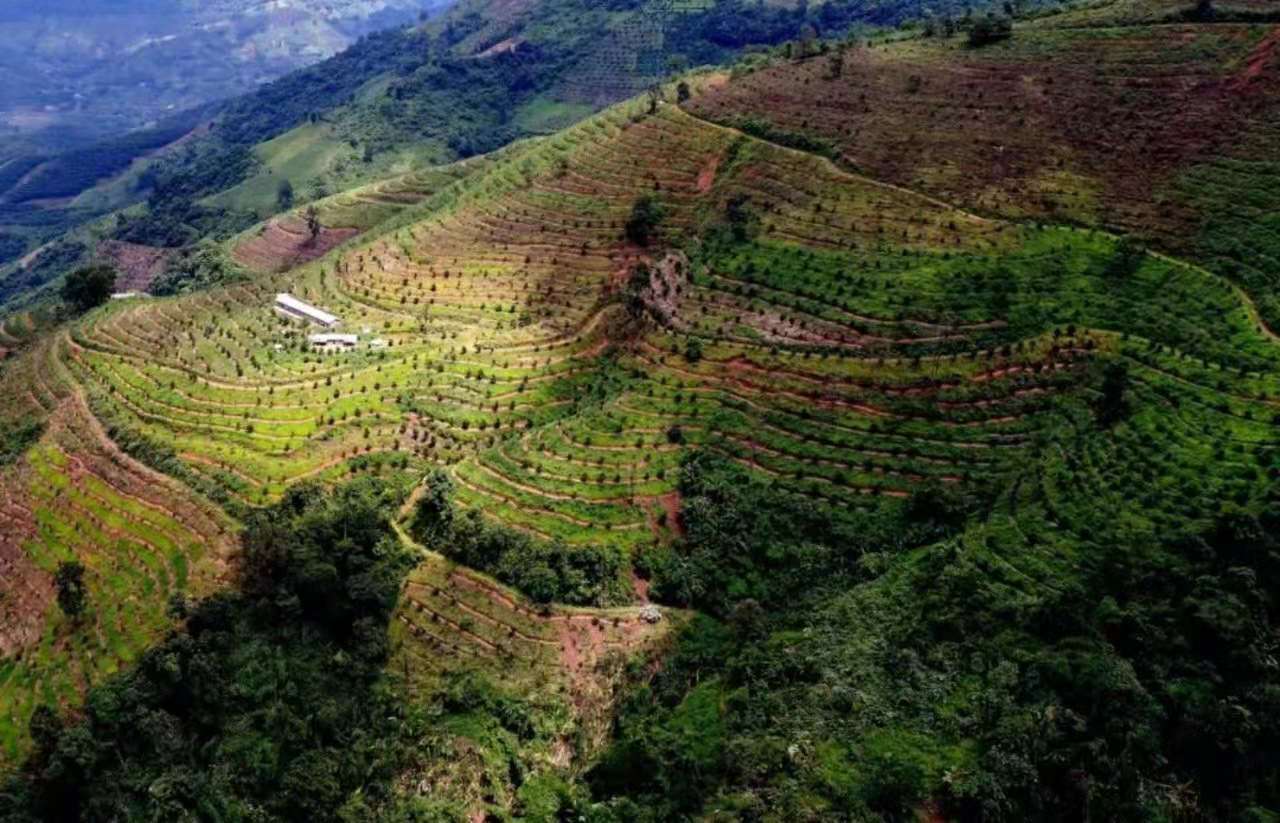
The Yunnan natural Typica sold by Front Street is called "Front Street 2013," and this is a Yunnan bean grown by Front Street itself. Front Street began growing coffee in Yunnan in 2013. The original idea behind growing coffee was to verify a conjecture: can "good land, good variety, good cultivation" really change the much-criticized taste of Yunnan coffee? With this conjecture in mind, Front Street visited veteran coffee-growing predecessors at the Spice and Beverage Research Institute, found a piece of undeveloped forest, and started growing coffee from scratch. Front Street deeply understands the importance of variety and specifically chose the Typica variety that has taken root in Yunnan for many years. Typica is rather delicate and must be cared for extremely carefully, so the Front Street employees responsible for cultivation built a simple house at the foot of the mountain and lived a life of rising at sunrise and resting at sunset. Front Street's plantation is located in Lincang near Myanmar, sparsely populated, with only a village of a few dozen people nearby. Therefore, the original ecological environment is still preserved there, making it very suitable for growing good coffee.
In 2020, the first batch of Yunnan Typica coffee beans grown by Front Street itself came to market, named "Front Street 2013." It uses full red cherry natural processing to highlight sweetness. Front Street's cupping flavor notes are dried apricot, Sanhua plum, and caramel chocolate, with very high sweetness.
Front Street Coffee Brewing Recommendations
Dripper: Hario V60
Dose: 15g
Water temperature: 90°C
Grind size: 75% passing a No. 20 sieve
Water-to-coffee ratio: 1:15
Front Street Coffee Brewing Yunnan Coffee
Brewing method: Front Street recommends using a three-stage pour. In the first stage, pour 30 ml of water and bloom for 30 seconds. In the second stage, pour 100 ml of water in a circular motion, and when the water level drops halfway, continue pouring the third stage up to 225 ml. After the coffee in the dripper has finished dripping, remove the dripper and end extraction.
For professional coffee knowledge exchange and more coffee bean information, please follow Coffee Workshop (WeChat public account: cafe_style) For more specialty coffee beans, please add the private WeChat of Front Street Coffee (FrontStreet Coffee), WeChat ID: qjcoffeex
The above content is compiled by CoffeeHunters, a coffee news website.


