








What Does Piccolo Coffee in English Mean for Cup Size and Ratios?
Piccolo coffee in English simply means small, and the Piccolo Latte is a mini latte served in a 3 to 4 ounce glass, roughly 88 to 118 ml. A standard build is one shot of espresso plus two parts milk and a thin layer of silky foam, a 1:2 ratio that lets the coffee flavor show without turning harsh.
The drink began as a way for roasters and baristas to test whether beans and milk worked together without pouring full 300 ml lattes. It later became a pick for customers who want less caffeine. Just as cappuccino means a specific milk-and-foam build in English, piccolo signals a fixed small format.
The espresso family is enormous. The same espresso plus milk, simply with different ratios, gives rise to lattes, cappuccinos, flat whites, and other distinctive drinks. This article focuses on one of the smallest members—the Piccolo Latte. We begin with the origin of its name and historical background, explaining why it is called a "small latte" and how it was originally used to test the harmony between coffee beans and milk. Next, we compare it with a regular latte in terms of cup size, number of espresso shots, and milk foam thickness, and share the specific parameters used by Front Street in practice—such as dose, extraction time, and milk steaming volume—to help readers recreate a balanced mini latte at home.

In the vast landscape of Italian coffee, simply adjusting the ratio of espresso to milk yields drinks as different as lattes, cappuccinos, and flat whites. In this issue, Front Street will discuss one of the petite members—the Piccolo Latte, which some also see as a mini version of the latte.
What exactly is a Piccolo Latte?
The English name for Piccolo Latte is "Piccolo Latte." "Piccolo" means piccolo in English, but in Italian it means "small," so it is often nicknamed the small latte. However, if you simply understand it as a scaled-down latte, you underestimate the thought behind the name.
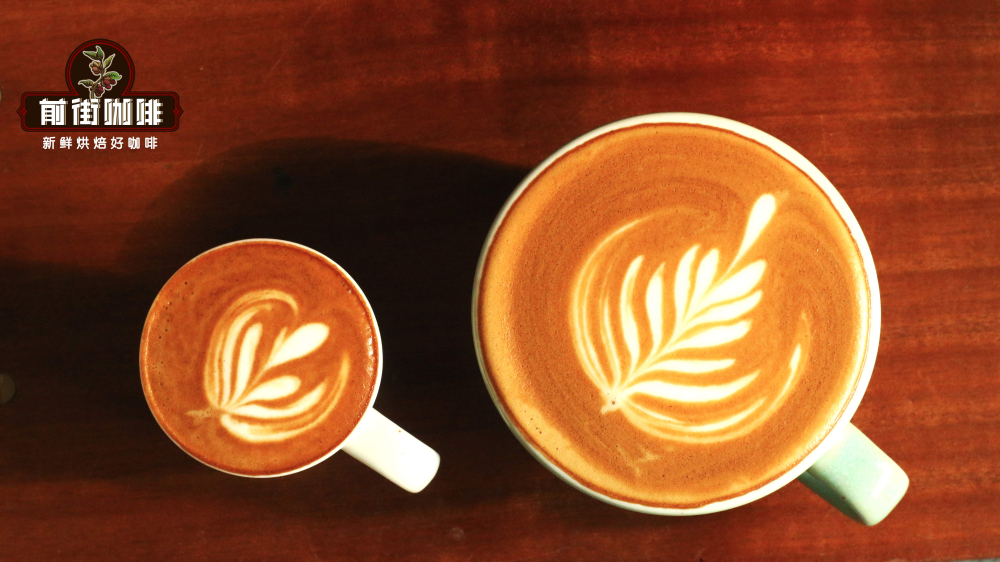
Traditionally, a Piccolo Latte is served in a 3 to 4 ounce (about 88 to 118 ml) glass. Sasa, the 2015 World Coffee Championship winner, once described it this way: in a 3-ounce cup, add 1 shot of espresso, then two parts milk and a layer of fine, silky milk foam, with a ratio of 1:2. This combination allows the coffee flavor to fully express itself without being overly intense.
Why was the Piccolo Latte invented?
The birth of this coffee originally came from roasters or baristas wanting to test whether coffee beans and milk were compatible, without making a standard-sized latte every time (a regular latte is about 300 ml, and large-scale testing would consume a lot of milk). Later, it gradually became an ideal choice for customers who do not want too much caffeine or are not satisfied with a large latte.
How does Front Street make a Piccolo Latte?
Since Front Street has not included the Piccolo Latte in its regular offerings, the shop does not have 90 ml glasses, so it uses a 90 ml ceramic cup to serve this coffee.
According to the traditional Piccolo Latte recipe, it should be 1 shot of espresso (about 30 ml) with two parts milk and milk foam (about 60 ml). However, Front Street now prefers to measure by weight, because the volume of crema changes with conditions and milliliters are not stable; calculating by grams is more precise.
To make a richer, more intense milk coffee, Front Street chose Front Street PWN Golden Mandheling SOE coffee beans. As one of the representatives of Asian specialty coffee, Front Street Golden Mandheling SOE undergoes three rounds of hand sorting plus one round of machine sorting. The beans are uniform and translucent, and after medium-dark roasting they are plump, exuding intense aromas of spice, caramel, cedar, and dark chocolate. The coffee extracted with a moka pot has a solid mouthfeel and good crema, making it very suitable for friends who do not like acidic coffee.
If you prefer the coffee's bitterness to be less prominent, you can try Front Street Strawberry Candy espresso. This bean is designed specifically for enthusiasts who favor floral and fruity notes, blending Costa Rica, Colombia, and Ethiopia. It has aromas of rose, citrus, grape, and dried blueberry, and when made into an Americano it presents a clear sweetness like fruit gummy candy.
Front Street uses a double shot of espresso (20 g) as the base for the Piccolo Latte, and including the crema, the volume is about 40 ml. When making the espresso, Front Street uses a double portafilter, doses 20 g of coffee grounds, extracts 40 g of coffee liquid in 27 seconds, and then splits the coffee liquid in two using a splitter.
When steaming milk, Front Street uses a 350 ml milk pitcher and pours in 100 ml of milk (too little milk is hard to steam), steaming it to a fine foam of 0.5 to 0.7 cm, then fully integrating the milk with the coffee before serving. Since the cup is only 90 ml, and there is already about 30 ml of coffee liquid, there is no need to worry about an imbalanced ratio of coffee to milk.
The above content is compiled by CoffeeHunters, a coffee news website.


