








How Does New Zealand Coffee Culture Shape the Flat White?
Flat white and latte are both espresso-based milk drinks, but they differ in milk foam thickness, milk ratio, and overall mouthfeel. A flat white is built on a double ristretto with foam just 0.3 to 0.5 cm thick, which keeps the coffee flavor rich and smooth rather than milky. The drink became popular in the 1980s as part of Australian and New Zealand coffee culture, where drinkers wanted stronger coffee without excess milk diluting it.
Australia and New Zealand each claim the flat white's origin, and both developed their own preparation paths. One uses a double ristretto mixed with steamed fresh milk; the other combines a single espresso with thin milk foam. Milk steaming technique matters here, since thin, glossy microfoam is what separates a flat white from a latte. Home brewers can adjust grind and milk texture to match either style.
Flat white and latte are both popular espresso-based milk coffees, but the two differ distinctly in milk foam thickness, milk ratio, and overall mouthfeel. Flat white uses a double ristretto as its base, with milk foam as thin as 0.3–0.5 cm, pursuing a rich, smooth, true coffee flavor. This article sorts out the origin background of flat white, its preparation method, a comparison with latte and cappuccino, and includes Front Street store's production parameters and five espresso blend bean recommendations, for coffee lovers to reference when recreating it at home.

For more specialty coffee knowledge, please follow: Front Street Coffee (Frontsteet Coffee)
Whether it's a larger cup or a smaller cup, whether water is added or milk is poured in, the base of common drinks like americano, latte, flat white, and cappuccino is inseparable from espresso. Espresso has extremely strong compatibility; as long as you adjust the type of auxiliary ingredient or change the ratio, it can evolve into another popular drink. The protagonist Front Street is introducing today—flat white—was formed precisely by adjusting hot latte, and has now become a quite popular member of the espresso family.
How did Flat white come about?
Regarding the birthplace of flat white, Australia and New Zealand each insist on their own view, both believing it originated in their own country. Although the place of origin is difficult to determine, one point can be confirmed: the emergence of flat white stemmed from Australians' higher demands for coffee flavor. In the 1980s, flat white began to become popular. At the time, people wanted higher coffee quality but were unwilling to let too much milk dilute the coffee, thereby preserving the strong flavor of espresso while also drinking a creamy, smooth texture, which also placed specific requirements on milk steaming. Flat white happened to satisfy these needs and gradually became an important foundation of Australian and New Zealand coffee culture.
Based on the characteristics of flat white, Australia and New Zealand each developed different presentation methods, thus forming two preparation paths. One uses a double ristretto as the base, mixed with steamed fresh milk, highlighting a rich milky coffee taste; the other mixes a single espresso with thin milk foam into a milk coffee.
The specific method varies depending on the coffee beans a store selects and the flavor it wants to express. The flat white produced by Front Street store uses its own roasted "Sunflower Warm Sun Blend Coffee," which has a fresh flavor and soft mouthfeel, so it uses a double ristretto as the base.
What is the difference between flat white and latte?
The most notable identifying feature of flat white is that thin, smooth layer of milk foam. The "Flat" in flat white means flat, which is to say the milk foam of the finished flat white must be thin enough to be level with the rim of the cup, not bulging over the edge, so that every sip of strong coffee liquid enters the mouth with a silky layer of foam.
Among the three common hot milk coffees, cappuccino has the thickest milk foam, usually 1–2 cm; flat white has the thinnest, generally only 0.3–0.5 cm; latte's milk foam is mostly around 0.5–0.7 cm and bulges slightly, while flat white's milk foam must be controlled below 0.5 cm, otherwise the liquid surface cannot achieve a "flat" effect. The specific thickness of milk foam differs from one coffee shop to another; some baristas, to let customers experience the upper layer of coffee crema to the greatest extent, simply don't steam milk foam and directly pour heated milk into the espresso. Front Street hopes customers will taste a dense, smooth flat white, so it retains a 0.3 cm layer of milk foam.
For a flat white pursuing a rich taste, the proportion of milk added to the espresso is smaller, and the specific amount of milk also depends on the cup volume produced by the store. It can be understood this way: if the same milk ratio as a latte is used, the overall drink tastes more like coffee-flavored milk. For example, the ceramic cup used by Front Street store for its flat white is 180 ml; using two ristrettos totaling 30 grams as the base, then 150 grams of hot milk must be added to present a richer, fuller coffee flavor.
How to make a cup of rich, fragrant flat white
As everyone's love for espresso continues to deepen, many "coffee enthusiasts" have already equipped themselves at home with pressurized espresso machines. If you want to make flat white at home, you can also refer to Front Street store's production process and parameters.

Front Street has a total of 5 espresso blend coffee beans in different styles. To let everyone taste the most complete coffee flavor, all coffee beans sold by Front Street are shipped within 5 days after roasting is completed.
"Front Street Specialty Blend Coffee Beans" are suitable for homes, offices, and specialty community coffee shops. Composed of Colombian washed coffee beans and Brazilian semi-washed coffee beans, they present flavors of nuts, dark chocolate, and caramel, with a comfortable bittersweet taste. Paired with milk to make a latte, it goes down smoothly, latte art shapes are stable, and the roasted aroma is rich; making a Dirty not only forms a beautiful layer but also leaves dark brown "tiger stripes" floating on the coffee surface.
"Front Street Commercial Blend Coffee Beans" are suitable for all types of coffee shops. Composed of Colombian washed coffee beans, Brazilian semi-washed coffee beans, and a small amount of Robusta coffee beans, they present flavors of nuts, cocoa, and caramel. Compared with other espressos, Front Street Commercial Blend uses the classic combination of Brazil and Colombia, then adds a small amount of Robusta, adding a highlight to the original flavor layers; the coffee shows complex nutty aromas such as toasted bread, almonds, and walnuts, with good crema fluidity and a low-acid, full-bodied taste. Combined with its price advantage, it is undoubtedly an excellent choice for opening a shop.
"Front Street Dark Cocoa Blend Coffee Beans, recommended by many baristas" are suitable for all types of coffee shops, bakeries, beverage shops, and home coffee machines. Composed of Yunnan washed small-bean coffee beans and Brazilian semi-washed coffee beans, they blend nutty notes with the acidity of ripe plums; after grinding into powder, they give off the aroma of creamy chocolate and cocoa cookies, with a balanced taste and golden-glossy crema, very suitable for friends opening a shop or using at home.
"Best-selling espresso coffee bean recommendation—Front Street Classic Blend Coffee Beans" are suitable for beginners, those learning latte art, and specialty coffee shops pursuing a high-end positioning. Friends who want to practice latte art at home can choose Front Street Classic Blend. This is a medium-dark roast espresso recipe composed of three origins, inspired by the "Mamba" popular in ancient times, that is, the combination of Mandheling and Brazil; to add aroma and crema, Front Street Classic Blend also adds a small amount of Robusta, thereby enhancing flavor intensity, letting beginners easily make espresso with golden crema at home.
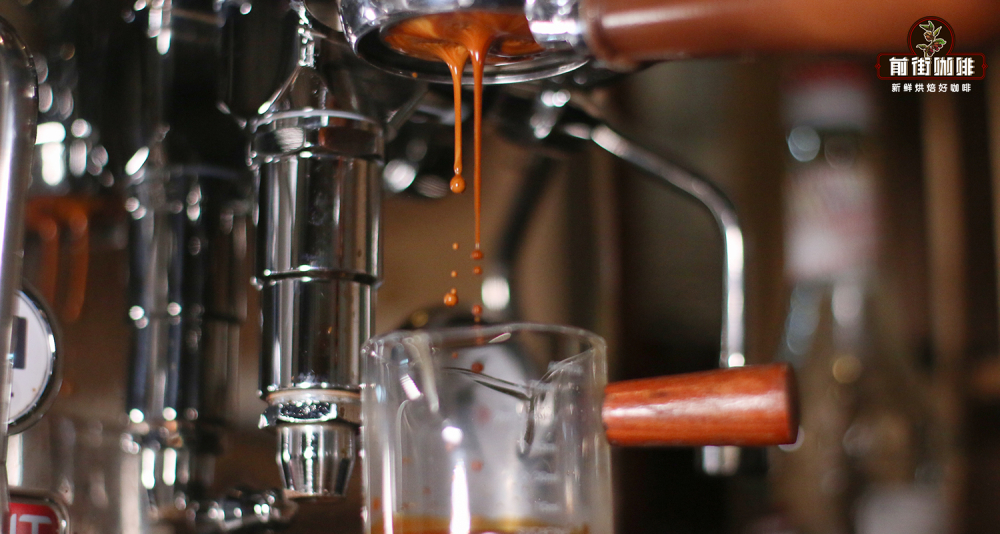
Front Street uses a 1:1.6 powder-to-liquid ratio for making espresso ristretto, that is, using 20 grams of coffee powder to extract 32 grams of coffee liquid, with extraction time controlled between 27 and 30 seconds. The cup capacity of Front Street's flat white is about 200 ml; prepare 170 ml of refrigerated fresh milk, and the dense milk foam after steaming is about 5 mm, with temperature controlled at 55–65°C, just right for drinking. Gently swirl the espresso ristretto base in the cup, and evenly and fully integrate the steamed hot milk into it.
A freshly made flat white goes down as silky as chocolate milk, with the texture of butter cookies and chocolate milk, fragrant, rich, and mellow, with a very long-lasting finish.
The above content is compiled by CoffeeHunters, a coffee news website.


