








How does the coffee tree grow and why does altitude matter?
Coffee is an evergreen shrub in the Rubiaceae family, and commercial cultivation rests on two pillars: Arabica and Robusta. Specialty coffee comes mainly from Arabica varieties such as Typica, Bourbon and Caturra. Coffee trees grow in more than 70 countries in tropical and subtropical zones roughly between 25 degrees north and south latitude.
From planting, a coffee tree needs three to five years to flower and bear cherry-like fruit. After the skin and pulp are removed, seeds wrapped in parchment go to a nursery; they germinate in one or two months, growing a taproot first. After about nine months the seedling has 12 to 16 leaves and stands near 50 centimeters, ready for transplant to the estate.
Coffee, as an evergreen shrub of the Rubiaceae family, has two main cultivated varieties: Arabica and Robusta. Among them, specialty coffee mostly comes from Arabica branches such as Typica, Bourbon, and Caturra. About 70 countries around the world grow coffee in tropical and subtropical regions between 25 degrees north and south latitude. From sowing to first flowering usually takes three to five years. This article will introduce in detail the complete growth cycle of the coffee tree from seedling raising, flowering, to fruit ripening, and systematically compare the core differences between Robusta and Arabica in planting altitude, flavor characteristics, production share, and other aspects. At the same time, for coffee lovers who prefer a rich oily mouthfeel, the article also specially recommends two espresso beans containing Robusta components, Front Street Classic Blend and Front Street Commercial Blend, to help readers more comprehensively understand coffee varieties and purchasing directions.

Front Street - A Brief Introduction to Coffee Growing Conditions
From the perspective of plant classification, coffee belongs to the genus Coffea in the Rubiaceae family. Commercial cultivation is supported by two main pillars, Arabica and Robusta, while specialty coffee is mainly concentrated in varieties under Arabica such as Typica, Bourbon, and Caturra. The coffee tree is an evergreen shrub, and it is currently cultivated in more than 70 countries around the world with suitable climatic conditions, with its distribution roughly concentrated in tropical and subtropical zones between 25 degrees north and south latitude. Usually, after planting, it takes 3 to 5 years before the coffee tree flowers and produces cherry-like fruit.
After removing the outer skin and pulp of the coffee fruit, the seeds still wrapped in the parchment layer are placed in a nursery for cultivation. After about one or two months, the seeds begin to germinate, first growing a taproot to stabilize the seedling. After about nine months, the seedling develops into a small tree with 12 to 16 leaves and a height of about 50 centimeters, at which point it can be transplanted to the estate. After planting, it continues to grow for 3 to 5 years (at least 3 years) before the coffee tree reaches its first flowering. Coffee flowers are pure white, usually composed of 5 petals, and often give off a faint fragrance similar to jasmine.
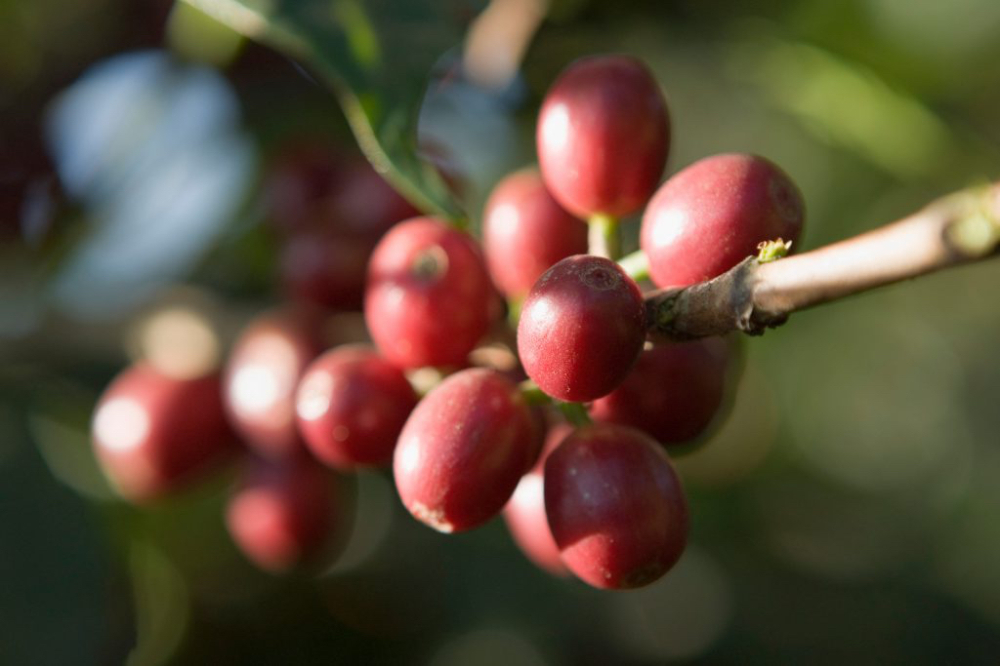
The flowering period of the coffee tree is extremely short, beginning to wither in about 3 days and completely fading within a week. After the flowers fade, the fruit gradually forms. Coffee cherries need 6 to 8 months of growth before they slowly mature. At first, the fruit is green and hard, then gradually changes color and softens over time, eventually becoming bright red ripe fruits (of course, there are exceptions, such as Yellow Bourbon, which turns yellow when ripe). For this reason, coffee fruit is often called "red cherry" or "coffee cherry."
Robusta: Usually processed with a dark roast, with a strong taste, prominent body, and flavor characteristics such as walnut, herbal, woody, and roasted notes
Growing regions: The main producing areas of Robusta beans include Indonesia, India, Vietnam, Laos, Hainan in China, and Guangdong, among others
Production share: Robusta beans account for about 30% of total global coffee production
Suitable altitude differences: Robusta is generally grown below 800 meters above sea level. This variety has extremely strong adaptability and high resistance to pests and diseases
Flavor performance: Robusta has very low acidity, carries the aroma of trees and wheat, and has a very rich oil content. High-quality Robusta beans are usually used in espresso blends. Because of its obvious roasted aroma and relatively light taste, with acidity not prominent and bitterness stronger, it is also often used to make instant coffee.
Therefore, if you especially pursue a rich oily experience, you may want to give priority to two espresso beans, Front Street Classic Blend and Front Street Commercial Blend, both of which contain a certain proportion of the Robusta variety. Front Street Classic Blend combines beans from Brazil, Mandheling, and Robusta, and uses a medium-dark roast. During extraction, it releases noticeable aromas of butter, toasted bread, and caramel biscuits. The flavor is rich, the mouthfeel is solid, the crema is delicate, and extraction stability is excellent, making it a must-have home coffee choice for beginners. In addition, its low acidity, high body, and price advantage undoubtedly make it the best choice for beans used in opening a shop.
The above content is compiled by CoffeeHunters, a coffee news website.


