







What separates the panama geisha coffee labels?
Hacienda La Esmeralda sells its Panama Geisha under three labels: Red, Green and Blue. The labels reflect growing plot, lot selection and cup performance rather than a single fixed flavor. Red Label sits at the top of that range, Green Label is the more accessible tier, and Blue Label is the entry level.
Geisha coffee itself was collected in Ethiopia's Kaffa forests in 1931, sent to CATIE in Costa Rica in 1953 as T2722, and reached Panama in the 1960s. The Peterson family at La Esmeralda later pushed the variety to prominence with its white floral and citrus honey profile.
Geisha coffee is known as the "ceiling of the coffee world," and its elegant white floral aroma and bright citrus honey sweetness have captivated countless coffee lovers. However, when faced with the three brands launched by Hacienda La Esmeralda—Red Label, Green Label, and Blue Label—many people feel confused: What exactly are the differences between them? This article will begin with the historical origins of Geisha, tracing the legendary journey of this variety from the wild forests of Ethiopia to Hacienda La Esmeralda in Panama, and will analyze one by one the grading standards, production plots, and flavor characteristics of Hacienda La Esmeralda's three major Geisha brands. At the same time, Front Street Coffee will also share product information for two popular Geisha coffees in-store, the Red Label and Green Label, to help everyone have a clearer reference when making everyday purchases.
For more specialty coffee knowledge, please follow the WeChat official account: Front Street Coffee (FrontStreet Coffee)
Geisha is an extremely rare variety in the coffee world, known for its elegant white floral aroma and bright orange-blossom honey sweetness. It has repeatedly taken first place in major coffee competitions, and its price rises year after year, which is why it is often given the title "ceiling of the coffee world." Today Front Street will talk about the origins of Geisha and why exactly it is so enchanting.
In 1931, Geisha was first collected in the wild forests of Kaffa in southern Ethiopia. At the time, the purpose was to find new varieties resistant to disease, and it was named after Geisha Mountain near where it was discovered. Afterward, this batch of seeds was sent successively to research institutions in Kenya, Uganda, Tanzania, and other places for trial planting. In 1953, Geisha was introduced to CATIE, the Tropical Agricultural Research and Higher Education Center in Costa Rica, and recorded under the number T2722. Although many local farms planted it, Geisha's branches are slender and easily broken, and its yield remained low, so it never received much attention from farmers and was not widely promoted.
By the 1960s, CATIE distributed T2722 Geisha to coffee growers in Panama, and only then did Geisha truly take root in Panama. In the 1990s, the Peterson family of Hacienda La Esmeralda began vigorously developing the coffee business and bought a new farm in a high-altitude area—Jaramillo. At that time, many coffee trees on the farm were infected with leaf rust, but Daniel Peterson noticed that the Geisha trees were clearly less damaged. So they decided to transplant the Geisha, which had originally been mixed among other varieties, separately to more areas of the farm, while also planting it at higher elevations.
In 2003, the Peterson family finally realized Geisha's true potential. When it was cupped for the first time, the cup showed an extremely intense white flower aroma and a very clean mouthfeel, with a finish carrying notes of berries, citrus, and bergamot, thus establishing the classic flavor impression of Panamanian Geisha. Amid their surprise, they decided to enter this coffee in the 2004 BOP (Best of Panama) competition and officially named it "Geisha." So today's world-stunning Panamanian Geisha is precisely the T2722 variety from back then.
The reason Geisha has won the favor of so many coffee people is that, unlike the traditionally heavy and deep impression of black coffee, it is more like a fresh and lively floral-fruity tea. It gives off a rich fragrance and layered fruit flavors, evoking a series of distinctive aromas. As the temperature changes, its delicate mouthfeel and the fruitiness interwoven with sweetness and acidity fill the entire mouth. Geisha's outstanding flavor performance is enough to make it the "ceiling" in the minds of many coffee people. And the talent scout who pushed Geisha onto the altar was none other than Panama's Hacienda La Esmeralda. Front Street's bean list has always retained two popular products from Hacienda La Esmeralda—"Red Label" and "Green Label"—allowing enthusiasts to enjoy the "ceiling" of specialty coffee in daily life as well.
Guests who come to Front Street for the first time to taste Hacienda La Esmeralda Geisha often ask: "Why is Hacienda La Esmeralda's Geisha so expensive?" Front Street has mentioned in many articles that coffee is ultimately an agricultural crop, and its flavor performance is inseparable from factors such as variety, climate, altitude, soil, and management. The taste of coffee is the most authentic presentation of variety and terroir, and what post-processing and roasting need to do is preserve, restore, and display the bean's own flavor as completely as possible. The reason Hacienda La Esmeralda's Geisha can perform so excellently is precisely the result of all the above conditions working together.
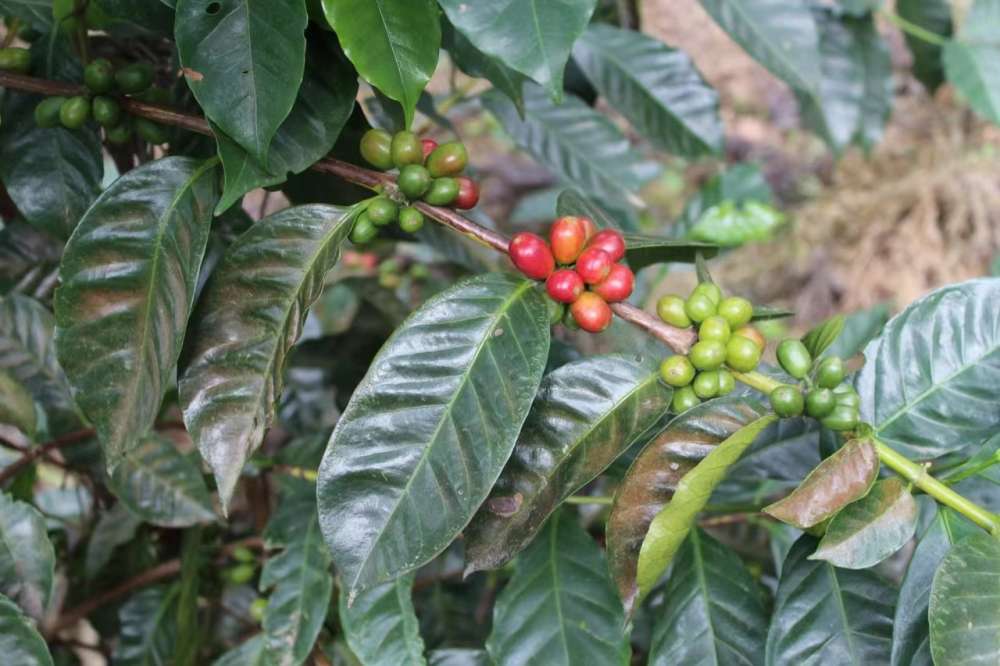
Compared with other Arabica varieties, Geisha not only produces few cherries, but the plant itself is also especially fragile and even more demanding about its growing environment. It needs high altitude, fertile soil, and also cloud cover or tree shade, and cannot be directly exposed to the sun. Geisha's leaf system is very thin, so its photosynthetic efficiency is therefore very low; its root system is also fragile, and it absorbs water and nutrients very slowly, so its yield is extremely low. In addition, in high-altitude environments the fruit ripening period is later, and the fruit production of a single Geisha tree is only half that of the Caturra variety, which is also one of the reasons for Geisha's high price.
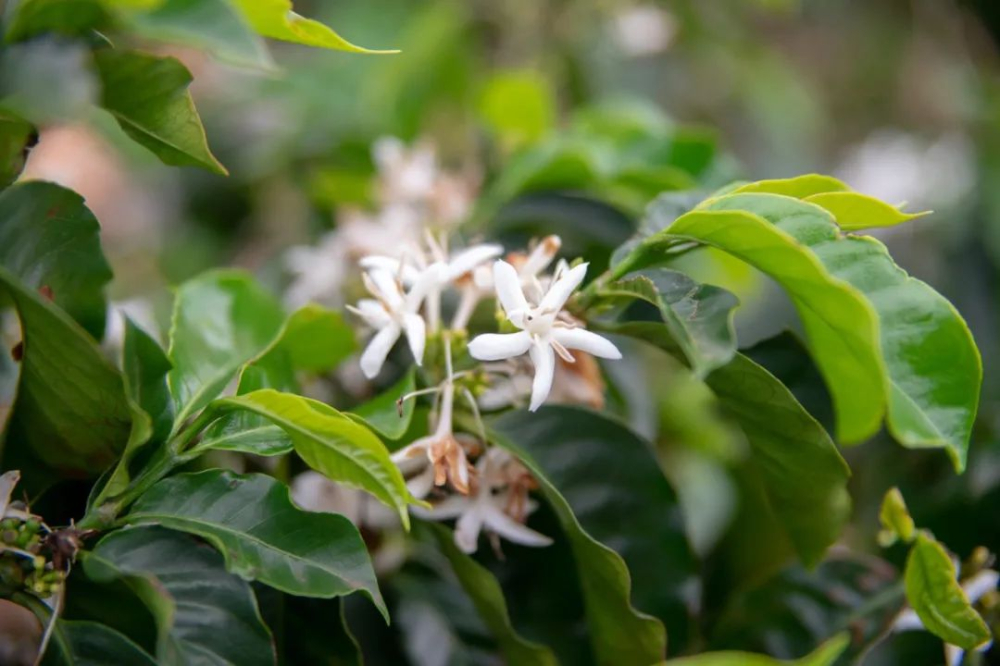
As the saying goes, things are precious when rare. Geisha's production is extremely limited. Panama's total annual coffee output is about 10,000 tons, while the renowned Hacienda La Esmeralda produces only 150 bags of green beans each year, equivalent to about 9,000 kilograms. If Geisha accounts for only 3% of that, it is merely 270 kilograms. Add to that the continuous hype by various media about Geisha's flavor, and people's enthusiasm for it only grows, so its price naturally remains high.
Characteristics of Geisha coffee beans
As Front Street Coffee (FrontStreet Coffee) mentioned above, after Geisha made a stunning debut at the BOP competition, a wave of Geisha planting swept through Panama. But Geisha trees are not easy to manage, have low yields, have strict altitude requirements, and the green bean processing stage also has particular requirements for picking. Because of these numerous barriers, not every estate can grow high-quality Geisha, which is also one of the reasons Hacienda La Esmeralda in Panama can occupy an important position in the Geisha market.
In addition, Geisha has another rather magical characteristic: the harsher the growing environment, the better the flavor of the coffee fruit, but the difficulty of picking also increases accordingly.
Therefore, Hacienda La Esmeralda invested most of its energy in infrastructure construction to support excellent batch separation and fine processing, and to grade Geisha according to plot cultivation. This also formed the Red Label Geisha, Green Label Geisha, and Blue Label Geisha now seen in Front Street Coffee (FrontStreet Coffee) stores.
Division of coffee-growing areas at Hacienda La Esmeralda
As Front Street Coffee (FrontStreet Coffee) said above, the coffee beans grown at Hacienda La Esmeralda have clear regional divisions. Mainly based on altitude, microclimate, cupping performance, and planted variety, the estate's growing areas are divided into five brands for sale. Among them, three brands belong to the Geisha variety: Esmeralda Special (Red Label), Private Collection (Green Label), and Geisha 1500 (Blue Label).
Hacienda La Esmeralda's three main plots are Jaramillo, Canas Verdes, and El Velo. Each plot is further subdivided into smaller plots.
Jaramillo:
Annual rainfall is about 4000 ml, average daytime temperature is 19-25°C, average nighttime temperature is 11-15°C, and average altitude is 1600-1700 m. The Jaramillo plot is subdivided into 5 smaller plots: Mario, Noria, Reina, Bosque, and Buenos Aires.
Canas Verdes:
Annual rainfall is about 3500 ml, average daytime temperature is 16-23°C, average nighttime temperature is 10-15°C, and average altitude is 1600-1800 m. Canas includes 9 smaller plots in total: Lino, Coronado, Fundador, León, Montaa, Trapiche, Chinta, Cabaa, and Tumaco.
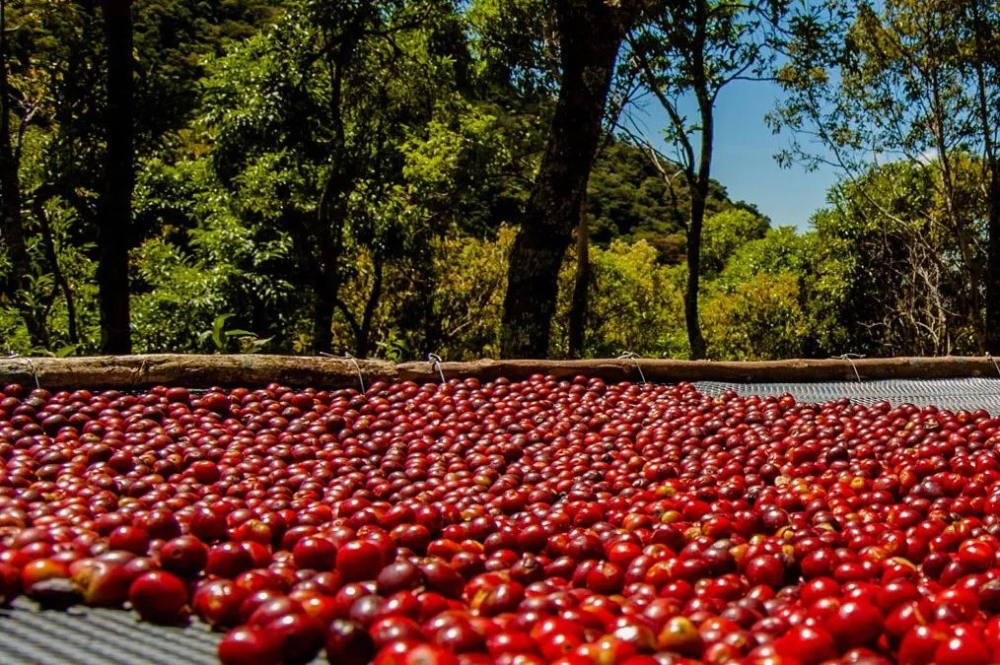
El Velo:
This plot is the most recently purchased by Hacienda La Esmeralda, with an average altitude of 1700-1900 m. In addition to growing Geisha and Catuai, there are also a small number of other introduced varieties here, such as Laurina, Pacamara, Mocha, and SL28. El Velo is divided into 7 smaller plots in total: Guabo, Portón, Durazno, Mural, Higo, Buena Vista, and guila.
Grading standards for Hacienda La Esmeralda Red Label, Green Label, and Blue Label
Hacienda La Esmeralda Red Label Geisha
The Geisha produced under Esmeralda Special is what everyone often calls Red Label. It uses Geisha coffee beans grown at an altitude of 1600-1800 meters, scoring above 90 points in cupping, and originating from the two production areas of Jaramillo and Canas Verdes.
In addition, Red Label also needs to participate in the independent auction held by Hacienda La Esmeralda itself. Among the divided plots, only the Geisha lots put up for auction count as auction Red Label. However, non-auction Red Label also circulates on the market. In fact, it is Geisha selected from the same plot that did not participate in the auction and is released to the market. The variety and quality are the same, only the selling price differs.
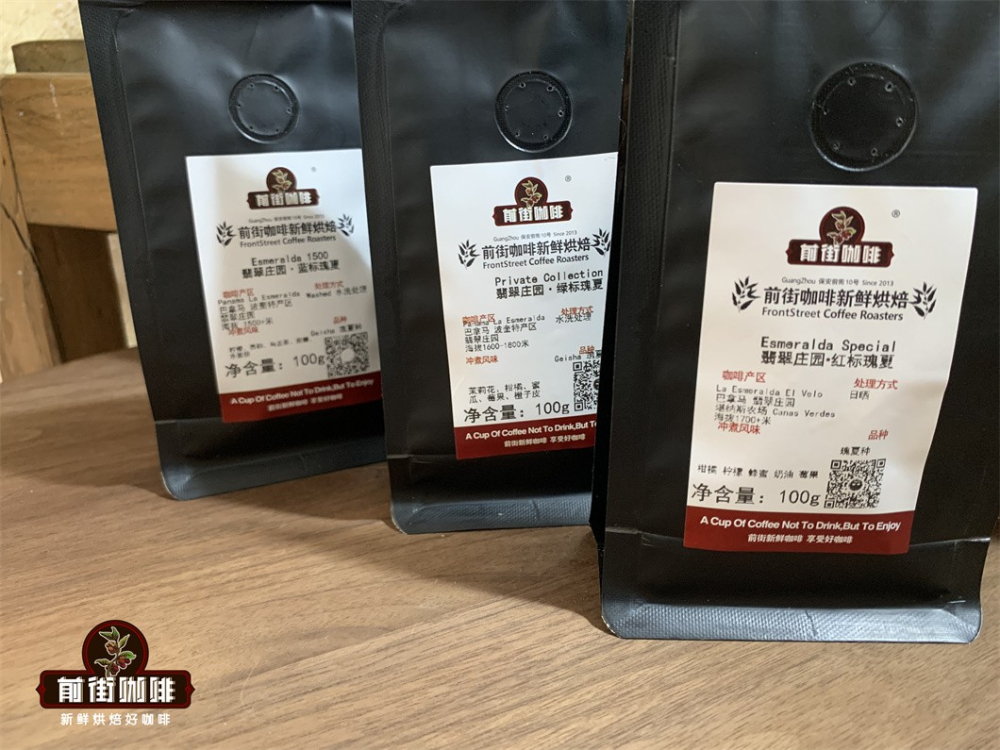
Front Street Coffee (FrontStreet Coffee) Panama Hacienda La Esmeralda Red Label Geisha Coffee Beans
Country: Panama Region: Boquete (Hacienda La Esmeralda) Altitude: 1700 m Variety: Geisha Processing Method: Natural Process Flavor: Citrus, Complex Fruit, Rose Tea, Honey
Hacienda La Esmeralda Green Label Geisha
Private Collection, commonly known as Green Label, differs from Red Label in that it is not an independent competition lot, but it is still an outstanding-quality Geisha. Green Label uses a blend of micro-lots of beans grown at an altitude of 1600-1800 meters and originating from different plots such as Jaramillo and Canas Verdes.
Because it adopts a blended-bean model, it does not provide detailed labeling of specific plots, so Green Label Geisha sometimes has a fairly high similarity in flavor to Red Label.
Second, although Green Label Geisha is not as highly graded as Red Label, it still carries Geisha's classic flavors, such as its distinctive floral aroma, fruit aroma, citrus-like acidity, and a full, juicy mouthfeel. Therefore, Front Street Coffee (FrontStreet Coffee) believes that Green Label Geisha has relatively outstanding value for money among the three labels.
Front Street Coffee (FrontStreet Coffee) Panama Hacienda La Esmeralda Green Label Geisha Coffee Beans
Country: Panama Region: Boquete (Hacienda La Esmeralda) Altitude: 1700 m Variety: Geisha Processing Method: Natural Process Flavor: Jasmine, Citrus, Melon, Berries
Hacienda La Esmeralda Blue Label Geisha
Geisha 1500, or Blue Label, refers to Geisha grown in a 1400-1500 meter environment, harvested as a blend of beans from different plots of Esmeralda's three sub-estates. The Geisha produced in this area is sold for export and becomes Volcanic Rock Geisha coffee beans, with a flavor consistent with the original Blue Label. At present, the Blue Label brand has been discontinued by Hacienda La Esmeralda, and this lot of Geisha has been converted to export sales, namely Volcanic Rock Geisha coffee beans. The Volcanic Rock flavor profile shows light floral aroma and fruity sweet acidity, and its mouthfeel fullness is not as good as the other two brands.
Front Street Coffee (FrontStreet Coffee) Panama Hacienda La Esmeralda Washed Blue Label Geisha Coffee Beans
Country: Panama Region: Boquete (Hacienda La Esmeralda) Altitude: 1400-1500 m Variety: Geisha Processing Method: Washed Process Flavor: Lemon, Oolong Tea, Cane Sugar, White Peach
The above content is compiled by CoffeeHunters, a coffee news website.


