







Where do geisha coffee beans come from originally?
Geisha coffee beans belong to the Arabica species, not a separate one. The variety was collected in Ethiopia's Kaffa forests in the 1930s, passed through Kenya and Tanzania, reached CATIE in Costa Rica in 1953 as T2722, and arrived in Panama in the 1960s. Panama is where it became famous.
Its cup shows white floral aroma, layered fruit and a clean tea-like body. Low yield and brittle branches kept it ignored for decades until Hacienda La Esmeralda won competitions with it. Panama geisha is now planted in Colombia, Costa Rica, El Salvador, Guatemala and even parts of China.
Is Geisha coffee bean an Arabica? What variety does the Panama Geisha coffee tree originate from? These are questions many coffee lovers often have when encountering Geisha. In fact, Geisha is a precious variety under the Arabica species, and its legendary journey began in Ethiopia in the 1930s, then traveled through Kenya and Tanzania to Costa Rica, and finally shone brilliantly in Panama. Front Street Coffee, through numerous cupping sessions, has repeatedly had its understanding refreshed by Geisha's fresh floral aroma, rich fruit notes, and clean tea-like body. This article will comprehensively review Geisha's variety classification, historical transmission path, flavor characteristics, and how Hacienda La Esmeralda propelled it to the throne of top-tier coffee, while also sharing Front Street's recommended Panama Hacienda La Esmeralda Red Label Geisha and its brewing suggestions.
For more specialty coffee knowledge, please follow the WeChat public account: Front Street Coffee
In the minds of many coffee enthusiasts, the flavor landscape of specialty coffee can be simply divided into two camps: one is the extremely delicate and elegant Geisha, and the other is all remaining varieties. Geisha coffee from Panama has long secured a high position, making it arguably the most representative top-tier existence in the current specialty coffee wave. In Front Street Coffee's past cupping experiences, the clear floral aroma, richly layered fruit notes, and clean refreshing tea-like body exuded by Geisha have time and again made Front Street look at this bean with new eyes.
Flavor Characteristics of Geisha Coffee Its unique flavor expression and high price have prompted coffee growers around the world to compete in introducing Geisha. Today, Geisha coffee trees have appeared in Colombia, Costa Rica, El Salvador, Guatemala, and other countries, and can even be found in China's Yunnan and Taiwan regions.
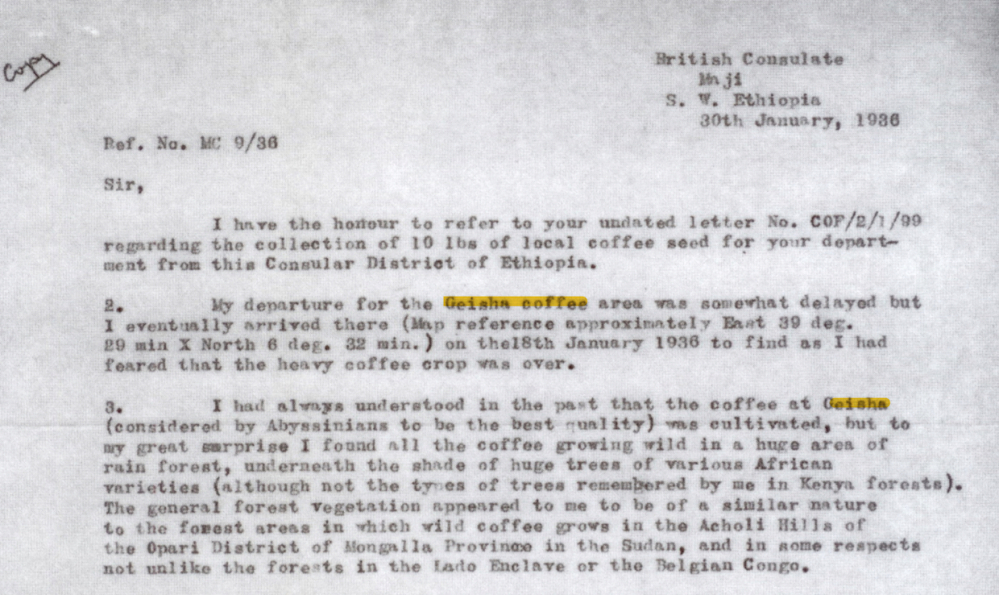
Although Geisha coffee is now scattered across multiple producing countries, it is a widely recognized fact that it rose to fame in Panama while its roots lie in Ethiopia. In the 1930s, Colonel Whalley from England was tasked with traveling to Ethiopia to collect 10 pounds of coffee seeds. In 1936, he completed the mission and wrote a letter mentioning the coffee variety GEISHA. Afterwards, this batch of collected coffee seeds was packed together into the same bag, marked with the word GEISHA, and sent to the British embassy in Kenya.
Tanzania's Lyamungu Research Center later received some of the seeds forwarded from Kenya. Subsequently, the Tanzanian side selected and bred five Geisha lines, VC496 to VC500. Among them, VC496 performed particularly outstandingly in resistance to leaf rust, becoming a star line highly regarded by that research institution, and in 1953 it was sent to Costa Rica's coffee gene bank CATIE for research on leaf rust-resistant coffee varieties. Costa Rica cataloged VC496 and renumbered it as T2722.
In the 1960s and 1970s, coffee leaf rust ravaged Central America, disheartening many growers. In 1963, Mr. Don Pachi, then serving in Panama's Ministry of Agriculture, distributed Geisha coffee seeds numbered T2722 to coffee farmers in the Boquete region for planting.
However, compared with varieties popular in Central America at the time such as Caturra and Catuai, Geisha's yield was a full two-thirds lower, and its branches were very fragile, making it difficult to withstand strong winds and heavy rain. In addition, that was an era when instant coffee and heavy roasting prevailed, so Geisha's unique charm was buried for nearly half a century before finally being discovered.
For Geisha coffee to have its status today, Hacienda La Esmeralda is an indispensable talent scout. In BOP competitions at the end of the twentieth century, Hacienda La Esmeralda often ranked at the bottom. To improve the estate's coffee quality, the estate owner introduced seeds of multiple coffee varieties from Costa Rica's CATIE for cultivation and comparative record-keeping, ultimately discovering that Geisha coffee possessed complex fruit flavors and honey-like sweetness, completely different from typical Central American coffee flavors (nuts, caramel).
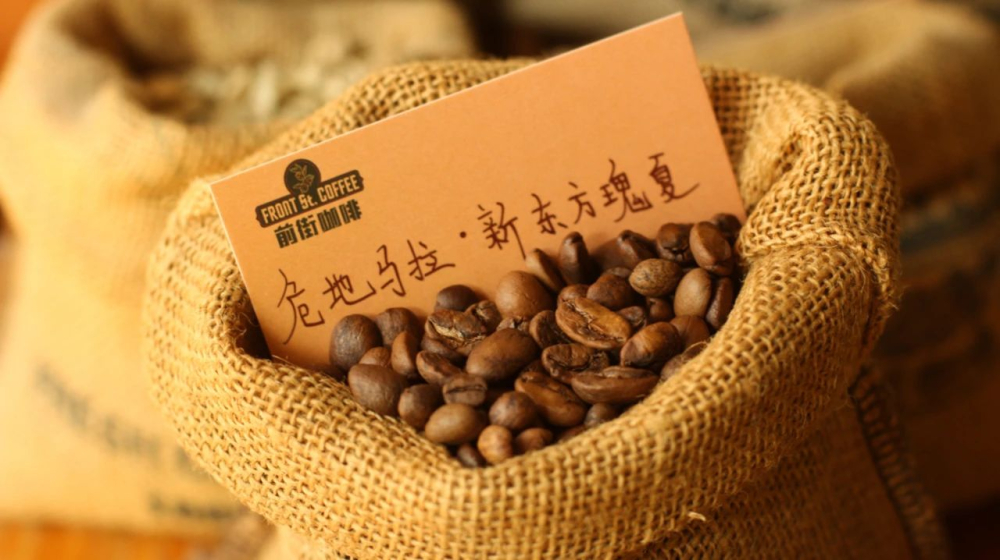
Panama Geisha Coffee Beans
In 2004, Daniel of Hacienda La Esmeralda carefully selected a competition lot to enter that year's BOP competition. Geisha's unique flavor astonished the judges present, winning that year's BOP championship in one fell swoop and subsequently setting a new auction price record for green coffee beans. For a time, Geisha became synonymous with top-tier coffee, and estate owners suddenly woke up as if from a dream, setting off a wave of Geisha planting.
As one of the participants in the coffee industry, Front Street Coffee can find many excellent-quality Geisha coffee beans from different origins on the market every year. Front Street's bean list has featured quite a few Geisha variety coffees from Central and South America: Colombia, El Salvador, Costa Rica, Guatemala, Honduras, Jamaica, and so on...
However, after comparative cupping, Front Street believes that if one wants to taste the classic Geisha coffee flavor, Panama Geisha, with its white floral aroma, honey sweetness, complex juicy feel, and clean translucent texture, is difficult for other producing countries to match.
Among Panama's three main coffee-producing regions, Boquete and Volcan are the most famous. Close to the renowned Baru Volcano, with dense primeval forests and deep fertile soil, the climate and soil conditions have made indelible contributions to producing high-quality coffee beans with outstanding flavor.
The quality of Panama Geisha can almost be equated with its auction price: in 2004, $21 per pound; in 2017, $601 per pound; in 2020, $1,300 per pound. Auction Geisha is certainly rare, but non-auction Geisha coffee beans are equally worth tasting.
On Front Street Coffee's menu, there are quite a few non-auction Geisha coffee beans that nonetheless come from top-tier Geisha estates: Hacienda La Esmeralda, Guarumo Estate, Sofia Estate, Elida Estate, Deborah Estate, Nugu Estate, Janson Estate, Donkey Estate, Aurora Estate, and so on...
As for Hacienda La Esmeralda, the discoverer of the Geisha coffee variety and promoter of Geisha flavor, Front Street believes that to taste the classic Geisha coffee flavor, it still has to be Geisha from Hacienda La Esmeralda. Among them, Hacienda La Esmeralda Red Label Geisha, as the estate's classic coffee brand, is also what Front Street strongly recommends to friends trying Panama Geisha for the first time.
Hacienda La Esmeralda places great importance on Red Label. The Geisha coffee beans under this brand are all produced above 1,700 meters, can also be labeled in detail down to the specific plot, and are additionally required to score above 90 points in cupping.
When selecting Hacienda La Esmeralda Red Label coffee beans, Front Street specifically chose Geisha coffee beans from the same plot as the estate's 2004 BOP champion lot, namely Geisha from the Mario plot of the Jaramillo farm, and adopted the most traditional processing method—natural processing—greatly enhancing the coffee's sweetness and mouthfeel weight.
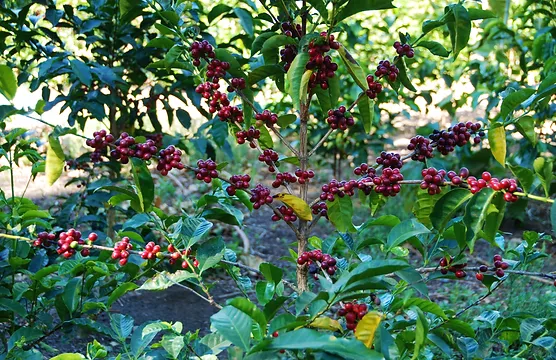
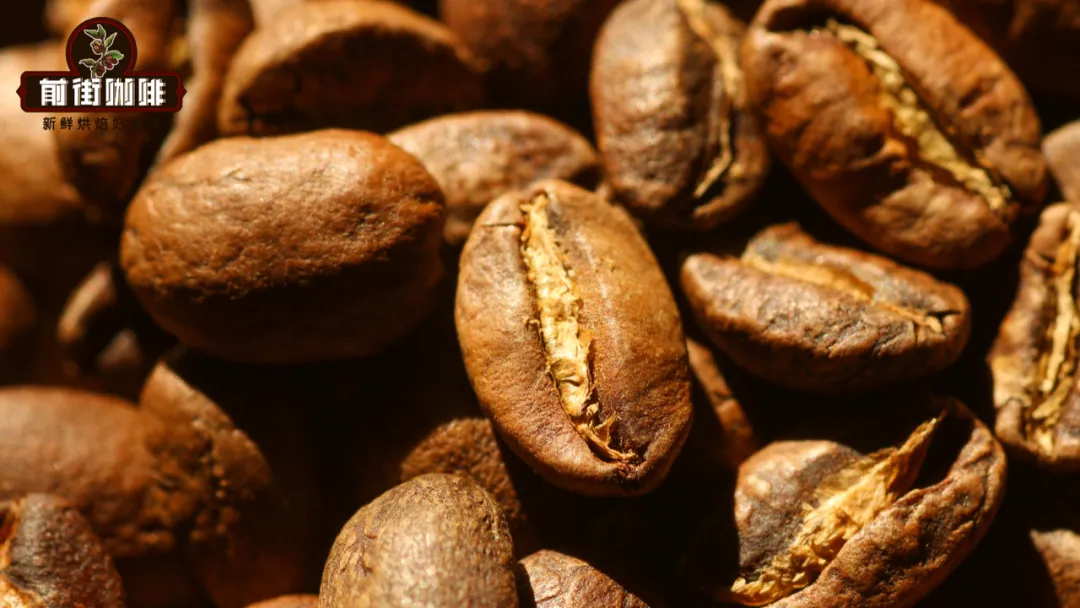
Front Street Coffee — Hacienda La Esmeralda Red Label Geisha Coffee Beans
Region: Boquete, Panama
Estate: Hacienda La Esmeralda
Plot: Mario
Altitude: 1700+ meters
Variety: Geisha
Processing method: Natural
When formulating the roasting curve, Front Street Coffee's roaster took into consideration the need to retain more floral aroma and fruit acidity in the Geisha coffee, and adopted a medium-light roast level.
With the improvement of living standards, people have set strict requirements for the freshness of food, and coffee beans are no exception. The coffee beans shipped by Front Street are all freshly roasted within 5 days. By the time they arrive, they have just passed the 4-to-7-day resting period, which is exactly the optimal flavor period.
However, Front Street occasionally receives feedback saying that the coffee tastes too rough, the flavor is thin, there is a dry sensation in the throat, and so on. This is because after coffee beans are roasted, the bean body contains abundant gas. When coffee beans that have not yet rested enough are brewed, the large amount of gas in their internal structure inhibits the release of flavor substances. After coffee beans undergo a longer resting period, the flavor and mouthfeel also tend toward roundness and fullness. Of course, impatient friends can perform a blooming step during brewing to promote gas release.
Dripper: Hario V60
Water temperature: 92°C
Dose: 15 grams
Coffee-to-water ratio: 1:16
Grind size: EK43s setting 10 (80% passing through China standard No. 20 sieve)
Three-stage extraction: First pour 15 grams of coffee grounds into the dripper and level them. For the first stage, pour 30g of water to bloom for 30 seconds while starting the timer. Throughout, use a small stream at the center point and begin spiraling outward, making sure the entire coffee bed is moistened.
For the second stage, still use a straight small stream to pour 120g of water. The purpose is to raise the entire coffee bed. You can spiral in as large a circle as possible so that all coffee particles enter a state of degassing and extraction. Finish pouring at around 1 minute 05 seconds, when the scale shows 150g.
When the liquid level drops to the halfway point, begin using a small stream to spiral in a small circle for the third stage, pouring 90 grams. Try to control the stream so it does not spiral too widely, because it is easy to disturb the coffee bed and cause under-extraction. Moreover, gentle washing can also enhance the release of sweet substances in the later stage of the coffee. The final total poured water is 240 grams. Wait until all the coffee liquid has dripped through before removing the dripper. The time is about 2 minutes 20 seconds.
The Hacienda La Esmeralda Red Label Geisha coffee brewed by Front Street using the above suggestions and steps has a pleasant floral note on the nose. On the palate, rich tropical fruit aromas are immediately felt, and on careful reflection there are also flavors of jasmine, cranberry, dried mango, and fruit candy. The fragrant finish is full without astringency, making it very pleasant to drink. Front Street believes that in terms of flavor complexity, Panama Geisha is indeed slightly superior to those from other producing regions.
The above content is compiled by CoffeeHunters, a coffee news website.


