








What Makes Elida Estate Geisha Coffee Taste So Distinct?
Elida Estate sits in Boquete, Panama, at very high altitude on volcanic soil, where cool temperatures slow cherry ripening by roughly a month. That combination has produced record BOP cupping scores. Its sun-dried Geisha shows citrus blossom, ginger flower, pear, peach, orange, cocoa, and sandalwood notes, with juicy, bright acidity and a satiny, light mouthfeel.
The estate dates to 1918 and grows three varieties: Catuai, Typica, and Geisha. Green-tip Geisha represents the top grade of its green beans. Nearby Baru Volcano gives these coffee farms a distinct microclimate, and their low temperatures let cherries develop more flavor compounds, which explains the layered floral and fruit profile in the cup.
The Elida Estate in the Boquete region of Panama, with its ultra-high altitude, volcanic soil, and microclimate, has become the record holder for BOP cupping scores. This article provides a comprehensive analysis of Elida Estate's cultivation history, variety composition, and processing techniques, with a focus on the complex flavors of its sun-dried Geisha—interwoven notes of citrus blossom, ginger flower, and fresh fruit, with a juicy and bright mouthfeel. It also shares Front Street Elida Catuai's pour-over brewing parameters and flavor performance, allowing you to experience the delicate aromas and sweet taste of a famous estate in a more accessible way.

Front Street Panama Elida Geisha Introduction
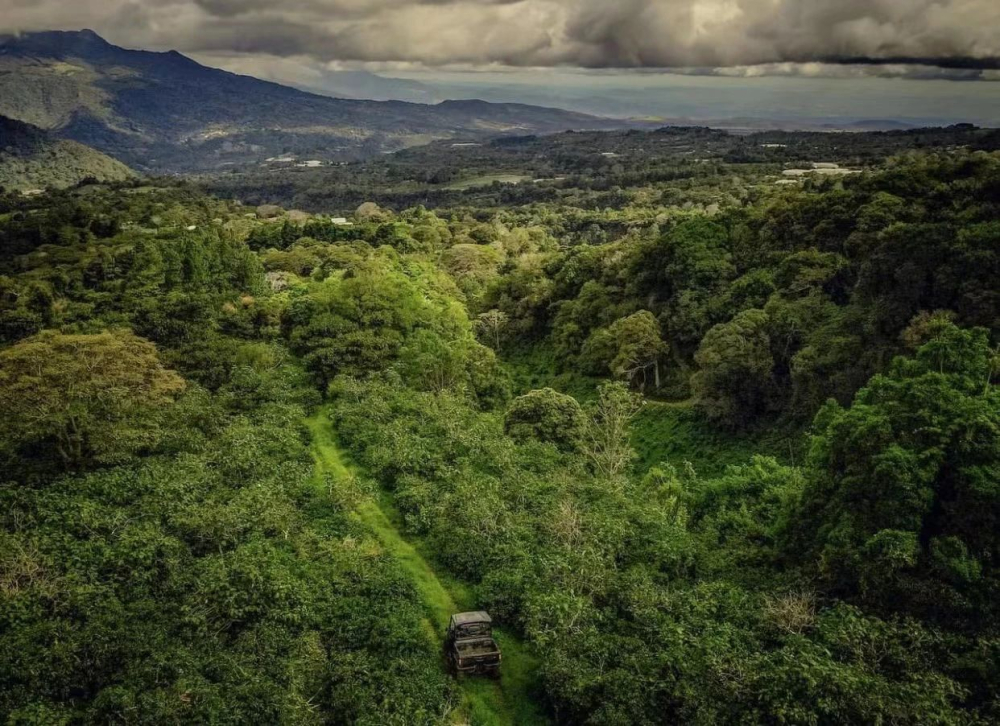
Elida Estate is located in Boquete, Panama's famous specialty coffee region. At high altitudes, low temperatures extend the ripening period of coffee cherries, typically delaying maturity by about a month compared to normal. Meanwhile, the fertile volcanic soil provides abundant nutrients for the coffee trees. Baru Volcano also endows the area with a unique microclimate. Together, these factors have contributed to Elida Estate's outstanding performance in various cupping competitions.
The history of Elida Estate can be traced back to 1918, making it a deeply established, veteran coffee estate. I have tasted the estate's Geisha many times in the past. Although quality levels have varied, the estate's core characteristic that left the deepest impression on Front Street is this: exceptionally full acidity and aroma, with intense and complex fruit flavors. Elida's sun-dried beans, in particular, are renowned.
Green-tip coffee belongs to the highest grade of Geisha green beans. Front Street Elida coffee displays excellent layering along with perfect balance. Complex floral notes (citrus blossom, ginger flower, fragrant orchid), bright acidity, fresh fruit notes (pear, peach, orange), as well as sweet cocoa, sandalwood, and a faint candy note. Structurally juicy and bright, with an aroma of umami. The mouthfeel is satiny and light, with saturated and vibrant flavors.
Elida Estate primarily cultivates three varieties: Catuai, Typica, and Geisha. The year-round low temperatures brought by high altitude delay the ripening of coffee cherries, while the estate's proximity to the volcano allows volcanic soil to provide abundant nutrients for cultivation, enabling the estate's coffee beans to win numerous awards in competitions. If you want to experience the foundational flavors of this estate's specialty coffee at a more accessible price, you can purchase Front Street Elida Catuai and savor the delicate aromas and sweet taste of a famous estate.
The estate owner, Mr. Wilford, has extremely strict requirements for coffee cultivation and processing, and is even more rigorous than his peers in the "purification" stage after green bean processing. Taking Front Street Panama Elida coffee beans as an example, after green bean processing is completed, they still require more than 5 months of low-temperature resting to remove greenness, which allows the coffee flavors to develop more evenly and fully.

Elida Estate is the most well-known estate of the Lamastus family, founded in 1918. From the planting of the first coffee tree by Robert Lamastus, the founder of the family coffee estate, a century has passed, and it has also witnessed the global spread of specialty coffee. Today, Elida Estate is still carried on by descendants of the Lamastus family, including estate owner Mr. Wilford, his father Thatcher, and fourth-generation successor Wilford Jr. As a traditional coffee family, coffee has long been in their blood. Wilford was born on a small coffee farm, and both of his parents were also born on coffee farms. Currently, the coffee produced by the estate comes from Elida Estate, Donkey Estate, and Luito Estate.
In addition to its exceptional ultra-high altitude and microclimate, estate owner Mr. Wilford has also devoted tremendous effort to harvesting and processing. To achieve the highest standards, Elida Estate only allows hand-picking of the ripest coffee cherries (Ripe on Pinton). High ripeness of the fruit naturally means high sugar content in the mucilage, which is also the foundation of Elida's high-quality flavor.
In addition to being extremely strict about coffee cultivation and processing, estate owner Mr. Wilford is also more rigorous than others in the industry when it comes to "purification" after green bean processing. In the case of Panama Elida, after green bean processing is completed, the beans need more than 5 months of low-temperature resting to remove greenness, which allows the coffee's flavors to develop more evenly and fully. (Low-temperature resting is a green bean purification concept strongly promoted by coffee master George Howell starting in 2006. We have found that although green beans from subtropical regions certainly need to be stored in a low-temperature environment, different processing methods and elevations will change the duration of low-temperature resting. In the case of Panama Elida, 5 months of low-temperature resting is optimal.)
The oldest coffee estate in Panama's history and one of the highest-altitude estates in the Boquete region, it cultivates Geisha at an ultra-high altitude (2050m). It has not only won the BOP championship multiple times, but is also the holder of the BOP cupping score record—in 2018, Elida Green Tip Washed Geisha broke the 2016 BOP record of 94.15 for Elida Green Tip Washed Geisha with an ultra-high score of 94.66.
03 | Front Street Elida Estate Green Bean Analysis
Typica is one of the oldest varieties among the Arabica species discovered to date, along with Bourbon. The Arabica species originated in Ethiopia, and this species still grows naturally in the highlands of the local primeval rainforest. Typica beans are slender, the tree is tall, the fruit is oval-shaped, and the branches are slightly sloping. Typica leaves are long and narrow, with an spreading posture and a slant angle of 50–70 degrees. The coffee yield per tree is very low, but the cupping score is very high.
04 | Front Street Elida Estate Roasting Analysis
Because a lower bean-charging temperature is used, the flavor will lack the cleanliness and intensity of a high-temperature charge, but the advantage is that the mouthfeel becomes softer and smoother. Since the development time after first crack is very short, the heat must be sufficient; otherwise, the target drop temperature cannot be reached, and the degree of caramelization will also be insufficient. I will use a soak. This is what roasting beginners ask about most. In fact, the soak action is simply lowering the temperature or turning off the heat, using the roaster's temperature to continue roasting the beans. Throughout the roasting process, the beans are absorbing heat; only first crack and second crack are exothermic actions. During these two stages, it is best not to increase the heat, otherwise the beans can easily develop a spicy sensation.
Soak emphasizes that, with the heat turned off, the residual heat of the roaster and the temperature generated by the beans releasing heat during the cracking stage are used to allow the roasted beans to continue roasting slowly.
Roaster Yangjia 600g semi-direct fire
Charge when the drum temperature reaches 170°C, set the damper to 3, adjust the heat to 140°C after 30 seconds, keep the damper unchanged, turning point at 1'25''. Adjust the heat once at 140°C. At this point the bean surface turns yellow, the grassy smell completely disappears, and dehydration is complete. Adjust the heat to 110°C and the damper to 4;
At 8'45'', ugly wrinkles and dark streaks appear on the bean surface, and the toasted bread smell clearly turns into coffee aroma. This can be defined as the prelude to first crack. At this time, you need to listen clearly for the sound of the first crack point. At 9'07'', first crack begins. Reduce the heat to 90°C and set the damper to 4 (adjusting the heat must be done very carefully, and must not be so low that there is no cracking sound). 1'45'' after first crack, drop at 190°C.
Cupping:
Dry aroma: caramel, roasted almond, floral
Wet aroma: jackfruit, fermented wine aroma
Mouthfeel: smooth on entry, with obvious flavors of raisin, peach, orange, melon, sucrose, and caramel, a green tea tea-like body, and high cleanliness.
05 | Front Street Elida Brewing Analysis
Considering that Front Street Elida Catuai is mainly floral and fruit-oriented, Recommended brewing method: pour-over. Grind size: fine granulated sugar (80% passing through a No. 20 sieve). V60 dripper, 15g coffee, water temperature 90–92°C, water-to-coffee ratio close to 1:15.
Bloom with 30g water for 30s. Stages: pour to 120ml and pause, then slowly pour to 225ml, i.e. 30-120-225.
[Front Street Panama Elida Sun-Dried Catuai] Flavor and mouthfeel: on entry, peach, raisin, and orange flavors are clearly noticeable; gradually, sucrose and melon sweetness emerge; the finish carries grapefruit and a green tea tea-like flavor.
The above content is compiled by CoffeeHunters, a coffee news website.


