







What Varieties Are Grown in Yunnan Coffee Regions?
Yunnan coffee belongs to the Arabica species and is known locally as Yunnan small-bean coffee. The province supplies over 98 percent of China's coffee output. The main variety planted today is Catimor, a hybrid of Timo and Caturra, chosen for strong disease resistance and high yield rather than for extreme cup character.
The flavor follows a neutral profile: balanced acidity and bitterness, noticeable aroma, and a body that is strong without being harsh, with a light pleasant acidity. Arabica originated in Ethiopia and is also grown in Fujian, Guangdong, and Hainan. Yunnan's altitude and climate allowed planting area and output to expand, and Baoshan small-bean coffee has begun appearing in international markets.
Yunnan, as China's core coffee-producing region, accounts for over 98% of the country's coffee output. What many people don't know is that the coffee grown in Yunnan belongs to the Arabica species, locally known as "Yunnan small-bean coffee." The current main variety is Catimor, a hybrid offspring of Timo and Caturra, which has the advantages of strong disease resistance and high yield. Yunnan small-bean coffee's flavor follows a neutral route—balanced acidity and bitterness, prominent aroma, strong yet not harsh, with a pleasant slight acidity on the palate, very much in line with popular taste. Front Street's bean list also includes three Yunnan beans, among which "Front Street 2013" is roasted in-house, with a clean and bright sweetness that has received much praise. This article will take you through the variety origins of Yunnan coffee, its introduction paths, producing region distribution, and how Baoshan small-bean coffee has emerged on the international stage.
When coffee is mentioned, many people's first thought is overseas origins, rarely realizing that China also possesses a coffee-growing paradise—Yunnan. Domestic coffee comes almost entirely from here, accounting for as much as 98%. Yunnan's coffee-growing history is not short, but due to various constraints, it long failed to achieve scale. In recent years, Yunnan coffee has gradually gained attention in both quality and yield, with clear development momentum, and has even been dubbed "China's best-tasting specialty coffee." Front Street's daily bean list includes three coffee beans produced in Yunnan, among which "Front Street 2013" is produced and roasted by Front Street itself, and its flavor has won praise from many friends.
Yunnan Coffee Varieties
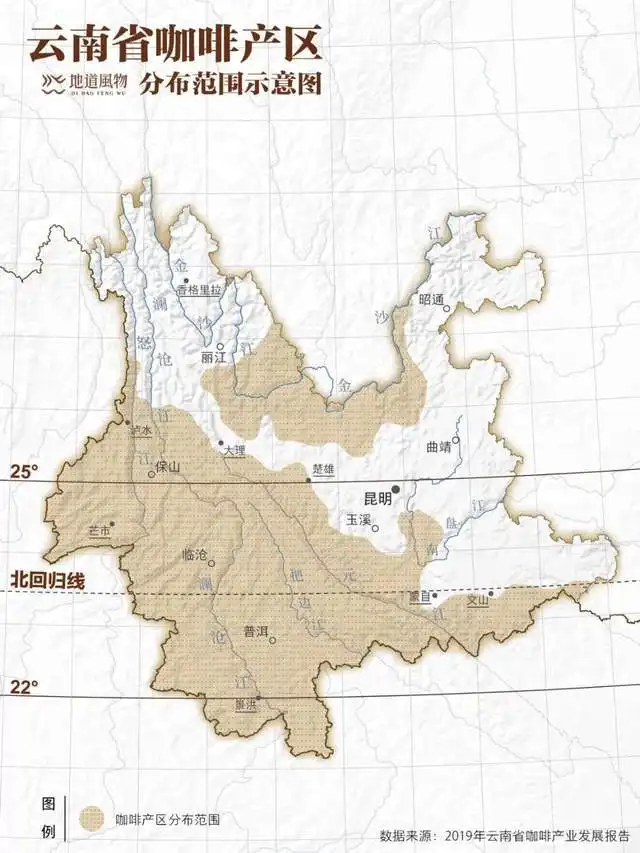
The so-called Yunnan small-bean coffee refers to the Arabica variety, which originated in Ethiopia and is cultivated in China's Fujian, Guangdong, Hainan, and Yunnan. Thanks to its exceptional geographical environment, Yunnan's planting area and output have both achieved rapid expansion, accounting for over 99% of the national total. The current main variety of Yunnan coffee is Catimor, which is a hybrid of Timo and Caturra, and therefore possesses strong disease resistance and high yield levels, earning it a place among Central American coffee varieties. Among the Yunnan coffee beans offered by Front Street, one is Yunnan small-bean coffee, and its variety is Catimor coffee. The original habitat of small-bean coffee is Ethiopia or the Arabian Peninsula. Yunnan's main planting areas are distributed in Lincang, Baoshan, Simao, Xishuangbanna, Dehong, and other places.
The original home of the Arabica species is the Ethiopian highlands, and it was introduced to Europe through the Arabian region in the 16th century. In the global coffee landscape, Arabica occupies a 75%~80% share, and its outstanding aroma has conquered coffee lovers around the world. World-famous varieties such as Blue Mountain and Mocha are almost all Arabica species.
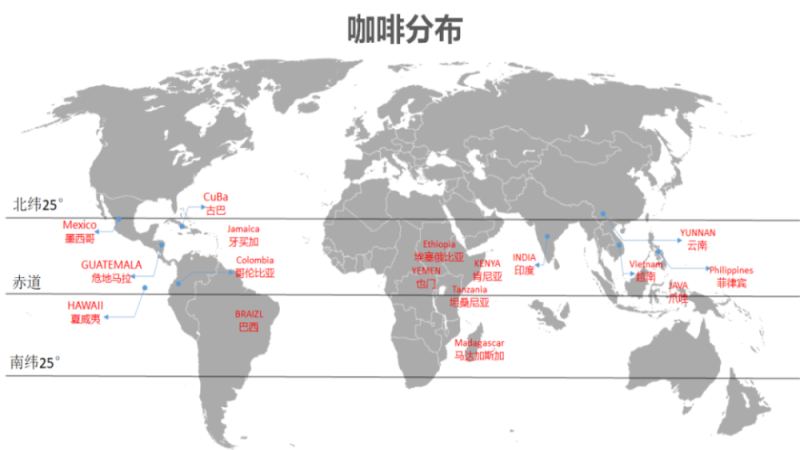
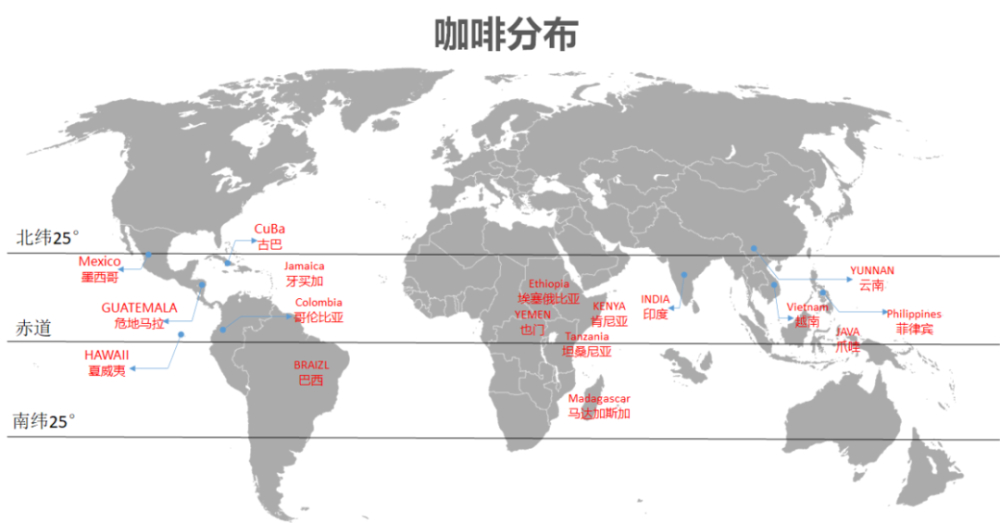
Today, the main cultivation regions for Arabica coffee beans include South America (except parts of Argentina and Brazil), Central America, Africa (Kenya, Ethiopia, and other places, mainly in East Africa), and Asia (parts of Yemen, India, and Papua New Guinea).
Arabica, with its rich fruity aroma, has won the favor of Chinese consumers who have only a short history with coffee. In the 19th century, missionaries brought it to China and widely planted it in western Yunnan. This region has abundant sunshine and significant temperature differences between day and night, and local people compensated for the shortfall in seasonal rainfall by channeling water up into the mountains, ultimately cultivating the uniquely aromatic "Yunnan small-bean coffee."
1. No contact with the ground throughout: from harvesting coffee beans to processing them into finished products, the coffee remains unaffected by soil and other debris, ensuring taste and quality;
2. Graded harvesting: because coffee beans do not ripen uniformly, harvesting concentrates beans of the same grade together rather than mixing them; manual operations require a large labor force for harvesting, sorting, and processing. Front Street's own homegrown coffee beans are hand-picked as fully red cherries and processed by sun-drying, presenting a clean, bright, and highly sweet flavor.
The History of Yunnan Coffee
According to research, Yunnan small-bean coffee was introduced via two routes, east and west. The eastern route can be traced back to 1902, when French missionaries introduced it to Zhukula in Binchuan County at 26 degrees north latitude and 1,400 meters above sea level. In this source, Bourbon accounted for 69% and Typica for 31%, though the cultivated area in Yunnan was limited. The western route involved Jingpo border residents bringing coffee to Nongxian Village in Ruili County in 1914, initially only for courtyard ornamental purposes. In early 1952, researchers from the Tropical and Subtropical Crops Research Institute of the Yunnan Academy of Agricultural Sciences discovered these plants during a social survey and collected 35 kilograms of fresh fruit, bringing them to Lujiangba in Baoshan City for trial planting, thus laying the foundation for Yunnan's main cultivated coffee varieties.
Since the 1950s, the scale of small-bean coffee cultivation in Yunnan has gradually expanded. Yunnan's superior geographical and climatic conditions are highly suitable for the growth of small-bean coffee, and have given rise to the unique flavor of Yunnan small-bean coffee—"strong yet not bitter, aromatic yet not harsh, with a hint of fruitiness"—making it quite popular in the international coffee market. In 1993, at the World Coffee Evaluation Conference held in Brussels, Belgium, Yunnan's "Baoshan Small-Bean Coffee" (a geographical indication protected product) won the world "Eureka" Gold Award. Since then, Yunnan small-bean coffee has emerged on the world stage and become a regional brand of Yunnan coffee.
In 1998, the People's Government of Yunnan Province issued the "Opinions of the People's Government of Yunnan Province on Accelerating the Development of the Coffee Industry," pointing out the direction for the development of Yunnan's coffee industry at the government level. Subsequently, driven by the market force of continuously rising coffee bean prices, Yunnan's small-bean coffee planting area expanded rapidly. By 2017, the planting area had grown to 122,000 hectares, with a total output of 144,000 tons. Output accounted for 1.5% of the global total, ranking 12th globally and 4th in Asia. At present, Yunnan Province is China's largest and most important coffee bean production base, with both coffee planting area and green bean output accounting for over 97% of the national total, and it has gradually formed a development pattern integrating planting, production, and processing.
In 2017, Yunnan had about 1,000 coffee enterprises, and the entire industry chain and its links—from breeding, planting, and processing to consumer beverage production and market sales—were already complete. Products were exported to Europe, America, Japan, South Korea, the Middle East, and other places, making Yunnan coffee one of China's important agricultural products participating in global market competition. At the same time, Yunnan small-bean coffee has become one of Yunnan's top ten key agricultural industries with plateau characteristics, surpassing tobacco and vegetables to become Yunnan's largest agricultural industry in terms of foreign exchange earnings. Baoshan City is a city under Yunnan Province in the People's Republic of China, located in western Yunnan, and is also China's largest coffee-growing area, with an average annual temperature of 21.3 degrees, annual sunshine hours of 2,334.5 hours, annual rainfall of 721.51-100 mm, accumulated active temperature of 7,800 degrees for days at or above 10°C, and basically no frost throughout the year. It has a long history of cultivation and very rich growing experience, with more than 50 years of planting history.
Baoshan small-bean coffee was rated as first-class on the London market in the late 1950s and earned the laudatory name "Lujiang No. 1." In 1980, it was recognized as the "Crown of National Coffee" at the National Coffee Conference. In 1987, the technical president of Swiss Nestlé Coffee Company, after drinking Baoshan small-bean coffee, praised it saying: this is the best coffee I have had in China. In December 2010, after review by the General Administration of Quality Supervision, Inspection and Quarantine, it was decided to grant "Baoshan Small-Bean Coffee" national geographical indication product protection.
From the perspective of taste, Yunnan small-bean coffee follows a relatively neutral route, with neither acidity nor bitterness overly prominent, truly achieving aromatic yet not bitter, strong yet not harsh, and pleasantly slightly acidic, belonging to a type with relatively high general acceptance. If you prefer fruity acidity, Front Street suggests specifically choosing Yunnan small-bean coffee beans grown at high altitude and roasted on the lighter side; this type of bean has bright acidity and weaker bitterness.
For professional coffee knowledge exchange and more coffee bean information, please follow Coffee Workshop (WeChat public account: cafe_style)
For more specialty coffee beans, please add the private WeChat of Front Street Coffee (FrontStreet Coffee), WeChat ID: qjcoffeex
The above content is compiled by CoffeeHunters, a coffee news website.


