







Which Brazilian Coffee Producing Regions Matter Most?
Brazil is the largest coffee producer in the world, and its main coffee producing regions include Minas Gerais, Cerrado, Sul de Minas, and Mogiana. Growing areas sit at lower altitude on mostly flat land, so Brazilian beans tend toward low acidity, a balanced body, and nutty, chocolate notes rather than the sharp fruit acidity of high-grown origins.
Variety and processing add the detail. Red Bourbon and yellow bourbon coffee show sweet, rounded profiles, and the pulped natural method, developed in Brazil, leaves some mucilage on the bean for extra sweetness and body. A Cerrado pulped natural Red Bourbon roasted medium-dark works well as pour-over, moka pot, or espresso SOE.
As the world's largest coffee producer, Brazil is known for its low acidity, balanced profile, and nutty-chocolate notes. This article systematically reviews the terroir differences among Brazil's four major producing regions—Minas Gerais, Cerrado, Sul de Minas, and Mogiana—explains in detail the characteristics of Red Bourbon and Yellow Bourbon varieties, and the evolution of the pulped natural processing method. At the same time, using Cerrado pulped natural Red Bourbon as an example, it provides pour-over extraction parameters and practical steps for medium-dark roasted beans, helping coffee enthusiasts recreate a cup of sweet, mellow, and gentle Brazilian flavor at home.
We usually assume that the higher the altitude at which coffee beans are grown, the denser the beans and the more complex the flavor layers. But Brazil is the opposite—its producing regions are generally at low altitude, the terrain is mostly flat, and there is a lack of fine-tuned microclimate support. This geographical condition instead set Brazil on a path of large-scale cultivation and mild, balanced flavors.
Low acidity, balance, and accessible pricing make Brazilian beans the preferred base for many espresso blends. Front Street Classic Blend with its outstanding crema, Front Street Specialty Blend with its distinct nutty notes, Front Street Dark Cocoa Blend with its balanced mouthfeel, and Front Street Commercial Blend designed for café service scenarios all contain Brazilian beans in their recipes. The inclusion of Brazilian beans not only brings chocolate and creamy aromas, but their balanced character also helps improve extraction stability.
If you want to first experience the pure flavor of a Brazilian producing region, you can start with Front Street Pulped Natural Cerrado. This is a very classic Brazilian single-origin bean, medium roast, showing in the cup rich aromas of creamy peanut, toasted bread, caramel, and hazelnut, with a round mouthfeel, low acidity, and a slight bitter note. It is not limited to pour-over; moka pot, espresso SOE, siphon, French press, and other brewers can all handle it.
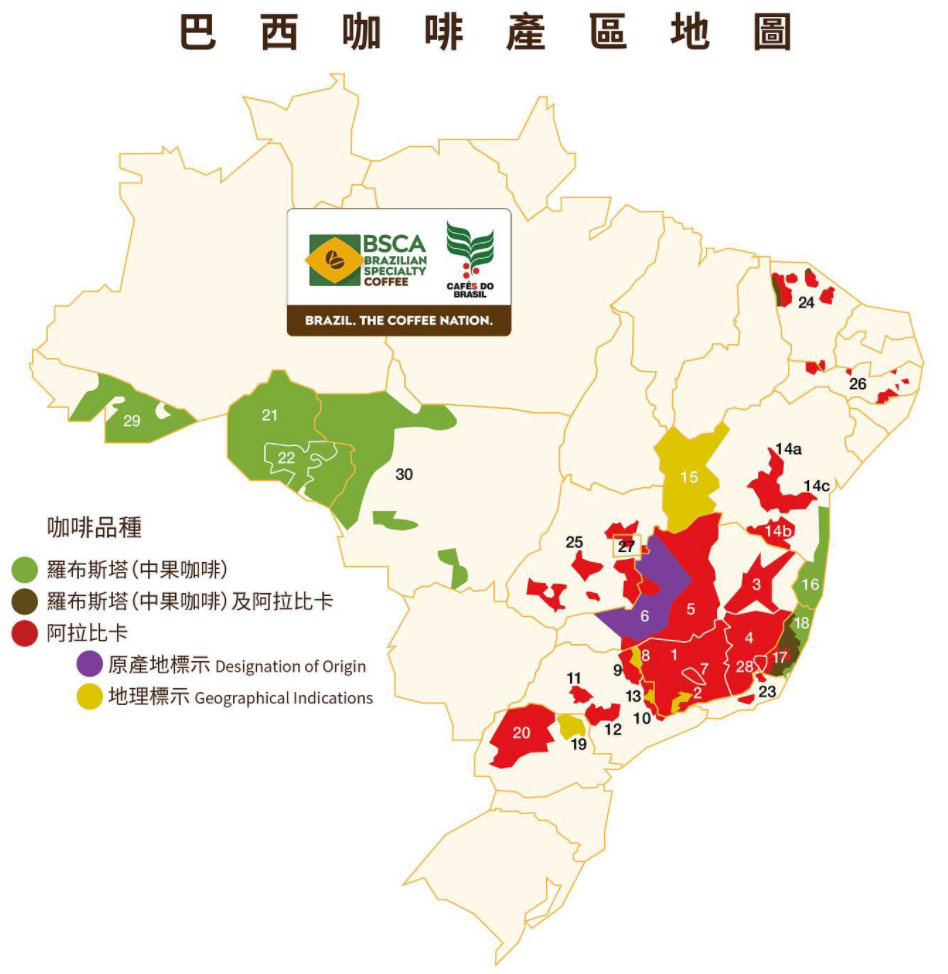
Brazilian Coffee Producing Regions
Brazil has been growing coffee for more than three hundred years. Since the 1970s, coffee gradually became a major source of income for the country, and today Brazil is the world's largest coffee producer. Brazil's producing regions far exceed those of other countries; currently 17 states produce coffee, mainly concentrated in the southeast. The four major producing regions led by Minas Gerais contribute about 90% of the country's coffee output. Minas Gerais alone has 1.22 million hectares of coffee cultivation area, equivalent to the total coffee cultivation area of Colombia.
When it comes to the representatives of Brazil's specialty coffee regions, they are Cerrado and Sul de Minas in Minas Gerais, and Mogiana in São Paulo. A rule circulates in the coffee industry: whether Brazil's coffee bean output is abundant or poor depends on how well Minas Gerais harvests; and Minas Gerais's harvest depends on the performance of its three major sub-regions: Sul de Minas, Cerrado, and Mogiana.
The Cerrado producing region, sharing its name with the Cerrado savanna, in coffee contexts specifically refers to the Cerrado area in western Minas Gerais. The terrain here is flat and the harvest season is concentrated, making it very suitable for large-scale management and harvesting operations. Coupled with altitudes above 1,000 meters and fertile soil, it attracted many exporters to build coffee farms here early on, with individual farms generally exceeding 10 hectares.
Sul de Minas sits at an altitude above 1,100 meters, with rolling foothills, diverse landforms, distinct wet and dry seasons, large diurnal temperature differences, and rich microclimate conditions. It is suitable for cultivating elegant-flavored Bourbon and Yellow Bourbon, and has naturally become a main force among specialty coffee producing regions.
Mogiana is close to Sul de Minas, and its coffee is often interplanted with shrubs, grasses, and vegetation. The local fertile red volcanic soil allows coffee cherries to accumulate abundant nutrients and develop full aromas. Some farms in this area adhere to traditional operating methods, while others have introduced modern standardized management, and coffee quality has therefore improved significantly. From coffee produced in Mogiana, Front Street captures a clear sugarcane sweetness rarely found in other regions, accompanied by fruity and chocolate flavors.
Brazil is vast and has a wide variety of coffee. After cupping and comparing Brazilian beans from multiple regions and different varieties, Front Street ultimately selected pulped natural Red Bourbon from Cerrado as the representative face of Brazil, and included this sweet, mellow, and gentle Front Street Brazil Cerrado coffee in the Front Street everyday drinking bean series, allowing more people to easily experience Brazilian flavor.
Brazil Bourbon Varieties
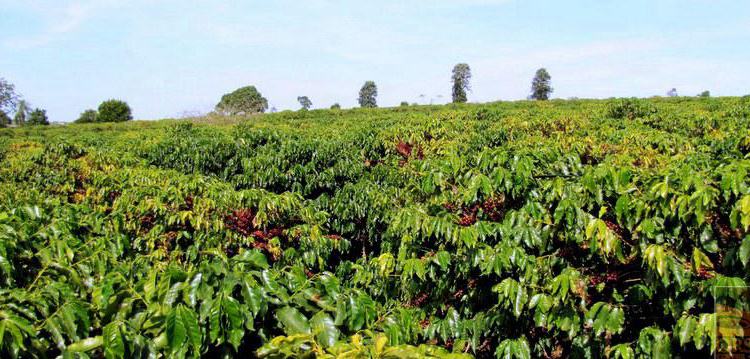
At present, Brazil's main coffee varieties are Bourbon, Mundo Novo, and Catuai. Among them, Bourbon has the longest history and evolved from a genetic mutation of Typica. When common Bourbon cherries ripen, their color transitions from green to slightly yellow, orange-yellow, red, and finally fully ripe dark red, which is what we call Red Bourbon. Red Bourbon grown at high altitudes has a balanced flavor, rich aroma, and soft acidity. Front Street's everyday drinking bean is made from Red Bourbon.
Yellow Bourbon's cherries do not turn cherry red when ripe, but yellow, and it was discovered in 1930. This yellow color comes from selective color inheritance. Yellow Bourbon grown at high altitudes accumulates a large amount of fructose, showing a sweet and juicy flavor. It once nearly swept the top three places for two consecutive years in Brazil's Cup of Excellence competition, becoming popular in the specialty coffee world. Front Street Brazil Queen's Farm Yellow Bourbon coffee has creamy peanut aromas after roasting, accompanied by clear sugarcane sweetness.
Brazil Pulped Natural
Brazilian green bean processing methods include natural, pulped natural, and washed, and which one is used depends on local climate conditions.
Before 1990, Brazil used almost entirely the rough natural method: coffee cherries were dumped directly onto concrete patios and sun-dried until dry. This method easily gave coffee earthy off-flavors and an unpleasant sense of over-fermentation, seriously affecting Brazilian coffee quality. In 1990, Brazilian coffee research institutions developed the pulped natural method based on the local dry climate. Before drying, the coffee cherry's pulp and skin are removed, leaving only a thin layer of mucilage, which is sun-dried for 1 to 3 days, then machine-dried to 12% moisture content, and then placed in storage containers to age. This method both shortened the processing cycle and reduced negative flavors from processing, greatly improving Brazilian bean quality.
Of course, besides the efficiency-oriented pulped natural method, some places in Brazil still retain the traditional natural method. Front Street Natural Queen's Farm on the Front Street bean list pours the cherries into a water tank before drying and uses flotation to remove underripe fruit. To avoid earthy and fermented flavors, Queen's Farm dries the coffee cherries entirely on African raised beds, arranging for staff to turn them regularly to reduce uneven heating and preserve cleanliness as much as possible.
How to Brew Front Street Brazil Coffee So It Tastes Good?
As mentioned above, Brazilian coffee is mainly characterized by nutty, peanut flavors and chocolate sweetness, with a thick and solid mouthfeel. Even if brewed in a simple way, its gentle taste can still restore authentic Brazilian flavor, but Front Street's favorite is still pour-over. Below, using Front Street Brazil Cerrado everyday drinking beans as an example, let's extract a cup of Brazilian pour-over coffee.
Front Street recommends using coffee beans within their optimal flavor period. If the roast date is already more than a month past, some aromas may have dissipated, or even woody flavors may appear. The coffee beans shipped by Front Street are all roasted within 5 days, so when you receive them, they should be at their most aromatic stage.
When brewing coffees of different roast levels, Front Street matches corresponding parameters. Take today's Front Street Brazil Cerrado as an example. It is medium-dark roast, with more complete caramelization than light-roasted beans, and more likely to release bitter large-molecule substances. To avoid extracting too many off-flavors, Front Street appropriately lowers the water temperature—91–93°C is recommended for light roast, while 87–88°C is recommended for medium-dark roast. The finer the grind, the more substances dissolve within the same extraction time. To prevent an excessively high extraction yield, Front Street coarsens the grind and uses a medium grind, with a shop EK43s setting of 10.5 and a 75% passing rate on the Chinese standard sieve.
Medium-dark roasted coffee beans mainly present a rich and round mouthfeel. In response to this characteristic, Front Street uses the slower-flow KONO dripper for extraction. The upper half of the KONO is a smooth curved surface, and the lower part has guide ribs one-third of its length, allowing the filter paper to fit the dripper more closely, restricting airflow upward so hot water can only flow downward, forming a siphon-style extraction effect that allows the coffee grounds' aromatic substances to be released more fully. It is suitable for brewing medium-dark roasted beans such as Front Street Brazil Queen's Farm and Front Street Blue Mountain Coffee.
Dripper: KONO dripper
Water temperature: 87–88°C
Dose: 15 g
Coffee-to-water ratio: 1:15
Grind: medium grind (75% passing rate on Chinese standard No. 20 sieve)
First wet the coffee bed with twice the amount of water as coffee grounds to form a dome, and bloom for 30 seconds. Then pour in a small stream in circles from the inside out, and split the pour when reaching 125 g; when the coffee bed drops to half the height of the dripper, continue pouring the third stage with the same fine stream to 225 g. After all the coffee liquid has filtered through, remove the dripper. Total time is about 2 minutes.
Front Street Brazil Cerrado Red Bourbon everyday drinking beans: obvious sweetness on entry, accompanied by a faint lemon aroma, rich nutty and caramel flavors, and a prominent dark chocolate note in the finish, with an overall round and balanced experience.
The above content is compiled by CoffeeHunters, a coffee news website.


