








What defines coffee cultivation in Yunnan's arabica regions?
Coffee cultivation in Yunnan began in 1892, when French missionary Père Théodore planted seeds brought from Vietnam beside the church in Zhukula Village to supply his own coffee habit. The trees thrived and multiplied. Today Yunnan arabica grows mostly in high mountain areas between 800 and 1,800 meters, with the dry-hot valleys near 1,100 meters holding the densest plantings.
Baoshan, Lincang, Pu'er, and Dehong are the main producing regions, and Pu'er alone has over a century of coffee history as Yunnan's largest growing area. Low latitude, high altitude, and abundant rainfall support the crop. Typica, Bourbon, and Catimor are the common varieties, and much of the harvest has long been washed and sold as instant coffee material rather than specialty lots.
Yunnan coffee has traveled over a century, from the first seed planted by a missionary to today's presence in the global specialty coffee scene. This article outlines the origins of coffee cultivation in Yunnan, the characteristics of major producing regions such as Baoshan, Lincang, Pu'er, and Dehong, the differences between Typica, Bourbon, and Catimor varieties, and washed processing methods. It also shares the flavor profile and pour-over parameters of Front Street Coffee Estate's sun-dried Typica, helping coffee enthusiasts systematically understand the origin story and taste characteristics of Yunnan arabica coffee.

For a long time, few people even knew that Yunnan could produce coffee, let alone discuss its flavor quality. Coffee is perceived by most as a foreign beverage, and Yunnan's connection with coffee began with an accidental introduction by a missionary—that single seed launched Yunnan's coffee cultivation journey. As the specialty coffee wave advances, origin traceability has become an important dimension for measuring quality, and Yunnan coffee has gradually entered the international spotlight, recognized by more and more people. Although Yunnan beans have long been mainly supplied to Nestlé as instant coffee material, their potential has always existed. Today, Front Street will discuss the story behind Yunnan coffee.
Coffee Cultivation History
In 1892, French missionary Père Théodore arrived in Yunnan to preach, settling in Zhukula Village. To satisfy his coffee-drinking habit, he sowed coffee seeds brought from Vietnam beside the church. The coffee trees grew well and subsequently multiplied into more plants, thus beginning coffee cultivation in Zhukula Village.
Arabica Coffee Producing Regions
Yunnan coffee is mostly distributed in high mountain areas at elevations of 800 to 1,800 meters, with the dry-hot valley regions around 1,100 meters being the most concentrated. Thanks to superior natural conditions and climate, local coffee has excellent quality, full flavor, and just the right body. Major producing regions include Baoshan, Lincang, Pu'er, and Dehong. These areas, with their low latitude, high altitude, and abundant rainfall, are ideal choices for coffee cultivation in Yunnan.
Pu'er: Coffee cultivation here has a history of over a century, and it is Yunnan's largest coffee-producing area, with excellent geographical location, climate, and soil conditions.
Baoshan: One of Yunnan's best-quality producing regions, with an average annual temperature of about 21°C. The favorable climate gives the coffee produced here small, uniform beans, rich fruity aromas, and a mellow, balanced taste.
Lincang: Located in southwestern Yunnan, near the Tropic of Cancer, with an average annual temperature of about 16°C and abundant sunshine. Its climate conditions are similar to Colombia, with cultivation at elevations above 1,000 meters, nurturing rich acidity and sweet, mellow flavors. Front Street Coffee's own coffee estate is also located in the Lincang producing region.
Dehong: Typical southern subtropical rainforest climate, with cultivation at elevations above 1,000 meters.
Coffee Varieties
Typica: An ancient native Arabica variety with excellent flavor genetics. Its young leaves at the top appear copper-red, which is one of the characteristics for identifying this variety. Typica is globally recognized as a specialty coffee variety, but it has weak disease resistance and is susceptible to pests and diseases, requiring more labor for management. It has a rich flavor, prominent sweetness, and a sweet, smooth taste.
Bourbon: A genetic mutation of Typica, which gradually spread after being cultivated on Bourbon Island. Its yield and growth vigor are both higher than Typica, and it develops better flavor when grown at high elevations. As a mutant, it also has poor disease resistance and has the characteristic of needing a year of rest after a year of fruiting. It has a rich aroma, smooth taste, obvious sweetness, and fruity notes.
Catimor: A hybrid of Timor and Caturra. Since Timor belongs to the Robusta variety, Catimor does not have pure Arabica lineage, and its flavor quality is destined to be lower than traditional Arabica. The original purpose of breeding Catimor was to improve disease resistance and yield. Although Caturra is Arabica, the hybridized Catimor masks the varietal characteristics of Arabica, resulting in flat aroma and flavor with noticeable bitterness.
Processing Methods
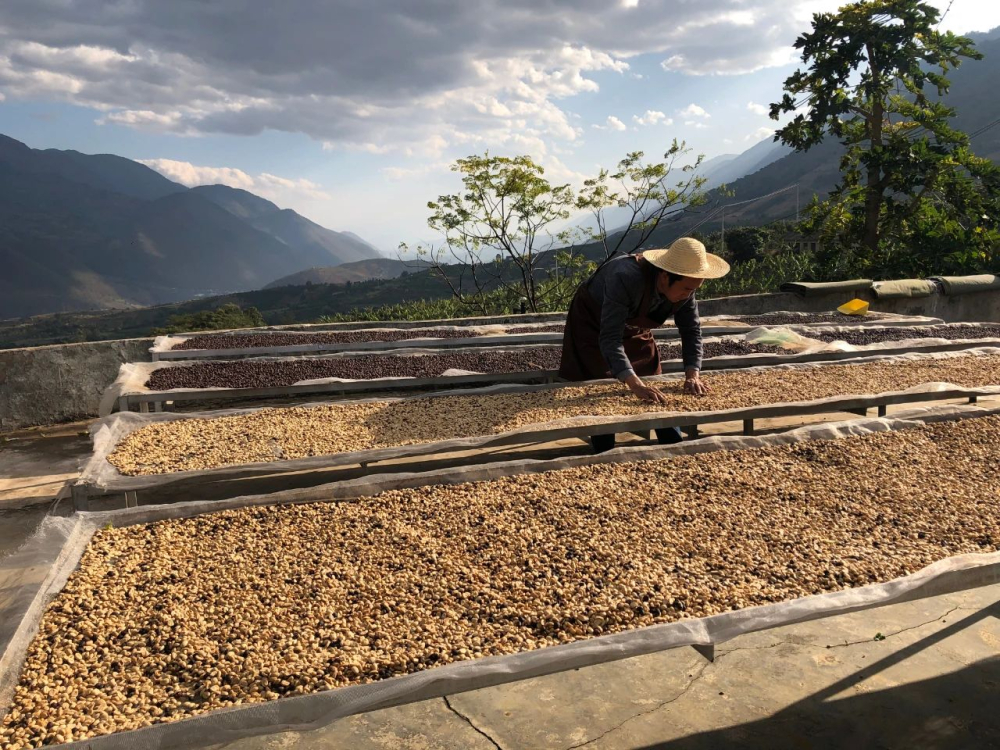
Yunnan coffee mainly uses washed processing, with honey processing and anaerobic processing also appearing in recent years. The process begins with sorting freshly picked cherries, selecting high-quality coffee cherries, then using a machine to remove the skin and separate the seeds. The seeds are then placed in a water tank to soak and ferment, breaking down the pectin attached to the surface. Finally, the fermented seeds are dried. Coffee from washed processing typically has bright fruit acidity and a clean taste.
The Arabica varieties grown in Yunnan have a relatively small appearance, hence they are called arabica coffee. Although Typica is also cultivated, the main variety is Catimor, which is favored by coffee farmers for its strong disease resistance and high yield.
The Yunnan Typica coffee beans grown by Front Street use sun-dried processing. The picked and sorted coffee cherries are exposed to sunlight, and the pulp and pectin undergo slight fermentation, giving the coffee beans a fermented aroma and smooth mouthfeel. At the same time, the sugars in the pulp are absorbed by the beans, forming a sweet flavor after roasting. Therefore, under sun-dried processing, Front Street's Yunnan Typica coffee beans present plum-like acidity, a black tea sensation, and a brown sugar finish.
Below is Front Street's brewing recipe, with beans from the Front Street Coffee Estate in Yunnan, sun-dried Typica.
Front Street 2013 Yunnan Sun-Dried Typica
Region: Lincang, Yunnan, China
Variety: Typica
Altitude: 1,300m
Processing Method: Sun-Dried
How to brew Yunnan Typica coffee beans to taste great?
Choose 15 grams of coffee powder, with a recommended coffee-to-water ratio of 1:15. For a clearer flavor, use 1:16. Select a V60 dripper, with a brewing water temperature of 88°C, aiming to make the acidity softer. Use a medium grind (about 78% passing through a Chinese standard No. 20 sieve).
Three-stage extraction pouring: First, pour 30 grams of water for a 30-second bloom. Then, pour in a small stream in a circular motion until reaching 125 grams, then pause. When the water level drops and is about to expose the coffee bed, continue pouring until reaching 225 grams and stop. When the water level drops and is about to expose the coffee bed again, remove the dripper. (Start timing from the beginning of the bloom.) Total extraction time is 2'10".
The brewed coffee has plum-like acidity, a black tea sensation, and a brown sugar finish.
For professional coffee knowledge exchange and more coffee bean information, please follow Coffee Workshop (WeChat public account: cafe_style).
For more specialty coffee beans, please add the private WeChat of Front Street Coffee: qjcoffeex.
The above content is compiled by CoffeeHunters, a coffee news website.


