








Does Water Level Really Change the Coffee Shape in a V60?
Raising or lowering the water level changes the coffee shape of the bed inside the dripper, and that in turn changes extraction. When the bed sits high, water passes through a thinner layer of grounds more quickly; when it settles low, contact time lengthens and extraction rises, which affects how prominent the sweetness becomes.
Pour rate matters as much as height. A slow pour keeps particles clustered and extraction even, while a fast pour that outpaces drainage pushes the bed up and shortens contact. In a coffee v60 brewing cup, segmented pouring reduces the difficulty of water control and keeps the bed from rising too far, so results stay repeatable.
On various coffee-sharing platforms, the term "high-sweetness water level" appears frequently, claiming that by controlling the water level height during brewing, coffee can exhibit a more prominent sweetness. Can the water level truly influence the flavor direction of a cup of coffee? This article will start from the structure of the coffee bed and the extraction mechanism, analyze the advantages and applicable scenarios of high and low water levels, and provide specific operational suggestions, including how high the coffee bed should be raised in the dripper, and how to reduce the difficulty of water control by segmented pouring, among other practical tips. It will also recommend Front Street Coffee series beans suitable for pursuing sweetness, helping you brew the ideal flavor with the right method.

Friends who frequently browse Xiaohongshu are probably familiar with the phrase "high-sweetness water level." Numerous videos are all talking about the same thing: as long as the water level during brewing is controlled at a specific height, the sweetness of the coffee will become more pronounced.
Many people can't help but wonder—can something like water level really influence the direction of coffee's taste?
What exactly does water level do to coffee?
The answer is yes. Front Street Coffee has actually mentioned this repeatedly in past shares: the water level changes the structure of the coffee bed, which in turn interferes with the extraction result. When the water level rises, the coffee bed rises with it; when the water level drops, the coffee bed becomes lower. The resulting effects are concentrated in two areas—first, the uniformity of extraction of the coffee grounds, and second, the duration of contact between the coffee grounds and hot water.
When the pouring flow rate is relatively small and neither the water level nor the coffee bed is significantly raised, the coffee grounds remain in a relatively clustered state, and each particle receives relatively more uniform extraction. At the same time, hot water needs to pass through a thicker layer of grounds, and combined with the inherently slow pouring speed, the overall extraction time is prolonged, making the extraction efficiency higher instead.
Conversely, when the pouring flow rate is relatively large (exceeding the drainage speed), the water level and coffee bed are pushed up to a certain height. At this point, the distribution of coffee grounds becomes loose, and some particles adhere to the dripper wall. This structure shifts the "main direction" of hot water during extraction (concentrating instead on the bottom layer of grounds). Combined with the greatly increased paths for hot water to flow through and faster drainage, the extraction time is naturally compressed.
The above conclusions come from Front Street Coffee's repeated practice and summary. With the same bean, when the water level and coffee bed are raised to a higher position during brewing, the drainage speed noticeably increases, the coffee's acidity is more lively, and the flavor layers are clearer and more distinct; when the water level is raised only slightly, the drainage speed is slower, the coffee's taste tends to be more balanced, the mouthfeel is thicker and fuller, and the sweetness is more prominent. This is the difference that different water levels bring to extraction.
As is well known, single-origin coffee beans are more suitable for pour-over. If sweetness is the goal, bean selection should favor coffees with tropical fruit, caramel, maple syrup, dried fruit, and floral notes, especially the low-acid, low-bitterness Front Street Coffee Strawberry Candy, Front Street Coffee Sidra, Front Street Coffee Blackberry, Front Street Coffee Mozart, as well as the medium-roast Front Street Coffee 2013 Yunnan Small-Molecule and Front Street Coffee Queen's Estate. Paired with water level control, they can all brew a satisfying cup.
How do you apply these principles to actual brewing?
Through Front Street Coffee's breakdown above, the respective strengths of high and low water levels should now be clear. What needs to be addressed next is how to use them reasonably.
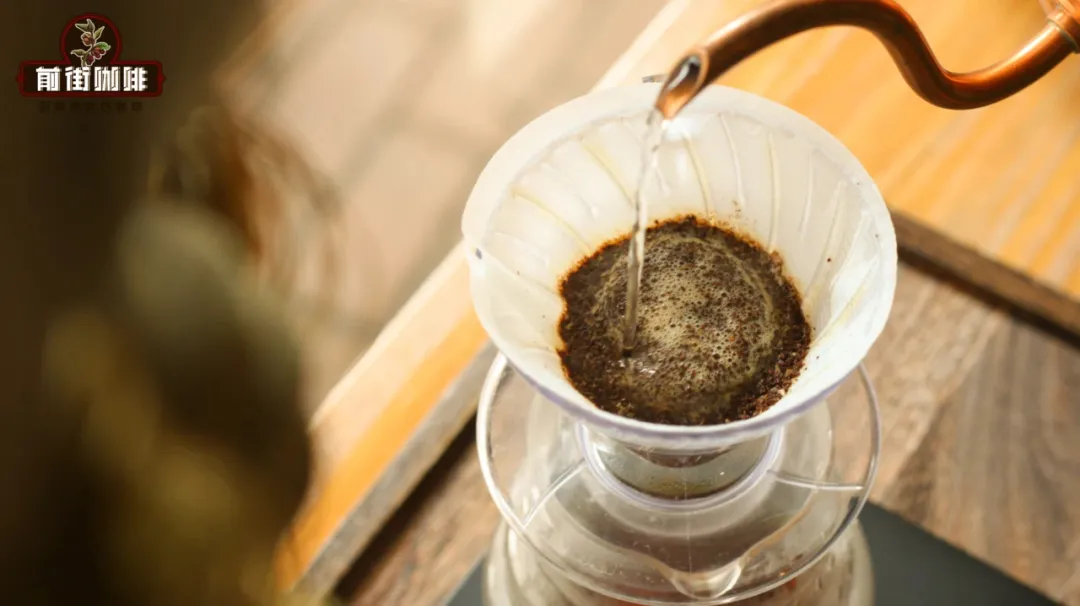
Actually, it's not complicated to operate. If you want this bean to show richer layers or more lively acidity, then increase the water flow to raise the water level and coffee bed. How high to raise it specifically depends on the amount of coffee grounds. For example, when brewing 15g of grounds with a small dripper, you can raise the coffee bed to three-quarters of the dripper's height; if using a V60, it's about halfway up the short ribs.
Once the coffee bed is raised to this position, because drainage speeds up, extraction uniformity decreases somewhat, and the coffee will show more lively acidity and more distinct layers. One reminder here: unless you increase the amount of coffee grounds, this height is basically the upper limit for a small dripper with 15g of grounds. The reason is that with too few grounds, you can't build a higher coffee wall. If you ignore the support of the coffee wall and forcibly push the water level higher, hot water will escape from the edges and form bypass water, ultimately affecting the extraction result and the taste in the cup.
Conversely, if you want the coffee to have higher sweetness and a more balanced performance, you should switch to a small flow rate for brewing, avoiding raising the coffee wall too high. Again using a small V60 with 15g of grounds as an example, keeping the coffee bed at about two-thirds of the dripper's height is sufficient.
This height allows the coffee grounds to remain concentrated. As Front Street Coffee says, the coffee grounds thereby receive more efficient and more uniform extraction, the taste is more balanced, the sweetness stands out, and the mouthfeel is more full-bodied (all relatively speaking). Yes, this is the highly praised "high-sweetness water level."
However, low-water-level brewing has a threshold—it greatly tests the brewer's water control skills, because a small flow rate must be maintained throughout. If you're not yet confident in your water control, you might as well divide the pouring into more segments, controlling the coffee bed height by compressing the amount of water poured in each segment. The approach is the same as the technique used when brewing high-density light-roast beans.
The above content is compiled by CoffeeHunters, a coffee news website.


