








How do you brew iced pour-over coffee that isn't weak?
Use a simple universal formula: coffee grounds plus 10 times hot water plus 5 times ice cubes, then grind finer than you would for hot pour-over. The ice dilutes the drink, so the hot-water portion is brewed stronger on purpose. Adjusting grind is the main lever, since a finer grind raises extraction and keeps strength after the ice melts.
The article breaks down parameter adjustment for iced pour-over, a three-stage pouring technique, and a one-pour iced method developed by Tetsu Kasuya. Iced pour-over sits alongside the cafe americano coffee, cold brew and ice drip as a summer cafe staple, offering soft acidity and clear sweetness without the wait of cold brew.
On a scorching summer day, a refreshing glass of iced pour-over coffee is undoubtedly the top choice for cooling down and keeping going. But many people who try making iced pour-over at home often run into the problem of the coffee tasting weak after being diluted by the ice cubes. Actually, as long as you master a simple universal formula—coffee grounds with 10 times hot water plus 5 times ice cubes—and then appropriately adjust to a finer grind based on extraction logic, you can easily make a glass of iced pour-over with both good strength and flavor. This article will break down in detail the principles of parameter adjustment for iced pour-over, the three-stage pouring technique, and the convenient "one-pour iced pour-over" method developed by Mr. Tetsu Kasuya, so that you can reliably replicate cafe-level iced coffee at home.
The weather lately really feels like it could melt you in minutes. In this kind of weather, anyone still willing to happily meet up at a cafe is absolutely a friend through life and death! But even in such hot weather, you still can't just stop drinking coffee, right? So if you don't want to go out, can't afford an ice drip brewer, and can't wait several hours for cold brew, is there still a way to quickly get a refreshing, pleasant glass of iced coffee and properly keep yourself going?
When it comes to the star iced drinks in summer cafes, besides long-time top "celebrity contenders" like iced Americano, cold brew, and ice drip, iced pour-over is undoubtedly one of the most popular. It is not only refreshing and pleasant, with soft acidity and a clear sweetness, but under the effect of the ice cubes it is even more invigorating and thirst-quenching, absolutely worthy of being called an excellent summer cooler.
After getting into pour-over coffee, many friends also know that a delicious pot of coffee is all about finding the right extraction yield and strength, usually by coordinating adjustments to grind size, water temperature, coffee-to-water ratio, pouring technique, and equipment.
When we have the same coffee beans, there's really no need to "bring home" every single parameter. To make the iced pour-over you drank in the shop, all you need to learn is one "universal formula":
Iced pour-over = coffee grounds (fine grind) + 10 times hot water + 5 times ice cubes.
Compared with hot pour-over, iced pour-over has the key extra element of ice cubes. To ensure the final coffee is strong enough, flavorful enough, and cold enough, we must find a way to shift part of the hot water to make room for the ice cubes in order to achieve the above goal. According to the pour-over extraction principle that the early part is strong and the later part is weak, the less water poured, the more concentrated the resulting coffee liquid will be, so when added to ice cubes it won't be diluted into something too weak.
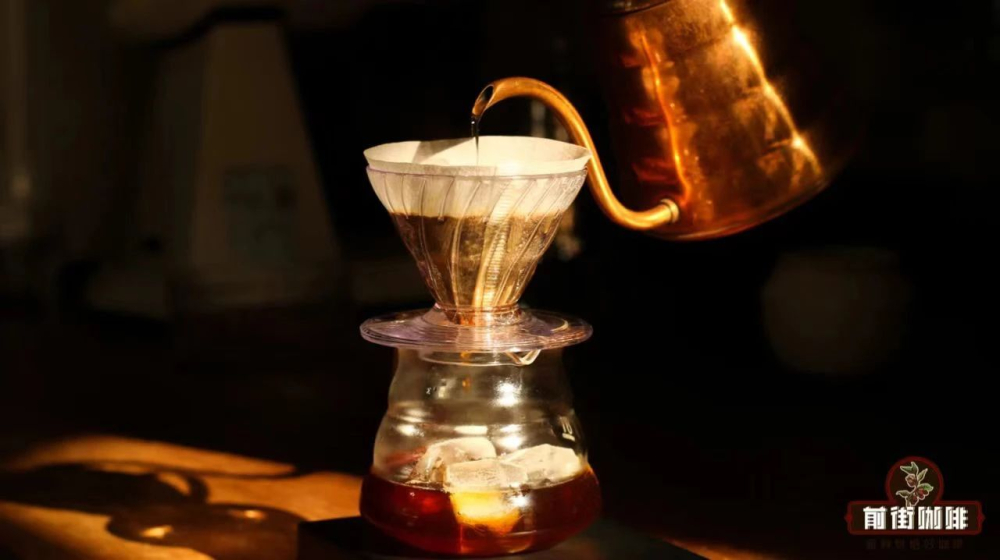
However, you should know that the less hot water poured, the shorter the entire extraction process becomes. The most common situation is that it goes from the original 2 minutes to 1 minute 20 seconds, which also means there is no chance for the flavor compounds in the later stage to be released, so the whole glass of iced coffee will most likely end up under-extracted. In other words, although the strength is sufficient, the flavor is not! So in order to coordinate the proportion of aromatic compounds released, we need to grind finer, which in turn extends the extraction time.
For example, the grinder used at the Front Street Coffee shop is an EK43s. If a coffee uses a setting of 10 when brewed hot, then when brewing it iced, adjust the setting to 9 to 9.5; when using a C40 hand grinder, if a bean uses 24 clicks for hot brewing, then for iced brewing adjust it finer to 22 clicks.
Technique: three-stage
Before pouring, first put the ice cubes into the server (adding ice first or later does not have much impact on the flavor), then add 15 grams of coffee grounds. First, starting from the center and moving outward in a small circle, pour 30 grams of water in a thin stream and let it bloom for 30 seconds. In the second stage, pour 60 grams of water using the same technique. When the water in the dripper is about to finish dripping, pour in the remaining 60 grams of hot water. The final extraction time should fall between 1 minute 50 seconds and 2 minutes.

Seeing this, some friends may think it is still too troublesome and wonder if there is a more direct and rough iced brewing method that doesn't require careful technique. Don't worry, there really is one, and it is the "one-pour iced pour-over" developed by Mr. Tetsu Kasuya.
Grind size: EK-43s setting 7 (C40 is roughly around 18–19 clicks)
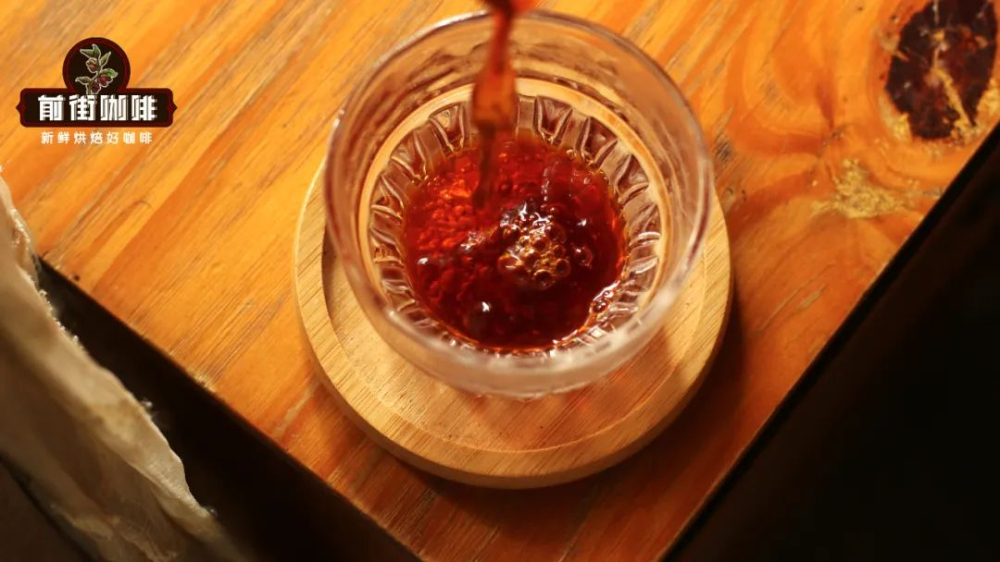
Finally, remove the dripper and shake the server vigorously until all the ice cubes have melted into the coffee liquid, then you can pour it into an ice-filled cup and drink it (if you think the strength is too high, you can add 1–2 ice cubes to taste).
The iced pour-over extracted by this one-pour method has a round mouthfeel, less pronounced acidity, and a strong sweet aftertaste, and it also gives this cup of coffee aromas of cinnamon, liqueur chocolate, peach, and Darjeeling black tea.
The above content is compiled by CoffeeHunters, a coffee news website.


