







Can You Add Milk to an Americano SOE or Espresso?
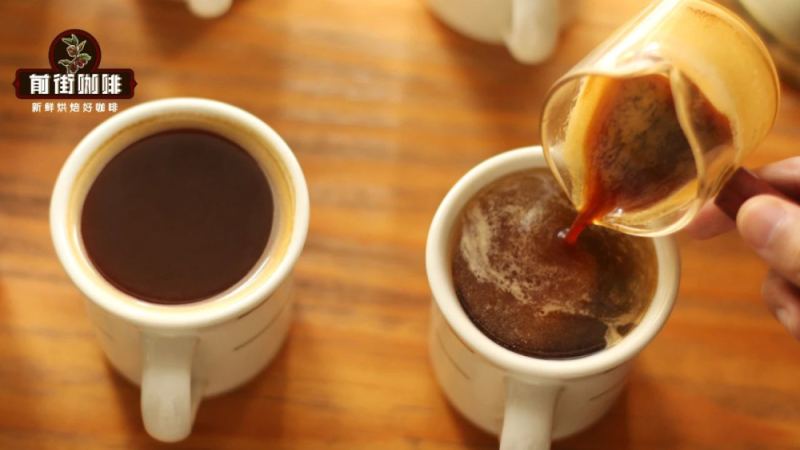
Americano can be drunk with milk if that suits your taste, since no fixed rule governs how it should be served. The drink itself is simply espresso combined with water, and the difference from straight espresso lies in bean selection, concentration, and mouthfeel rather than in any strict serving code.
Americano's popularity traces to World War II, when American soldiers in Italy diluted strong espresso with water to approach the drip coffee they grew up with. Most cafés worldwide still add water to espresso, while drip-style Americano appears mainly in offices and homes. Water-to-coffee ratios, pumps, and boilers shape extraction, and an americano soe uses a single-origin bean.
Can Americano have milk added? What exactly are the differences between it and espresso in terms of flavor and mouthfeel? These questions often confuse friends who are just getting into coffee. Starting from the daily experience of Front Street baristas, this article sorts out the origins and preparation methods of Americano, compares the differences between Americano and espresso in terms of coffee bean selection, and delves into the extraction principles of espresso machines. The article also introduces the flavor characteristics of espresso beans such as Front Street Commercial Blend, Warm Sun Blend, and Specialty Blend, as well as mechanical knowledge like water-to-coffee ratios, pumps, and boilers, helping you understand more comprehensively the logic behind a cup of coffee.
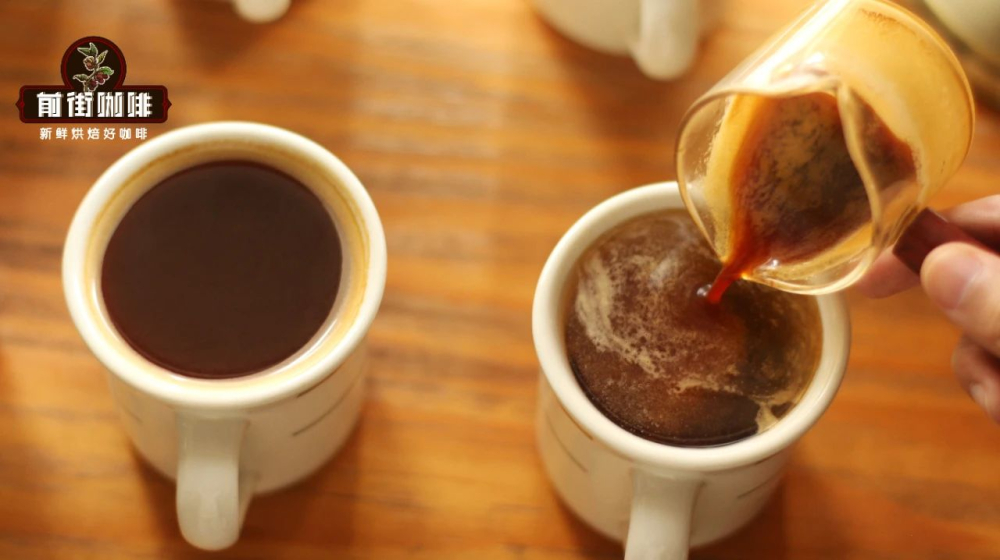
How exactly should Americano be drunk to be considered correct? Front Street baristas occasionally encounter customers throwing out this kind of question. Whenever this happens, Front Street's usual answer is: taste it according to your own feelings, and as long as it tastes good to you, that's fine. Front Street understands that what the other person really wants to ask is whether there is a fixed set of drinking rules. But in Front Street's view, drinking coffee does not need to be bound by rigid rules; being overly particular can easily make you lose the fun. So at Front Street, drinking coffee has always been a relaxed and casual affair. The reason customers raise such questions is mostly that they do not know enough about coffee itself and feel a sense of distance from it. Therefore, Front Street decided to systematically talk about the knowledge behind Americano.
The popularity of Americano can be traced back to World War II. At that time, American soldiers stationed in Italy were not used to the strong espresso that locals preferred. In order to recreate the drip coffee taste they had back home, they added water to espresso. This way of drinking it was not welcomed in Europe, and traditional Europeans rather despised it, so they called it "Americano."
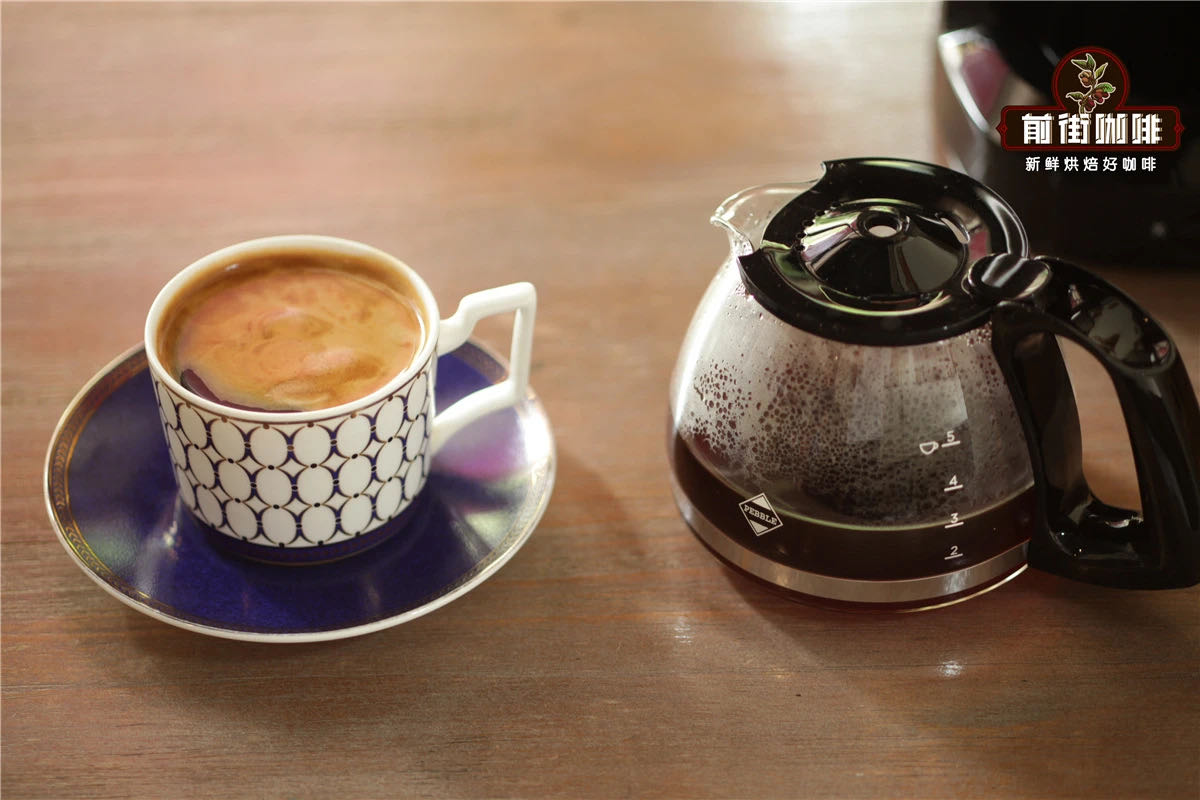
Although Americano has two preparation methods, looking at most coffee shops around the world, they all use the method of adding water to espresso; as for traditional drip-style Americano, it basically only appears in offices or home settings. The structure of Americano is extremely simple, nothing more than a combination of water and espresso, with the ratio mostly falling between 1:4 and 1:8. However, even Americano diluted with water still tastes like the espresso liquid itself, and in earlier years the flavor choices for espresso were far less rich than they are now, and the taste could not really be called comfortable or excellent.
To solve the problem of coffee being hard to swallow, milk coffees such as lattes and cappuccinos were born one after another and became increasingly popular. Since they are also based on espresso, these drinks are now all categorized as espresso coffee. So which tastes better, espresso coffee or Americano? Front Street cannot give a simple answer to this question.
If Americano is regarded as traditional drip coffee and espresso coffee as traditional espresso liquid, then Americano is undoubtedly easier to drink than espresso. But as for which tastes better, Front Street believes the key depends on what coffee beans are used. Coffee beans are the core factor determining whether a cup of coffee is good or bad. For example, Front Street's Commercial Blend coffee beans and Warm Sun Blend simply cannot be compared together. The reason is not only the huge price difference, but also that the Commercial Blend coffee beans are specially supplied by Front Street to large chain commercial coffee shops. In pursuit of a rich crema in the espresso, Front Street deliberately added 10% robusta beans to enhance the body.
Warm Sun Blend, on the other hand, is the espresso bean Front Street is most proud of. Front Street stores have used this espresso blend for three consecutive years. Its unique flavor is the common review customers give it, and some customers even make a special trip just to drink a shot of espresso. Its mouthfeel is thick yet lively, with a strong vinous aroma. This fermented aroma comes first from the whiskey-barrel processing method of Sherry coffee beans, and second from the natural processing of Red Cherry. The sweetness is prominent, with a slight soft fruity acidity.
As mentioned earlier, the mouthfeel of Americano is closely related to the coffee beans used. In fact, if product memorability is not taken into account, Front Street would also choose Specialty Blend coffee beans. This espresso bean uses the traditional Brazilian blend with Colombian formula, with prominent nutty flavors, a smooth mouthfeel, and a slight chocolate tone, making it very harmonious with dense hot milk.
Now you should understand that the soul of a coffee drink is hidden in a small cup of espresso. Generally speaking, Front Street uses 20 grams of coffee powder to extract 36 grams of coffee liquid. But the water-to-coffee ratio for Americano varies from coffee shop to coffee shop and needs to be adjusted flexibly according to factors such as the coffee beans, coffee machine, and grinder, with the barista's senses making the final judgment.

So how is espresso extracted? This involves the working principle of the espresso machine. Most coffee machines go through four stages to turn coffee grounds into coffee liquid: water source, pump, boiler, and group head. Every coffee machine needs water to operate. For espresso machines, there are two water source routes: a water tank or a connection to a stable water supply pipeline. Usually the water source depends on how the machine is used.
For Front Street, it needs to consistently produce delicious coffee every day, so a continuous water supply is especially important. The pump is the core component of espresso. What force exactly pushes water through the dense layer of coffee grounds? The secret lies in pressure. Some early espresso machines used a large lever piston, and baristas had to manually pull the lever to force water through the coffee. But most modern espresso machines have abandoned this physical labor and instead use electric pumps—vibration pumps or rotary pumps. A vibration pump is a small electromagnetic device, with a piston connected to a magnet placed inside a metal coil. Electric current passes through the coil, causing the magnet to rapidly push the piston back and forth, forcing water through the machine. An ordinary vibration pump operates at a frequency of 60 times per second. Unlike a vibration pump, a rotary pump is purely mechanical.
This is also a complex mechanism. A motor drives a disc, and the disc rotates eccentrically inside a large circular chamber. The rotating disc is divided into multiple sections by vanes. When the disc turns, the vanes press against the outer chamber wall, reducing the cross-sectional area and thereby generating pressure. Water enters when the cross-section expands and is pushed out as the cross-section contracts. The boiler is where the machine heats, and it can maintain the pump's continuous pressurization of the water. Not only that, the boiler is also responsible for controlling the brewing temperature of the coffee machine. Currently on the market there are dual-boiler and single-boiler distinctions.
Now that you understand the historical story of Americano and the operating principles of the espresso machine, you may be curious: why does Americano taste different even when the operating method is the same? In fact, Front Street already said earlier that this is caused by different coffee beans. The greatest characteristic of blended coffee beans is to keep the mouthfeel of the entire cup of coffee as balanced as possible.
But with the development of the market, SOE coffee has now appeared, which is espresso made using coffee beans from a single origin. At the same time, coffee roasting levels are also changing. Everyone's requirement that espresso must have a thick crema has been somewhat lowered, and more people hope to taste the characteristics of the beans themselves from the coffee. Therefore, some people also use light-roasted beans with prominent floral aromas to make espresso. Front Street has not yet conducted related experiments, so it cannot tell you whether it tastes good or not.
The above content is compiled by CoffeeHunters, a coffee news website.


