







Which Beans Suit a Moka Pot?
A moka pot brews by heating water in the lower chamber and pushing it up through coffee grounds, so it works without an espresso machine. Its extraction pressure, crema, and strength sit below true espresso, which shapes the beans it suits. Five Front Street options are suggested: Golden Mandheling, Brazil Queen's Estate, Classic Espresso Blend, Strawberry Candy Espresso Blend, and Colombia Huila.
The device came about as an affordable stand-in for espresso machines. The first espresso machine appeared in Turin, Italy, at the end of the nineteenth century, and in 1905 La Pavoni launched a commercial model that heated the whole apparatus over a flame. Those machines were costly and bulky for homes, so a compact stovetop alternative like the Bialetti moka pot found its place in ordinary kitchens.
For enthusiasts who don't have an espresso machine at home, the moka pot is the most common alternative—simple to use, just add water and coffee grounds and apply heat. But there's a clear gap between the moka pot and espresso machines in terms of extraction pressure, crema, and coffee strength, which also determines what types of coffee beans it pairs best with. This article will outline the invention background and structural principles of the moka pot, analyze its pros and cons for brewing coffee, and highlight five Front Street Coffee beans suitable for moka pot use, including Golden Mandheling, Brazil Queen's Estate, Classic Espresso Blend, Strawberry Candy Espresso Blend, and Colombia Huila, helping readers find a choice that suits their taste.
Espresso is delicious, sure, but not every household has the budget or space to add an espresso machine. That's why more people choose to use a moka pot at home—it has a low barrier to entry: just load hot water and coffee grounds, place it on a heat source, and then all you have to do is wait for the coffee to come out.
However, the coffee made with a moka pot can't be compared in quality to today's espresso machines. Tracing back to its roots, the moka pot was originally created more as an affordable substitute for espresso machines. What we now call espresso extraction relies on extremely high pressure to push near-boiling hot water through a compacted puck of coffee grounds, and reaching that level of pressure only became possible after modern breakthroughs in espresso machine manufacturing.
To understand why the moka pot came to be, you must first understand the evolution of espresso machines. At the end of the nineteenth century, the first espresso machine appeared in Turin, Italy. In 1905, La Pavoni launched the first commercial espresso machine, enabling baristas to serve espresso to multiple customers in a very short time. After that, more and more cafés across Italy adopted La Pavoni equipment.
This large commercial espresso machine needed the entire apparatus to be placed over a flame for heating during operation; inside the machine, steam was used to push hot water from the lower compartment through a tube toward the coffee grounds. However, this machine was expensive and bulky—unless you came from a wealthy family, it was simply impossible for an ordinary household to install such a device at home.
The arrival of the moka pot had to wait until the 1930s, and its inventor was Alfonso Bialetti from northern Piedmont. After more than a decade working in the French aluminum industry, Alfonso Bialetti returned home in glory and set up a workshop in Piedmont to produce aluminum household goods. One day, Bialetti saw his wife doing laundry and suddenly had a flash of inspiration—and the concept of the moka pot was born. The washing equipment at the time had two layers: the lower layer held soapy water and was heated to boiling, while the upper layer held the clothes to be washed, with a tube connecting the two layers; hot soapy water rushed up through the tube to the upper layer and was evenly sprinkled over the clothes. With the assistance of Luigi De Ponti, the moka pot as we know it today was developed.
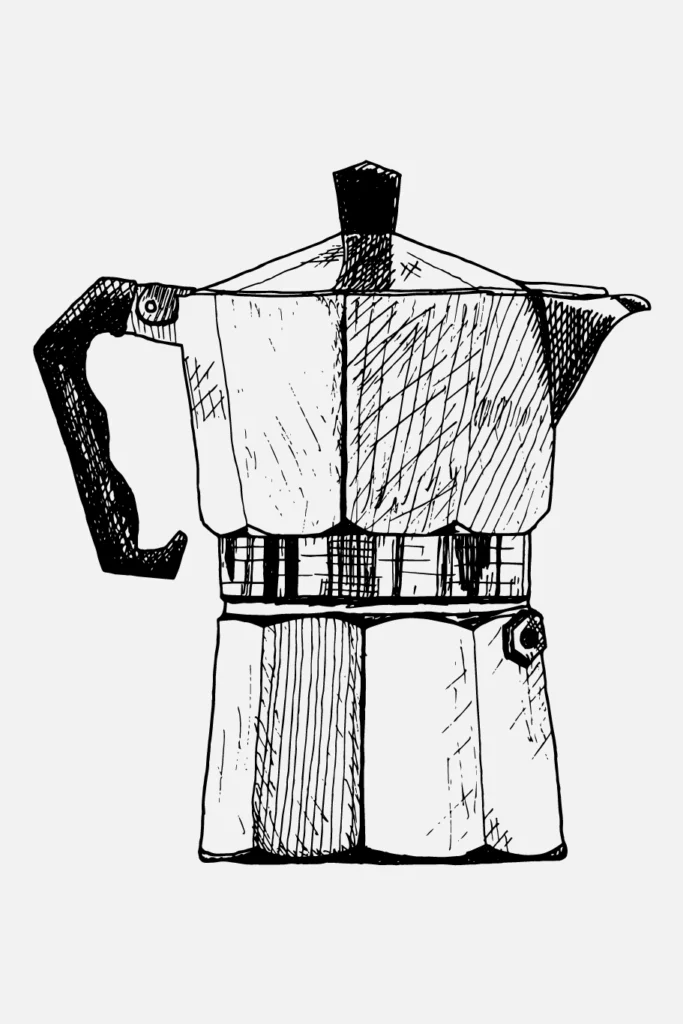
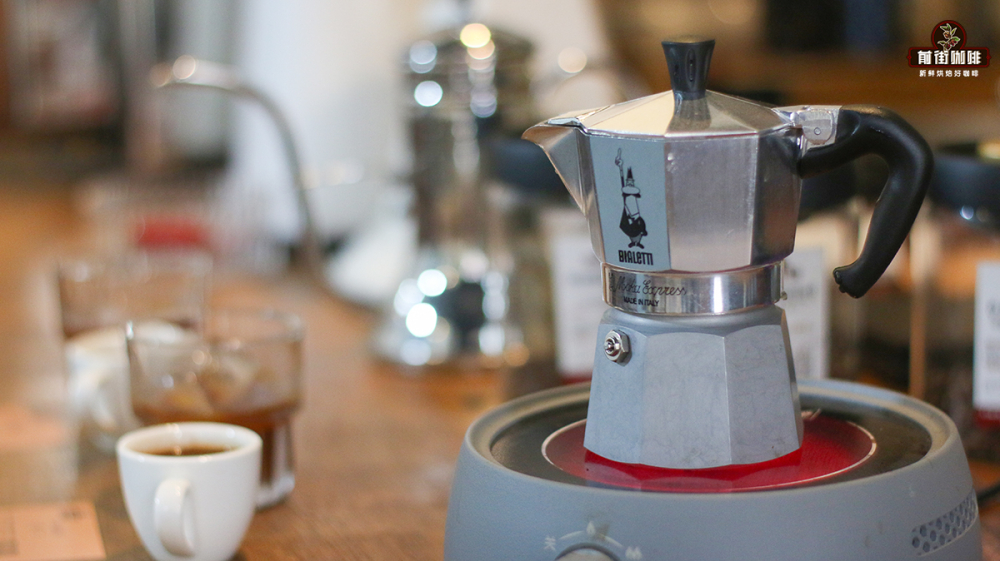
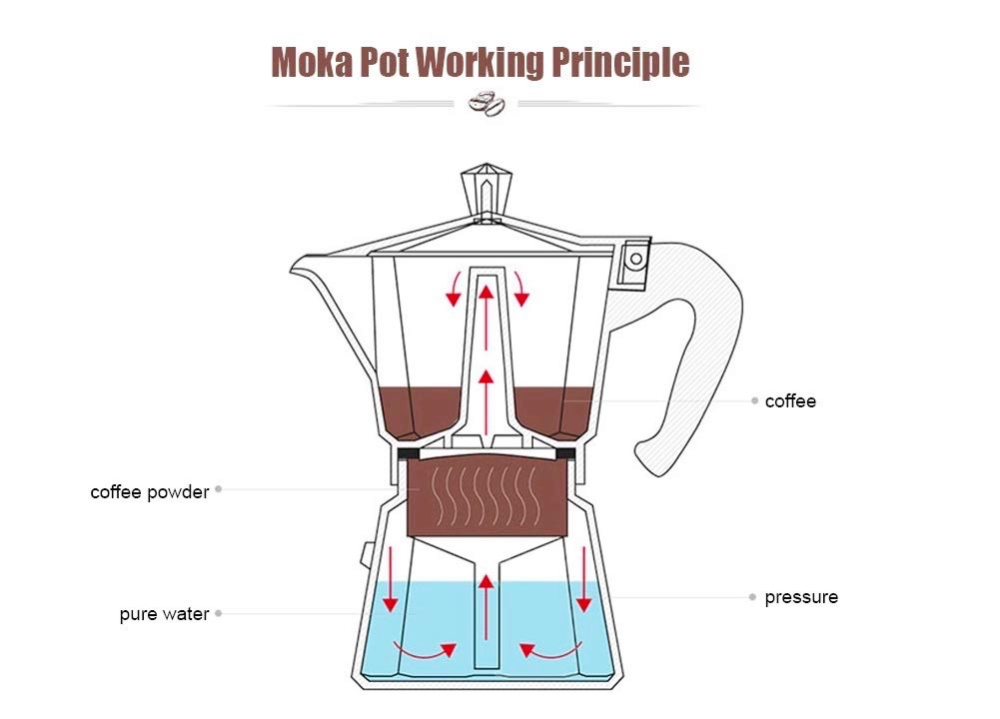
The operating mechanism of the Bialetti moka pot is exactly the same as that washing machine. The body is an octagonal aluminum structure with a rubber handle for heat insulation. The whole device consists of three main parts: the bottom container holds hot water, the top container collects the extracted coffee, and in the middle is a metal filter basket that holds the ground coffee.
When brewing coffee with a moka pot, first pour an appropriate amount of hot water into the bottom chamber, put the coffee grounds into the middle metal filter basket, then install the filter basket onto the bottom chamber, screw the top chamber on tightly, and finally place the whole device on a heat source. When the water in the bottom chamber boils and produces steam, because the bottom chamber is sealed and limited in space, the increasing steam raises the internal pressure, forcing hot water up through the bottom chamber's tube, through the coffee grounds in the middle layer, and then through the channels in the metal filter into the top chamber.
The moka pot was originally designed to replace the espresso machines of the late nineteenth and early twentieth centuries, but after decades of accumulation and development in espresso machine manufacturing, extraction pressure has long far exceeded the early 1.5 pascals, while in a moka pot the hot water rises because it is boiling, which means the water temperature is on the high side. There are significant differences between the coffees extracted by the two. One of the pros and cons of brewing with a moka pot is that the crema isn't rich enough—modern espresso machines extract at far higher pressure than a moka pot, so coffee made with a moka pot falls short of an espresso machine in crema performance.
In addition, another reason for this difference is that the moka pot's metal filter is relatively sparse, requiring a coarser grind than an espresso machine. The coarser the grounds, the smaller the contact area between water and particles, and naturally the fewer substances can be extracted—in other words, coffee brewed with a moka pot is less thick and concentrated than espresso.
Many friends want to make espresso at home and have also bought a moka pot. So the question arises: what coffee beans are suitable for brewing in a moka pot so that it tastes good? Since the moka pot was originally a stand-in for old-fashioned espresso machines, and espresso is known for being rich, bold, and smooth, if you want abundant crema, choosing coffee beans with a darker roast level is more appropriate.
1. Front Street PWN Golden Mandheling Coffee Beans
Region: Gayo, Indonesia
Altitude: 1400m—1600m
Variety: Ateng
Processing Method: Wet Hulling
Mandheling coffee beans come from Sumatra Island in Indonesia, Asia, and are also called "Sumatra coffee." Mandheling is a premium coffee bean grown on plateaus and mountain slopes at altitudes of 750-1500 meters, and it is one of the few Arabica varieties in Indonesia. When people mention Mandheling, many love its rich aroma, full body, and strong flavor, and its unique herbal spice notes are also a signature characteristic of Mandheling. Besides Indonesia's growing conditions, the wet-hulling process is also one of the sources of Mandheling's intense flavor.
Mandheling coffee is mostly processed using Sumatra's unique wet-hulling method. Due to a lack of water resources, Mandheling was initially mainly sun-dried, but the drawback was unstable quality; later, Brazil's semi-washed method was also tried, but the local weather is rainy, typhoons are frequent, and it is humid year-round, making it impossible to meet the conditions required for sun-drying, which gave rise to this processing method of forcibly hulling semi-dry coffee beans. In terms of roasting, in order to highlight Mandheling coffee's classic rich and full-bodied flavor, a darker roast level is usually adopted.
2. Front Street Brazil Queen's Estate Coffee Beans
Region: Mogiana region, São Paulo State, Brazil
Estate: Queen's Estate
Altitude: 1400m—1950m
Variety: Yellow Bourbon
Processing Method: Natural Process
The Yellow Bourbon variety was discovered in São Paulo State, Brazil, in the 1870s. Later, scientific research found that the Yellow Bourbon variety has a richer pectin layer, and the pectin layer contains a large amount of sugary substances, making Yellow Bourbon's sweetness more prominent. Moreover, this Front Street Yellow Bourbon coffee bean uses the most primitive and traditional post-processing method for green coffee—the natural process. The skin and pulp are completely retained, allowing more sugary substances to penetrate into the green coffee beans, achieving a qualitative leap in sweetness.
Queen's Estate has won multiple awards since the first Cup of Excellence Brazil competition in 1999, and even took 12 awards within 7 years, which fully demonstrates the superiority of the coffee beans produced by Queen's Estate. The natural process requires a large amount of manual labor, and to avoid undesirable fermentation flavors, Queen's Estate specifically uses small-scale sun-drying to ensure the quality of the green beans.
3. Front Street Classic Espresso Blend Coffee Beans
Brazil Red Bourbon + Indonesia Mandheling + Vietnam Robusta. Extracting coffee with a moka pot yields rich aromas of caramel, dark chocolate, maltose, and cookies, with abundant crema and roasted nut flavors. The spice and woody notes unique to Indonesian Mandheling, along with the nuttiness and balance of Brazilian Red Bourbon, form a complex, full-bodied aroma, while the crema brought by Robusta makes it a perfect partner for milk. Making a latte not only allows for beautiful latte art, but also provides a full coffee flavor.
4. Front Street Strawberry Candy Espresso Blend
Front Street Costa Rican coffee, known for its honey processing, has prominent sweetness, while Ethiopia is known for its bright citrus acidity and floral aroma. On this basis, combined with the chocolate and nutty flavors of Colombian coffee, the resulting Front Street Strawberry Candy espresso blend carries aromas of roses, strawberry gummies, and dried blueberries, with moderate grape and citrus sweet-tartness, and an almond aroma in the aftertaste. With the extraction support of a coffee machine, the espresso not only has no harshness, but also comes with good crema and a velvety texture, while offering a sweet-and-sour taste like strawberry gummies. It has obvious aromas of roses, strawberry gummies, and dried blueberries, with moderate grape and citrus sweet-tartness, and an almond aroma in the aftertaste.
5. Front Street Colombia Huila Coffee Beans
Front Street Colombia Huila coffee flavor characteristics: rich and solid mouthfeel, uniform beans, pleasant acidity, mellow aroma, moderate acidity, and rich sweetness that is very thought-provoking. At the same time, Front Street Huila coffee beans are very affordable and have excellent flavor, making them a must-buy daily staple for many moka pot users.
Some people who don't have a moka pot at home may want to know: Can a French press make espresso ? After all, the French press is one of the simplest coffee brewing tools, and many households keep one on hand. And when making espresso with a French press, even without that beautiful golden layer of crema, it still retains the coffee's natural oils and offers a different kind of flavor.
The above content is compiled by CoffeeHunters, a coffee news website.


