







How does the green coffee bean grading system work?
Green coffee bean grading rests on three main standards: screen size, altitude or hardness, and defect rate. No single global rule covers every origin, so producing countries build their own systems around local geography and farming methods. Kenya grades almost entirely by bean size, while Colombia, Ethiopia, Jamaica, Indonesia and Brazil mix methods or add cupping to fill gaps.
The screen method passes beans through screens with specific aperture sizes, so larger beans sort into higher grades. Altitude grading assumes slower maturation at height produces denser, harder beans, and defect-rate grading counts faults in a sample. Many origins combine these approaches, and some add cupping scores after grading to correct weaknesses in the physical standards.
As an agricultural product, coffee beans vary in quality, so a grading system is needed to standardize quality and provide a reference for buyers. However, because the geographical environments and cultivation patterns of producing regions around the world differ enormously, no unified standard can measure them all, and each region can only adapt to local conditions. At present, there are three main types of grading: screen size, altitude/hardness, and defect rate. Many countries also use combinations of these or even add cupping to compensate for shortcomings. This article will systematically sort out the logic and representative producing countries of these three grading methods, focusing on how Kenya grades solely by bean size, and introduce the grading practices of Colombia, Ethiopia, Jamaica, Indonesia, Brazil, and others. Front Street will also share related brand product information to help coffee lovers understand the meaning behind green bean grades.
Coffee beans are essentially an agricultural product, and agricultural products by nature cannot achieve nearly perfect replication like industrial assembly-line products, which makes the quality of each batch uneven. In order to give quality a unified basis for measurement and also give buyers purchasing green beans something to rely on, grading systems came into being.
However, coffee-growing regions are spread across the globe with an enormous span, and the geographical conditions and farming methods of each producing area vary greatly, so there is no universally applicable grading standard. In the final analysis, every origin formulates grading rules suited to itself based on its own national conditions.
At present, green coffee grading mainly revolves around three dimensions: bean size, altitude (hardness), and defect rate. Although they are grouped into three major categories, they are not the only basis for grading. Many countries use multiple methods at the same time, for example looking at both altitude and size. Some origins even supplement the shortcomings of their original systems with cupping after grading. In short, although these three are the most common grading methods, they are not the only indicators. I. Screen grading method (bean size) The principle of screen grading is straightforward: let coffee beans pass through screens with specific aperture sizes, directly measure the bean size, and then classify them into different grades according to size. The larger the bean, the higher the grade (except for Maragogype). In the article "Kenya Grading," Front Street mentioned that this method was the earliest grading system for coffee beans, so countries with a long history of coffee cultivation mostly continue to use this system to grade coffee beans.
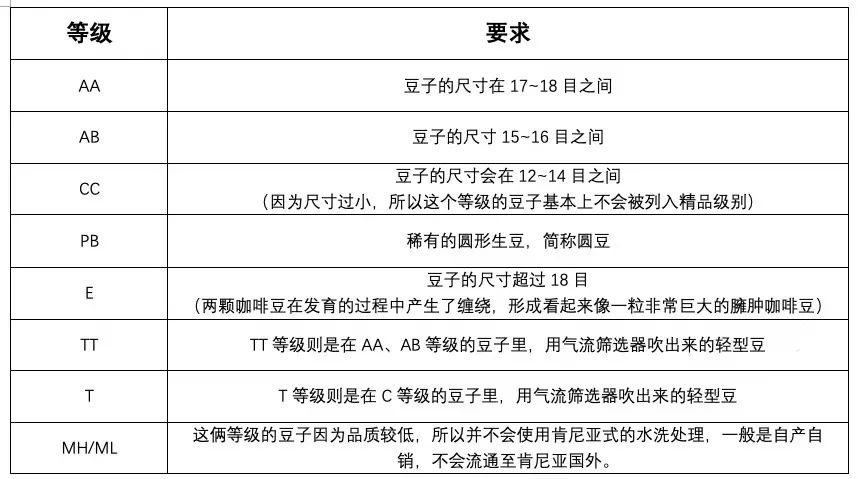
We all know that bean size cannot be directly equated with flavor quality. The reason for grading by this is that many producing regions believe that plump, uniform, large beans mean full maturity. Such beans completed a more comprehensive flavor transformation during growth, and beans of similar size heat more evenly during roasting, making the finished flavor more consistent. Kenya is precisely a producing country that uses bean size alone as the basis for grading, with specific grades as follows:
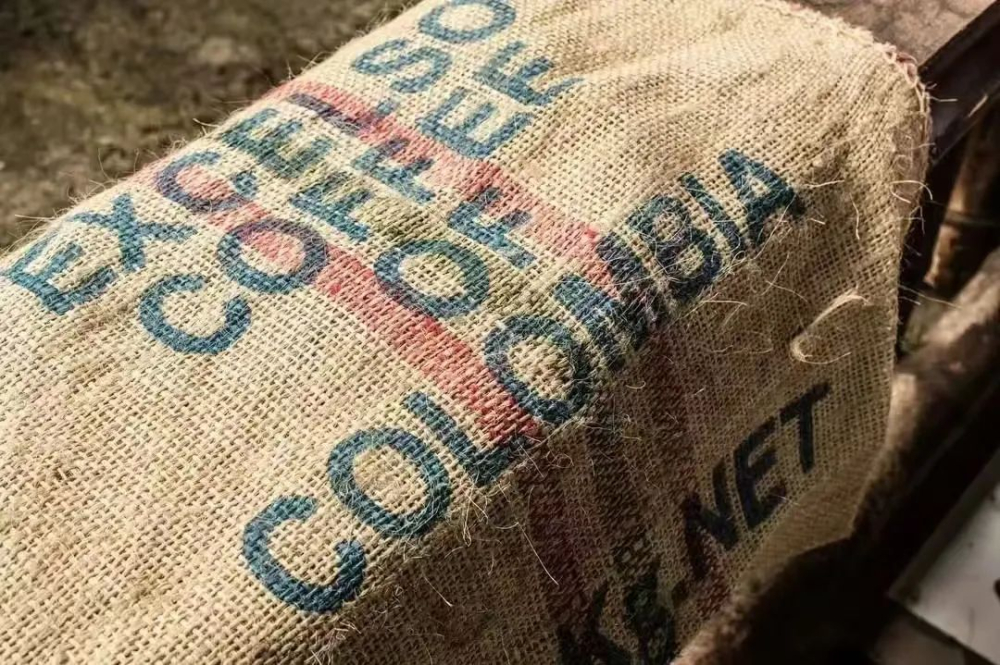
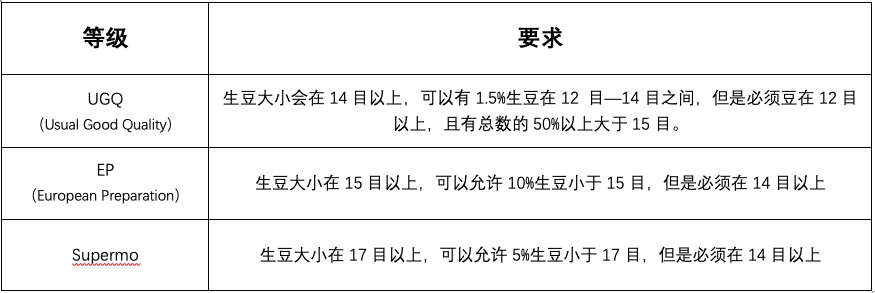
In addition to the above grades, Kenyan coffee also has secondary grading labels such as Top/Plus (+)/FAQ. But these are grading methods established by local coffee research institutions and green bean traders themselves (rated by cupping flavor). Front Street will not elaborate further here; interested friends can click the Kenya article above to jump over and learn more. Colombia also uses size grading for exported coffee beans, except that the beans must first pass assessment to obtain export qualification, with standards as follows: The size must be above 14 mesh; overall, at least 50% of the green beans must be larger than 15 mesh, and green beans between 12 mesh and 14 mesh must not exceed 5%. At the same time, it is required to be free of pests, uniform in color, free of off-flavors, clean in flavor, with a moisture content not exceeding 12.5%, and accumulated defects not exceeding 24 points.
After meeting these conditions, the coffee beans obtain export qualification and receive the "Excelso" (special high-grade) label. After another round of size grading, they can be exported. Their size grading is as follows:
II. Altitude/hardness grading method As Front Street often says, the size of coffee beans cannot directly determine the direction of flavor. Therefore, some Central and South American countries define bean grades by growing altitude. Because the higher the altitude, the more substances the beans can absorb, the greater the density, and the more outstanding the flavor. Panama, Costa Rica, Guatemala, Honduras, and other producing countries all adopt this model. But because altitude conditions differ from country to country, grading systems also adapt to local conditions. Below is an overview chart of altitude grading.
III. Defect grading method Precisely because coffee beans are an agricultural product, coffee cherries are easily affected by adverse factors during growth (poor development, pest damage, disease, mold, etc.), thereby becoming defective beans. Defective beans can seriously drag down coffee flavor, so a standard emerged that grades by the proportion of defective beans in green beans.
Ethiopia in the early period was a producing country that used defect-rate grading, and it is also a typical example of adapting to local conditions. The reason for using defect grading is that, on the one hand, Ethiopia's average altitude is relatively high, so altitude no longer needs to be used as a grading standard; on the other hand, local coffee cultivation and harvesting are mostly mixed modes: mixed planting and mixed harvesting. In the past, few people deliberately distinguished them, so a batch of coffee beans contained various varieties and sizes, and naturally could not be defined by size grading, leaving only defect rate. Ethiopia's earliest grading system was as follows:
Likewise, defect-rate grading has flaws just like size grading. So in 2009, Ethiopia launched a brand-new grading system: on the basis of the original defect-rate grading, adding cupping scores for comprehensive rating.
Grading that combines multiple methods Next, Front Street will share grading systems that combine multiple methods, starting with Jamaica, which has the coffee emperor! Jamaica's Coffee Industry Board "CIB" grades coffee grown in the Blue Mountains according to growing altitude (cupping performance), green bean size, and defect rate (also including moisture content, color, and uniformity).
Indonesia's coffee grading system combines defects and size, first conducting an initial rating based on the number of defects in a 300g green bean sample, then screening by size.
The mesh requirement for Indonesia's G1 grade coffee is 18 mesh, which is already considered Indonesia's highest national standard grade. PWN's Golden Mandheling has higher standards in mesh, defects, and all other aspects, and its quality is even better, but this belongs to PWN's own corporate standard (for details, please refer to "Golden Mandheling"). There is also Brazil! The grading system adopted by Brazil comes from the Green Coffee Association of New York in the United States, so grade labels begin with "NY" (New York). This system combines defect rate and size, first identifying the defect rate, then screening by size.
It is worth mentioning that Brazil does not have an "NY1" grade. Because the defect requirement for Brazilian coffee beans to reach the second grade (NY2) is no more than 6 defects per 300g, the first grade should logically have an even lower number. But Brazil believes that coffee is an agricultural product and is harvested purely mechanically, so it is impossible to achieve no defects at all. Therefore, Brazil's highest grade stops at NY2. Finally, Front Street still wants to briefly mention that coffee bean grade is only related to green beans and is something green bean traders and roasters need to pay attention to. As consumers of roasted beans, we do not need to pay too much attention to it. First, green beans with excessively low grades are mostly produced and sold domestically in the producing country; second, grade is not completely linked to quality. Take Ethiopia's G1 and G2, for example; the only difference is the number of defects. And roasters will not tolerate defects in their own work, and will screen them out before and after roasting. So experiencing the various delicious flavors of coffee is what we roasted-bean consumers should enjoy~
The above content is compiled by CoffeeHunters, a coffee news website.


