








How Do Flat White, Latte and Dirty Differ in the Cup?
Flat White, Latte, and Dirty all start with espresso and milk, but they separate on milk volume, coffee concentration, foam thickness, and assembly. A Latte carries the most milk and a delicate foam, a Flat White uses less milk with a thinner microfoam so the coffee reads stronger, and a Dirty is built to keep hot and cold layers apart.
Front Street builds these drinks on a dark-roast espresso blend of Brazilian, Indonesian, and Vietnamese beans that yields dense crema and works for both Americano and milk drinks. Milk is steamed and integrated by texture rather than by eye. The piccolo coffee ratio, a smaller ristretto-based drink, sits at the concentrated end of the same family.
Walking into a specialty coffee shop and facing the menu with Flat White, Latte, and Dirty, many people hesitate over which cup to choose. They are all made from espresso and milk, yet each has its own nuances in milk volume, coffee concentration, foam thickness, and preparation method. This article starts from Front Street's classic espresso blend, first clarifying the definitions and differences of Latte, Flat White, and Dirty, then ranking them by milk content, coffee content, and overall richness, and finally explaining step by step how to make all three coffees, including espresso extraction, milk steaming, integration techniques, and the secret to Dirty's hot-and-cold layering, helping coffee lovers make a choice according to their own taste preferences.

For more specialty coffee knowledge, please follow: Front Street Coffee ( Frontsteet Coffee )
These days, walking into a specialty coffee shop, the espresso menu almost always includes milk coffees like Flat White, Latte, and Cappuccino, and occasionally you'll even see Dirty, or the even more niche Piccolo. Faced with so many choices, where exactly Flat White and Latte differ, and what distinguishes Flat White from Dirty, often leaves people unsure. This Front Street article will discuss what Flat White coffee is, what Latte coffee is, what Dirty coffee is, and the differences between them.
These milk coffees pursue a rich, smooth, and creamy taste. Front Street uses a classic espresso blend, composed of beans from Brazil, Indonesia, and Vietnam, with a dark roast that both maximizes the coffee's rich aroma and makes it easy to extract abundant, dense crema. Whether making an Americano diluted with water or a Latte paired with milk, it's very suitable, and can be purchased and ordered at Front Street's Taobao store or Front Street Tmall flagship store.
What is Latte coffee?
The "latte" in Latte coffee comes from the Italian word "latte," which originally means "milk." Translated literally, Latte coffee can be understood as "milk coffee." Because milk accounts for a relatively large proportion, the milky taste is more prominent than the coffee taste when you drink it, and the small amount of milk foam gives the Latte a delicate and smooth texture.
The moderately thick milk foam of a hot Latte brings a silky feeling to the overall taste , and moreover! You can also see a handsome guy or a pretty girl doing latte art, which is simply a double enjoyment for both the sense of touch in the mouth and the visual sense.
What is Flat White coffee?
Flat White coffee is a coffee beverage that originated in Australia, but some also argue that Flat White actually originated in New Zealand. Apart from the dispute over its origin, the methods of making Flat White also vary. Flat White is a milk coffee drink with a stronger coffee taste, less milk, and thinner milk foam. In terms of choosing the espresso base, New Zealanders prefer to use a double ristretto to make Flat White, while Australian baristas prefer to use a single espresso.
In Australia, people only make Flat White hot , because once you add ice cubes, it becomes a Flat White that has lost its soul, since the ice cubes will dilute the overall concentration. We can understand it as: a cold Flat White is just a Latte~,.
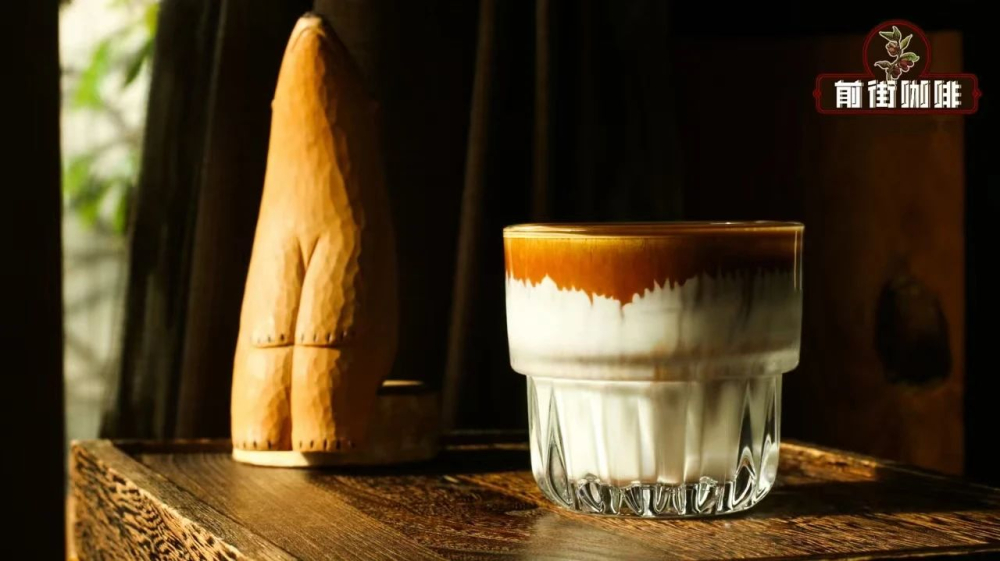
What is Dirty coffee? The vessel chosen for Dirty Coffee is often a glass cup that can show off the beautiful liquid, and no ice is added to it. What matters is that the espresso flows into the pure white milk, slowly permeating and slowly blending, forming a beautiful layered effect. As time passes, the pure white milk is gradually "polluted" by the rich Espresso, and seen through the glass cup, this drink appears dirty.

Dirty coffee can only be made iced~ because Dirty's greatest feature is its tasting experience of ice and fire!
So from the brief introduction above to Latte, Flat White, and Dirty coffee, Front Street has roughly summarized their ranking in terms of milk, coffee content, and overall richness:
Milk content: Latte > Flat White > Dirty Coffee content: Dirty > Flat White > Latte
Overall richness: Dirty > Flat White > Latte
After reading the ranking, I believe everyone already has a preliminary understanding of these three coffees. So how are they different in the production process? Next, Front Street will teach everyone how to make Latte, Flat White, and Dirty coffee~,
How is Latte coffee made?
To make a qualified cup of Latte coffee, the first step is to extract qualified espresso, with normal flow rate and no flawed flavors. In the espresso extraction part, the number of espresso shots used by each coffee shop also varies. Most coffee shops choose to use a double shot to serve Latte coffee, while some use a single shot. For example, Front Street Coffee (FrontStreet Coffee) uses a single shot to serve Latte coffee.
Next is the milk steaming part. Whether perfect milk can be steamed is one of the factors for judging whether a barista's level is qualified. Latte coffee's milk foam is relatively thin, and it tastes smooth and delicate. Therefore, when steaming milk for Latte coffee, it cannot be too thick. The steamed milk should have a glossy surface, with no obvious coarse bubbles or fine bubbles, and should be delicate and beautiful overall. Once the espresso is extracted and the milk is steamed, you can carefully integrate them to complete the Latte coffee.

Integration is also a very important part of making Latte coffee. Good integration can make Latte coffee taste smooth and comfortable, without any miscellaneous sensations. Only when the milk foam thickness is moderate and the coffee and milk are well integrated will you be able to pour an overall comfortable and clean milk foam pattern~
How is Flat White coffee made? First is Flat White coffee. From Front Street's earlier introduction to Flat White coffee, we can know that Flat White coffee is a coffee that highlights the coffee taste, while Latte coffee is a coffee drink with a large amount of milk added. The biggest feature of Flat White coffee is that when the milk is poured into the coffee, it is not integrated with the coffee by swirling, but instead poured in a thin stream from the center, ensuring that the crema on the surface of the espresso is not broken apart when the milk is poured, thereby forming a small white circle in the middle.
The amount of espresso used in Flat White is greater than in Latte. When making Flat White coffee, Front Street also uses a double shot of espresso, but the amount of milk poured in is 100ml less than for Latte coffee. In terms of steaming milk foam, it is also thinner than Latte coffee's milk foam, so that with your first sip you can take in all the milk foam and the unbroken espresso crema.
How is Dirty coffee made? For Dirty coffee, the milk used is best whole fresh milk, ensuring a full-bodied flavor while also ensuring that the milk has enough protein to "support" the espresso poured in afterward. Second, the milk temperature must be low, because no ice cubes are added to avoid damaging the milk's concentration, so the milk must remain at a low temperature, otherwise it will lose the soulful taste of ice and fire.
Front Street's ratio for making Dirty is 150 grams of milk and 40 grams of espresso. First take out a pre-chilled glass cup, make sure there is no water in the glass cup, and pour in the iced milk. Then lock in the tamped coffee portafilter, and place the glass cup with iced milk below the spout (if using a bottomless portafilter, place it directly below the outlet). The outlet should not be too far from the liquid surface. If it is too far, the coffee's own gravity will have stronger penetrating power and it will easily "integrate." A distance of about 1cm is recommended. Qualified espresso will flow evenly and slowly onto the surface of the milk, and "float" on the liquid surface, slowly sinking, forming a dirty look.
Before drinking Dirty coffee, Front Street suggests: drink it in one gulp! Once the Dirty is made, do not stir it, just drink it in one gulp, and you will find that the hot espresso on top has not yet been cooled by the ice, and the milk below has not yet been "polluted." That transformation from a rich chocolate-flavored hot coffee into a milky iced light coffee is simply indescribably wonderful.
After reading Front Street's introduction to the differences between Latte coffee, Flat White coffee, and Dirty coffee, has everyone learned how to choose the milk coffee they want to drink?
The above content is compiled by CoffeeHunters, a coffee news website.


