








How does Hacienda La Esmeralda geisha coffe compare with El Injerto Pacamara?
Guatemala's El Injerto Estate and Panama's Hacienda La Esmeralda stand as two reference points for Central American specialty coffee. El Injerto's Pacamara lots, grown in nutrient-rich volcanic soil, show rich fruity sweetness and have set high auction prices. Hacienda La Esmeralda defines the other direction with its Geisha variety, marked by bright floral and citrus notes.
The estate divides its Geisha lots by altitude into Blue Label, Green Label, and Red Label, a tier system buyers use to gauge flavor and price. The comparison in the article runs through each estate's background, geography, variety traits, processing, and brewing suggestions. Readers interested in sourcing notes may also see rainforest alliance organic coffee and certification mentioned as reference points.
Guatemala's El Injerto Estate and Panama's Hacienda La Esmeralda each represent one of the two peaks of Central American specialty coffee. El Injerto has repeatedly set high auction prices with its Pacamara variety, while Hacienda La Esmeralda defines top-tier flavor through its Geisha Red Label, Green Label, and Blue Label system. In this article, Front Street Coffee provides a complete analysis of the coffee style differences between these two major estates, from estate background, geographical environment, and variety characteristics to processing and brewing suggestions, helping enthusiasts understand Pacamara's rich fruity sweetness and Geisha's bright floral and citrus notes.
For more specialty coffee knowledge, please follow the WeChat public account: Front Street Coffee (FrontStreet Coffee)
Front Street Coffee (FrontStreet Coffee) has always aimed to drink coffee beans from around the world and build a flavor database, hoping to bring more coffee enthusiasts into the world of coffee. Today, Front Street Coffee (FrontStreet Coffee) will introduce two estates that hold pivotal positions on the world specialty coffee map: El Injerto Estate in Guatemala and Hacienda La Esmeralda in Panama.
El Injerto Estate can be called a benchmark estate in Guatemala, having won countless international awards. The area where the estate is located has nutrient-rich volcanic soil and a unique microclimate, and these natural advantages together create the excellent quality of its coffee. And Panama's Hacienda La Esmeralda also needs no lengthy introduction; it is one of the most representative estates of Panama coffee . The Geisha variety is the treasure of this estate; it can be said that without Hacienda La Esmeralda, there would be no Geisha coffee as we know it today. Based on altitude, the estate divides Geisha coffee beans into: Blue Label Geisha , Green Label Geisha, and Red Label Geisha. Likewise, Hacienda La Esmeralda has won numerous awards worldwide, and each Geisha auction it holds attracts coffee merchants from all over the world, with almost no one failing to admire its coffee.
Front Street Coffee (FrontStreet Coffee) Guatemala El Injerto Estate Micro-lot Pandora Coffee Beans
Country: Guatemala
Grade: SHB
Estate: El Injerto Estate
Roast Level: Medium Roast
Processing Method: Washed
Variety: Pacamara
Lot: Micro-lot Pandora Fatima EI07
Flavor: Chestnut, plum, chocolate
Cupping Evaluation: Full, rich, and changeable flavor; few coffee varieties have both fruity acidity and still obvious sweetness, with diverse variations including stone fruits, vanilla plants, tropical fruits, chocolate, and spice sweetness.
World-class Coffee Estate: El Injerto Estate
El Injerto Estate is located on the highlands of Huehuetenango, a famous producing region in Guatemala. The Aguirre family has grown coffee here since 1900, continuing to this day. The estate's name Injerto comes from a local fruit. El Injerto Estate places particular importance on ecological protection and organic farming, implements strict quality control, and ensures stable green bean quality. Through the efforts of the Aguirre family, the estate has obtained Rainforest Alliance certification and has been a frequent winner in many international coffee competitions since 2002.
Geographical Environment
El Injerto Estate has long played the role of a pioneer of Central American specialty coffee. About fifty years ago, it was one of the first estates to focus on single varieties and vertical integration to produce high-quality coffee. The estate covers a total area of 447 hectares, most of it between 1,500 and 2,000 meters above sea level, growing coffee, fruits, staple food crops, and ornamental plants. The remaining hectares are preserved as millennium-old primary forest, bringing the estate unique temperature regulation and the conditions to draw clean spring water directly from the mountains. In addition, this place provides an ideal habitat for wildlife, integrating coffee cultivation into a system that protects the natural ecology. Forest surrounds the coffee gardens, with annual rainfall of about 1,800-2,000 mm and relative humidity of 75%. The soil is deep volcanic soil with good drainage and rich organic matter.
About the Pacamara Variety
The 2004 Cup of Excellence (COE) made Pacamara famous overnight, and it frequently won championships over the following two or three years. The Pacamara produced by Guatemala's El Injerto Estate set a sky-high price of US$80.2 per pound of green beans in 2008. This variety is a cross between Maragogype and Pacas, combining the first four letters of each variety name to form Pacamara. It is an excellent coffee variety developed in El Salvador. The coffee beans are very large, close to Maragogype, about 21-22 screen size, and it is a variety that has performed excellently in Central and South America in recent years.
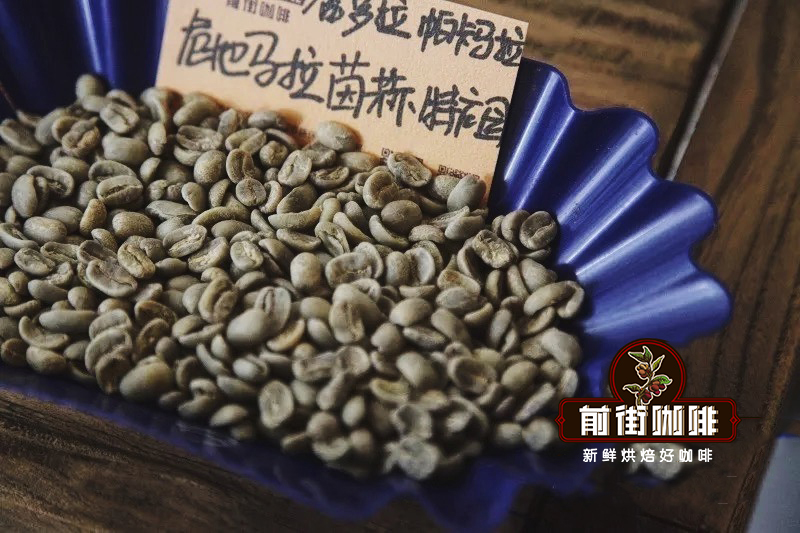
The appearance of the Pacamara variety is still quite similar to its cousin Maragogype. Since 2006, COE has cupped Pacamara from 30 estates, including many superstars, such as 2006 Honduras champion Santa Martha, 2007 El Salvador third-place Cerro Negro (Black Mountain Estate), Guatemala CoE regular champion estate El Injerto, and 2008 El Salvador runner-up Pacamaral Estate. These are all excellent representatives of Pacamara, but they all belong to award-winning lots, so they are expensive.
Self-organized Auction
El Injerto is also one of the few estates that organizes its own online auction. Along with the Panama Hacienda La Esmeralda auction, it is a grand event that global green bean merchants must attend. Starting in 2011, El Injerto put its best-quality coffee lots up for auction, called the "El Injerto Estate Auction," and these lots have had tremendous effort poured into them from variety cultivation, planting, and harvesting all the way to post-processing.
Independent Washing Technology
El Injerto hires workers at twice the local wage to hand-select fully red coffee cherries, and it has its own independent water processing facility. After pulping, the beans undergo two separations by bean shape and size grade, then are washed with clean mountain spring water, then enter clean tanks, undergo 2 days of fermentation and 7 days of sun drying, and are stored in the warehouse for at least 45 days before being sent for professional cupping.
Front Street Coffee (FrontStreet Coffee) 2020 New Crop Panama Blue Label Geisha
Region: Boquete
Estate: Hacienda La Esmeralda
Altitude: 1500m
Variety: Geisha
Processing Method: Washed
Panama Hacienda La Esmeralda
Panama is located in Central America, connecting North America and South America, and borders Costa Rica and Colombia. Panama's coffee path can be described as having been born with a silver spoon. As is well known, the Panama Canal was built by the United States, and after completion it was for a time controlled independently by the United States. It was precisely the construction of the Panama Canal that brought many American elites south at the end of the 20th century, partly due to work demands and partly to seek business opportunities. Hacienda La Esmeralda is a witness to that era.
In 1964, American banker Rudolph Peterson retired and moved to Panama, buying Hacienda La Esmeralda in Boquete, initially focusing on dairy. Later, his son Price resigned from his position as a doctor to help his father run the farm, introduced Caturra and Catuai coffee varieties in 1987, and established a washing processing plant in 1994, from then on having its own coffee processing factory. In 1996, he bought the nearby Jaramillo Estate, which had a superior geographical environment and original coffee varieties with good flavor, and merged it into Hacienda La Esmeralda.
The reason Jaramillo Estate was favored by the Petersons was precisely that its originally planted coffee beans had a pleasant orange aroma and floral-fruity fragrance, different from the original taste of Panama coffee. After cupping coffee beans from different areas of the farm, it was found to be an unknown coffee tree growing at the highest point of the estate. Because its yield was low, the previous owner only used it as a windbreak tree, but it was discovered by the Petersons, who decided to plant and cultivate the coffee trees in that area separately. After participating in the Panama green bean competition BOP in 2004 and winning the championship, it became astonishing; later expert identification revealed that the coffee bean was the Ethiopian Geisha variety. Afterward, the Peterson family put most of its energy into developing infrastructure to support excellent lot separation and fine processing.
Plot Division of Hacienda La Esmeralda
Hacienda La Esmeralda is located in the Boquete producing region of Panama. This region is an important coffee producing area in Panama, and many well-known coffee estates come from here, such as Elida Estate and Kotowa Estate. Hacienda La Esmeralda divides its Geisha plots extremely finely, mainly into three plots: Jaramillo, Cañas Verdes, and El Velo. Each plot is further finely divided into smaller plots. High-quality Geisha mainly comes from the two plots Jaramillo and Cañas Verdes.
Jaramillo has annual rainfall of 4000 ml, average daytime temperature of 19-25°C, average nighttime temperature of 11-15°C, and average altitude of 1600-1700m. Cañas Verdes has annual rainfall of 3500 ml, average daytime temperature of 16-23°C, average nighttime temperature of 10-15°C, and average altitude of 1600-1800m. El Velo is the newest plot purchased by Hacienda La Esmeralda, with an average altitude of 1700-1900m. In addition to growing Geisha and Catuai, this plot also has a small amount of other introduced varieties, such as Laurina, Pacamara, Mocha, and SL28.
Geisha Coffee : Geisha Red Label, Green Label, Blue Label
Hacienda La Esmeralda's marketing strategy differs from other estates. Based on cupping performance as well as planted variety and plot, it is divided into five major brands. There are three brands for the Geisha variety: Esmeralda Special, Private Collection, and Geisha 1500. There are two brands for the Catuai variety: Diamond Mountain grows and Palmyra.
Red Label
The Geisha produced under Esmeralda Special is what we often hear called Red Label. It uses Geisha beans grown at 1600-1800 meters above sea level, with a cupping score above 90, from the two producing areas Jaramillo and Cañas Verdes. Only the Geisha lots that Hacienda La Esmeralda itself puts up for auction from the divided plots in its own independent auction are the auction Red Label. However, there is now also non-auction Red Label on the market, which is actually Geisha selected from the same plots that did not go to auction and then circulated on the market. The variety quality is consistent; only the selling price differs. This grade of Geisha uses natural or washed processing, and the flavor has special, bright floral aroma and citrus aroma.
Green Label
Private Collection, commonly known as Green Label, is not a lot from the independent competition, but Geisha varieties that do not participate in auctions yet still have excellent quality. It uses micro-lot blended beans grown at 1600-1800 meters above sea level from different plots such as Jaramillo and Cañas Verdes. Because it uses a blended-bean model and does not specify the plot in detail, sometimes Green Label and Red Label can be very similar in flavor, but the next release may differ again. Although Green Label is not as high-grade as Red Label, it still carries the classic flavor of Geisha: floral aroma, fruity aroma, citrus acidity, and a thick, juicy mouthfeel. Green Label Geisha is likewise either washed or natural processed.
Blue Label
The brand Geisha 1500 is what we commonly see as Blue Label Geisha. It uses blended beans grown at 1400-1500 meters above sea level from three different plots: Jaramillo, Cañas Verdes, and El Velo. The flavor has slight floral aroma, fruity acidity, and sweetness; the mouthfeel is less thick. Blue Label Geisha is only washed processed.
Front Street Coffee (FrontStreet Coffee) 2020 Crop Blue Label Roasting Suggestions
Because Blue Label coffee beans have clear floral and citrus-family flavors and very high cleanliness, in order to highlight these flavors, Front Street Coffee (FrontStreet Coffee) recommends a light roast. The darker the roast, the more these bright qualities are consumed.
Machine: Yangjia 800N, 550g green beans charged
Charge temperature: 180°C
Turning point: 5'20", 151.6°C
First crack: 8'30", 181.8°C
Development after first crack: 1'28'', discharged at 190°C
Brewing Suggestions
Dripper: V60
Water temperature: 90°C
Coffee dose: 15 grams
Coffee-to-water ratio: 1:15
Grind size: fine granulated sugar (80% passing rate on China standard No. 20 sieve)
Front Street Coffee (FrontStreet Coffee) uses staged extraction: use 30 grams of water for a 30-second bloom, pour in a small stream in circles until 125 grams for the stage break, and when the water level drops and is about to expose the coffee bed, continue pouring until 225 grams and stop pouring. When the water level drops and is about to expose the coffee bed, remove the dripper. (Timing starts at the beginning of the bloom.) Extraction time is 2'00".
Flavor Description: Light jasmine floral aroma and citrus aroma; on the palate there is obvious citrus and smoked plum, with fresh and bright acidity; the middle section has nuts, and the finish is honey sweetness, with lasting sweetness.
For more specialty coffee beans, please add the private WeChat of Front Street Coffee (FrontStreet Coffee), WeChat ID: kaixinguoguo0925
The above content is compiled by CoffeeHunters, a coffee news website.


