







Where does coffee originate from, and why do Ethiopian regions differ?
Ethiopia is widely recognized as the birthplace of coffee, and it is also where the two beans compared here are grown. Yirgacheffe comes from the town of that name, while Huakui comes from the Sidamo Guji area. Although both are Ethiopian, they differ in altitude, variety, and processing method, so they taste quite different in the cup.
The comparison covers regional background, variety relationships, processing, and brewing suggestions for each bean. Ethiopia's mountainous terrain, wide latitude span, and heavy rains from June to September create large local climate differences. Those differences, not the country name alone, explain why two Ethiopian coffees can present separate flavor profiles.
Ethiopia, as the birthplace of coffee, has nurtured numerous renowned coffee regions, among which Yirgacheffe and the recently much-followed Huakui are often confused by enthusiasts. From the perspective of Front Street Coffee, this article provides an in-depth analysis of the regional backgrounds, variety relationships, and flavor characteristics of these two coffee beans. The article first introduces Ethiopia's cultivation models and main production regions, then details the Huakui from the Sidamo Guji region and the Gudingding from the Yirgacheffe town, covering altitude, processing methods, flavor descriptions, and brewing suggestions. Through comparison, readers will clearly understand that although Huakui and Yirgacheffe both belong to Ethiopia, they present entirely different coffee experiences due to differences in regional terroir and processing methods.
For more specialty coffee knowledge, please follow the WeChat public account: FrontStreet Coffee Ethiopia is widely recognized as the birthplace of coffee, a point that has long been a consensus in the coffee world. Whenever the country's coffee is discussed, the first thing that comes to most enthusiasts' minds is likely Front Street Yirgacheffe. In recent years, another bean from Ethiopia has emerged as a focal point—Front Street "Huakui." However, many people may not be able to clearly explain the relationship between the two. Even if you can't distinguish them for now, that's fine. Below, FrontStreet Coffee will help you sort out the connection between Front Street Yirgacheffe and Front Street Huakui through this article. Ethiopia As a famously renowned coffee origin, Ethiopia is located in northeastern Africa, at the core of the Horn of Africa, on the East African Plateau southwest of the Red Sea. It borders Djibouti and Somalia to the east, Sudan and South Sudan to the west, Kenya to the south, and Eritrea to the north.
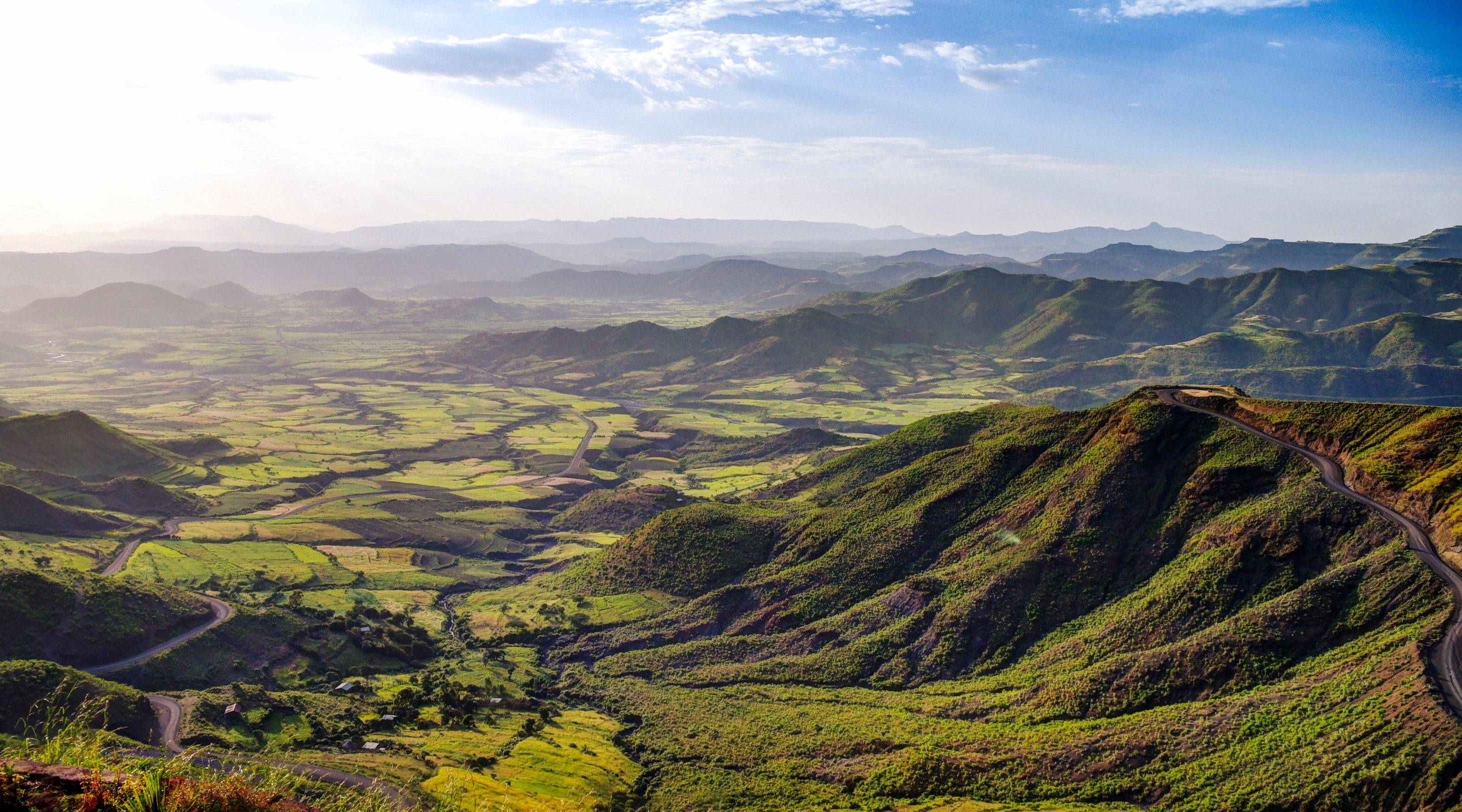
Ethiopia's terrain is dominated by mountains and plateaus, with the East African Rift Valley running through the entire country from north to south, and an average elevation of nearly 3,000 meters, earning it the title "Roof of Africa." Due to the country's wide latitudinal span and significant elevation differences, despite being in the tropics, temperatures vary greatly from place to place. The heavy rainy season runs from June to September each year, the dry season from October to January, and the light rainy season from February to May. Rainfall is unevenly distributed across seasons and regions, with localized droughts occurring from time to time. Temperatures range roughly between 9.7°C and 25.5°C, with an annual average of about 16°C. Coffee cultivation in Ethiopia is mainly concentrated in the western and southern regions, with more than half of the coffee grown under smallholder farming models, the so-called garden coffee, which is the country's most important production method. It is reported that about 1.2 million households depend on coffee cultivation for their livelihood, with each household cultivating no less than 4 hectares. Garden coffee refers to farmers growing coffee trees mixed with other cash crops in their backyards, usually interplanted with banana trees, creating a unique green landscape around every household.
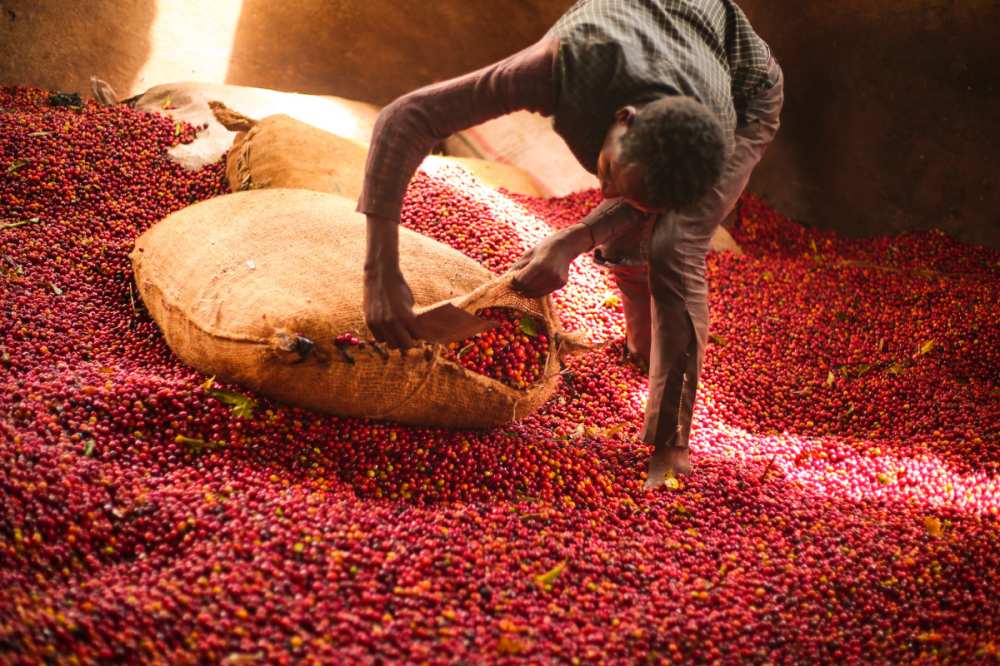
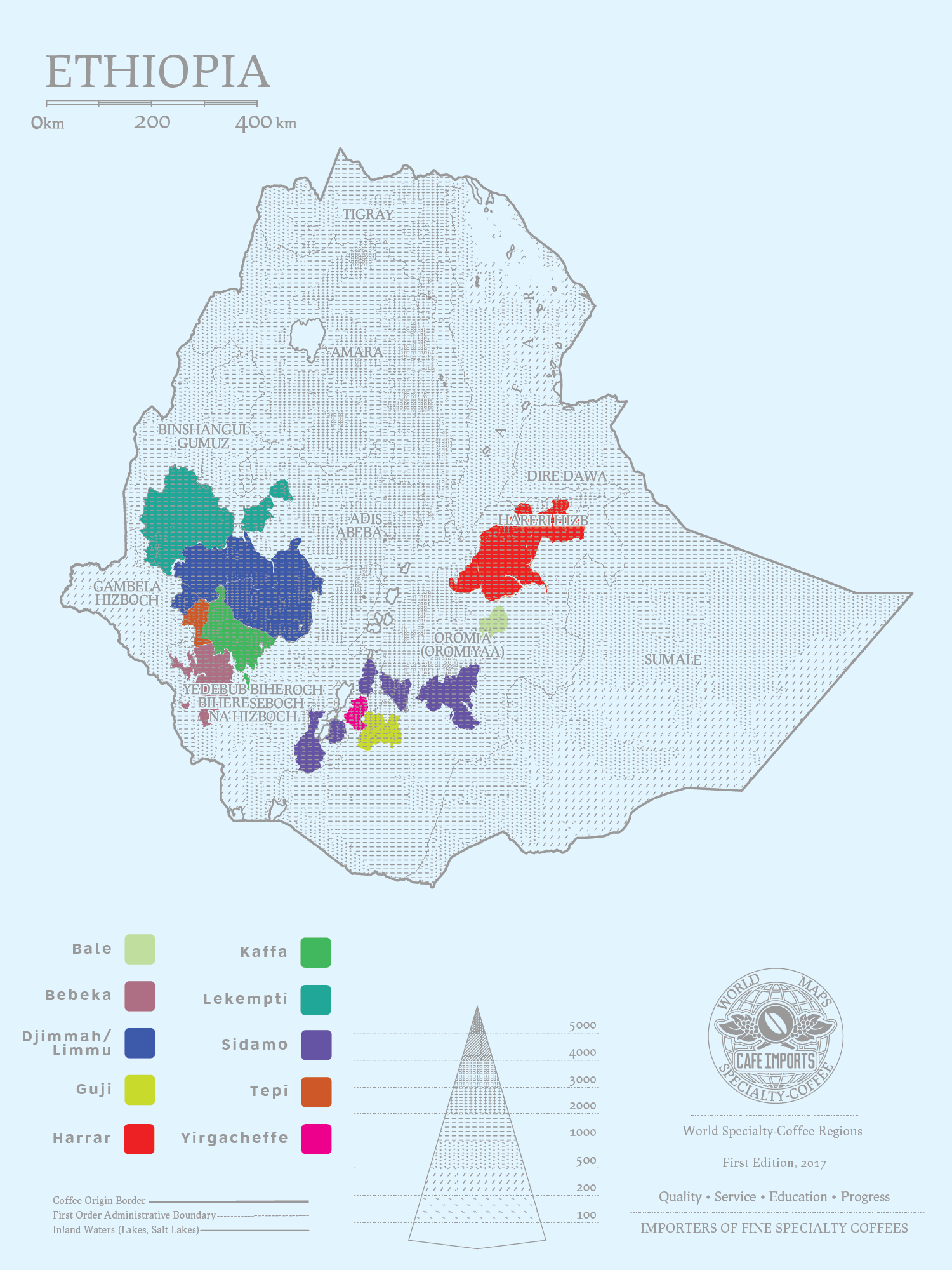
Since smallholder coffee yields are limited, various farmer cooperatives or processing plants are established locally to handle the processing of green coffee beans from the region. During the harvest season, farmers collect the cherries from their coffee trees and send them to nearby processing plants or cooperatives close to water sources for unified processing, after which they are sold under the processing plant's name. For example, the Front Street Gudingding Cooperative coffee beans on the Front Street bean list are made from coffee cherries grown in Yirgacheffe town, sent by farmers to the town for unified washed processing, and finally produced and sold worldwide under the cooperative's name. Production Regions Ethiopia has nine main coffee production regions: Sidamo, Yirgacheffe, Harar, Limu, Jimma, Tepi, Bebeka, Lekempti & Gimbi, and Illubabor.
Here, Front Street will only introduce the two regions involved in this article, namely Sidamo and Yirgacheffe. 【Sidamo】 Sidamo is located in southern Ethiopia, extending east to the Arsi and Bale administrative zones, and west to the Gamo Gofa administrative zone. Coffee cultivation in the Sidamo region ranges from 1,400 to 2,000 meters above sea level. The coffee flavors of this region are rich and diverse; different soil types, microclimates, and countless native coffee varieties give each town's coffee distinct differences and characteristics. Among them, Guji and West Arsi under Sidamo are the most well-known to the outside world. Coffee beans from the Sidamo region mostly use the natural processing method for green bean processing. Through repeated cupping, Front Street has found that the rich fruity aroma and smooth mouthfeel of the region's coffee beans are inseparable from the natural processing method.
On the FrontStreet Coffee bean list, the Front Street Huakui bean comes precisely from Guji in the Sidamo region. Coffee from the Guji region differs from that of the Yirgacheffe region in that its floral expression is more intense. After the Hambela produced in Guji won the championship in the 2017 Ethiopia National Taste of Harvest Competition, Chinese green bean importers named this bean Huakui; at the time, this bean carried intense strawberry and cream aromas. Front Street Huakui originates from naturally processed beans of the Buku Abel processing plant. The surrounding area where Front Street Huakui coffee is grown is covered with sugarcane and bananas. Supported by high-altitude climatic conditions, Front Street Huakui coffee has a smooth mouthfeel with passion fruit-like acidity. The natural processing method gives this bean a fermented wine aroma.
FrontStreet Coffee: Front Street Sidamo · Huakui 5.0 Coffee Beans Region: Sidamo, Ethiopia Altitude: 2050m-2300m Variety: Local native species Processing Method: Natural 【Yirgacheffe】 Yirgacheffe is a small town with an altitude between 1,700 and 2,100 meters. In its original name YirgaCheffe, Yirga means "to settle down," and Cheffe refers to "wetland." Therefore, YirgaCheffe means "let us settle down on this wetland." Yirgacheffe was once a sub-region of Sidamo, but because the coffee beans produced there and their production methods were so outstanding, Ethiopian coffee farmers prided themselves on their coffee having Yirgacheffe flavor. Because of this, Yirgacheffe was separated and became an independent production region. The word Yirgacheffe not only represents a region name but is also synonymous with a coffee flavor. Yirgacheffe coffee beans are known to everyone and are the introductory choice for many coffee enthusiasts. This is all thanks to the Yirgacheffe flavor—so-called Yirgacheffe flavor, namely intense jasmine floral aroma, lemon or lime acidity, and peach, almond sweetness, and tea aroma. As Han Huaizong described in "Specialty Coffee Studies," "Coffee enters the mouth, a hundred flowers bloom."
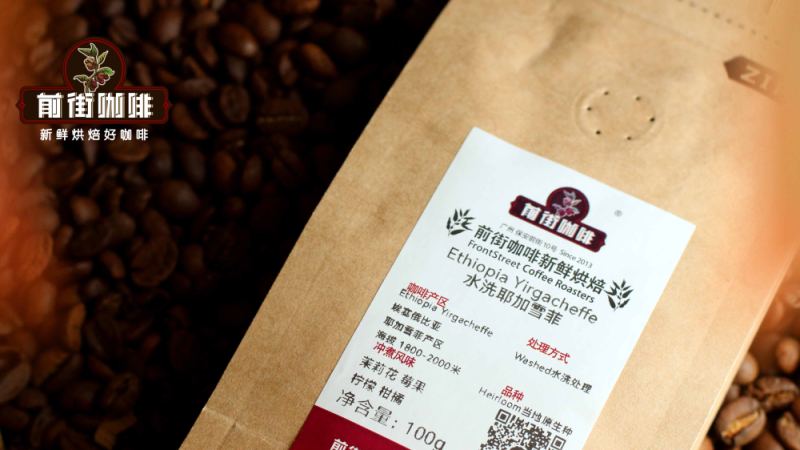
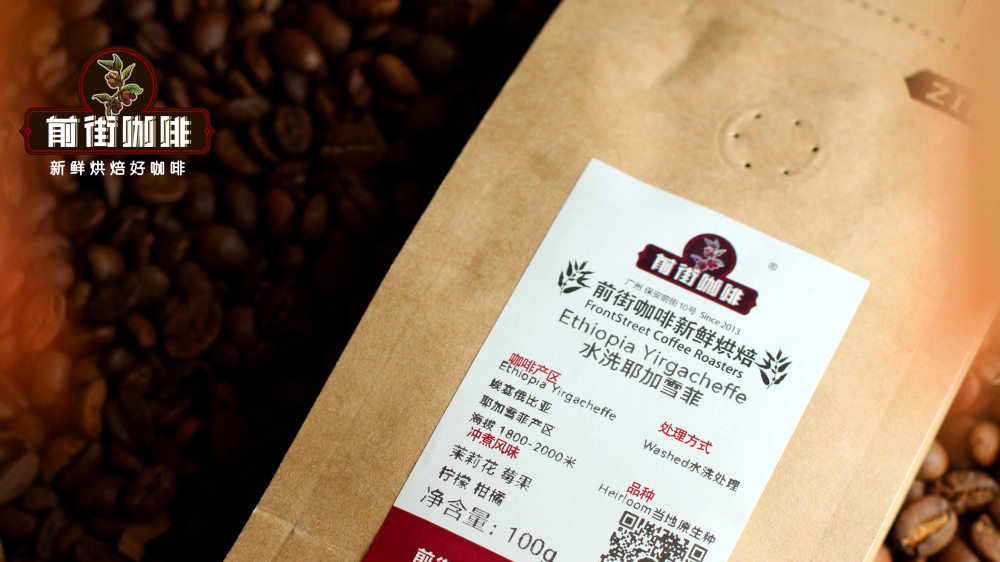
Compared with the impression of Sidamo coffee, Yirgacheffe mostly uses the washed processing method. FrontStreet Coffee believes that washed coffee has more prominent acidity and better cleanliness, best showcasing the characteristics of Yirgacheffe. On Front Street's bean list, the washed Yirgacheffe coffees include Front Street Worka, Front Street Kochere, and Front Street Gudingding. Among them, the Gudingding Cooperative that produces the Front Street Gudingding bean was independent from the Worka Cooperative in 2012. Many members of the Gudingding Cooperative were originally members of the Worka Cooperative, so the coffee production technology of the Gudingding Cooperative is naturally not to be underestimated.
FrontStreet Coffee: Front Street Yirgacheffe · Gudingding Coffee Beans Region: Yirgacheffe, Ethiopia Cooperative: Gudingding Cooperative Altitude: 2000m-2100m Variety: Local native species Processing Method: Washed Brewing Suggestions In order to fully extract the fruity acidity of these two beans, Front Street uses a higher water temperature and a finer grind for extraction, but to avoid over-extraction caused by high temperatures, a faster-flow dripper is chosen, such as the V60 dripper. Front Street recommends using freshly roasted coffee beans for brewing, so as to experience the coffee's rich flavors to the greatest extent. FrontStreet Coffee ships coffee beans within 5 days of the roasting date, because Front Street deeply understands that the freshness of coffee beans greatly affects the flavor. Front Street's roasting philosophy is "freshly roasted good coffee," allowing every customer who places an order to receive the freshest coffee when they receive it. The resting period for coffee is about 4 to 7 days, so when customers get it in hand, it is exactly at its best flavor.
Dripper: V60 #01 Water Temperature: 90-91°C Dose: 15g Coffee-to-Water Ratio: 1:15 Grind Size: EK43s#10 (80% passing through a No. 20 standard sieve)
Front Street brewing method: In the first stage, pour 30 grams of water for a 30-second bloom, then pour 95 grams (electronic scale shows about 125 grams), completing the pour in about 1 minute. When the water level drops to 2/3 of the coffee bed, pour the remaining 100 grams (electronic scale shows about 225 grams), completing the pour in about 1 minute 35 seconds. Dripping is completed in 2 minutes to 2 minutes 10 seconds. Remove the dripper and the extraction is complete. Flavor 【Front Street Gudingding】Citrus and black tea on entry; as the temperature changes, cream, caramel, and almond finish with a notably sweet aftertaste and a clean, sweet mouthfeel. 【Front Street Huakui 5.0】Floral, berry, citrus, and plum sweet-tartness, mango juice, honey, with a black tea sweet finish.
After reading to the end, Front Street needs to explain once again the relationship between Front Street Huakui and Front Street Yirgacheffe, in case some readers still do not fully understand. Front Street Huakui is a coffee bean produced in the Sidamo region, while Front Street Yirgacheffe refers to coffee beans from the Yirgacheffe region.
The above content is compiled by CoffeeHunters, a coffee news website.


