







What Is Arabica and What Is Robusta in the Coffee Belt?
Arabica, or Coffea arabica, accounts for about 80 percent of global production and is known for delicate floral and fruity aromas and a smooth mouthfeel. It originated in Ethiopia and grows mainly in the tropical and subtropical transition zones at 1,000 to 2,300 meters known as the Coffee Belt. The trade-off is fragility: Arabica is susceptible to disease and needs careful growing conditions.
Robusta, or Coffea canephora, carries more caffeine and tolerates stress and disease far better, which is why it appears in espresso blends and instant products. It has long been treated as the inferior option, yet specialty-grade Robusta is challenging that assumption through better farming, picking and processing. The two varieties occupy different market positions, and the third wave's focus on tracing coffee from seed to cup has made those differences easier for drinkers to taste.
The flavor quality of a cup of coffee is often foreshadowed at the seed stage. The third wave of coffee has led people to trace every step from cultivation, harvesting, and processing to roasting, and varietal differences are the most critical dividing line among them. Arabica accounts for about 80% of global production and is known for its delicate floral and fruity aromas and smooth mouthfeel, yet it is delicate and susceptible to disease; Robusta has higher caffeine content and strong stress resistance, and is often used in espresso blends and instant products, yet it has long borne a reputation for inferior quality. This article systematically sorts out the origins, growing conditions, flavor performance, and market positioning of the two major varieties, and explores whether specialty-grade Robusta can break through prejudice. At the same time, combined with several bean lists from the Front Street brand, it provides bean-selection references for coffee lovers with different taste preferences.
Coffee has gone through a long history, and it was not until the third wave of coffee swept in that people truly became willing to take the trouble to trace the complete journey of a cup of coffee from the land to the cup—the way farmers cultivate it, the selection during picking, the techniques of green bean processing, and how roasters tailor a roasting curve for each bean.
It All Begins with a Seed
The story of coffee begins with a seed, which comes from a tree that bears white flowers and gives off a jasmine-like fragrance. The fruit produced by this tree looks much like a cherry, and wrapped at the very center of the fruit is the coffee bean.
London's Botanical Kew Gardens is responsible for identifying more than 120 species of Coffea plants, many of which come from Madagascar, Asia, and Australia. Among so many varieties, Coffea arabica (Arabica) and Coffea canephora (Robusta) occupy the main position and are the two types most consumed by the public in daily life. Although the Coffea family has many members, so far no other variety has managed to gain a firm foothold in large-scale commercial production.
What Is Arabica?
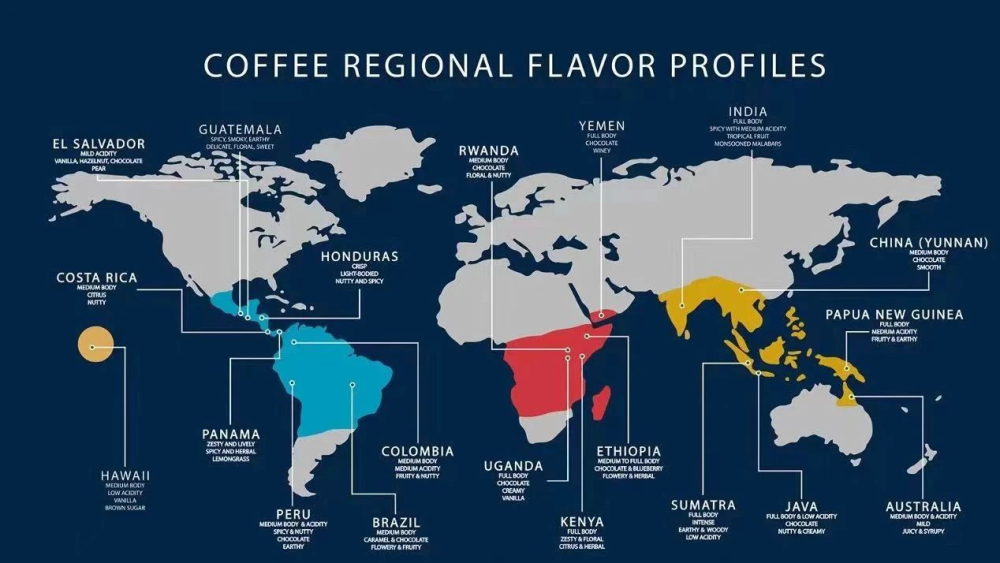
About 80% of global coffee production is Arabica. This variety originated in Ethiopia and is mostly distributed in the tropical and subtropical transition zones at altitudes of 1,000 to 2,300 meters, the so-called "Coffee Belt." This region often has fertile volcanic soil, regular rainfall, and abundant sunshine, exactly meeting the conditions for healthy coffee tree growth.
Arabica is quite picky about its growing environment, and its plants are susceptible to disease. Coffee leaf rust or fungal infections can cause orange spots to appear on the leaves, hindering photosynthesis and eventually leading to defoliation or even the death of the entire plant. If not controlled effectively, an entire estate may be destroyed. In addition, pests such as the coffee berry borer also prefer Arabica; they lay eggs inside the fruit, and after the larvae hatch, they feed on the pulp, greatly reducing coffee quality.
Despite these cultivation challenges, Arabica still wins the favor of most consumers with its smooth mouthfeel and pure flavor. A cup of Arabica can be full of aroma and complexity, often described as having notes of flowers, fruit, citrus, earth, cream, chocolate, caramel, honey, or sugar. The flavor range spans from lightly sweet to rich and full-bodied, depending on origin and processing method, offering a great deal of choice.
For Arabica lovers who prefer floral and fruity notes, you can try Front Street Strawberry Candy, Front Street Fruit Ding Ding, and Front Street Flower Butterfly; for Arabica with balanced acidity and bitterness, Front Street 2013 Yunnan Small-Molecule, Front Street Bird of Paradise, and Front Street Blue Mountain No. 1 are good choices; if you seek Arabica with high body, medium-dark roasted Front Street PWN Golden Mandheling should be the first choice.
What Is Robusta?
Robusta originated in West Africa and is suitable for cultivation in lower-altitude, higher-temperature regions. The remaining portion of the world's coffee production basically belongs to this variety. Robusta beans are smaller and rounder, and their caffeine content is nearly twice that of Arabica. The high caffeine content happens to serve as a natural insect-repellent barrier, helping it resist most pests, which also makes Robusta cheaper to cultivate and more affordable. In addition, because it can produce a thicker crema during extraction, it is often used in blend beans.
For making Italian-style coffee, Front Street Classic Blend and Front Street Commercial Blend are the first choices. Front Street Classic Blend uses a combination of Brazil, Mandheling, and Robusta, giving the coffee aromas of nuts and toasted bread, a full-bodied mouthfeel, and a beautiful crema, making it very beginner-friendly.
For café operators, stability, cost-effectiveness, and compatibility are all indispensable, so a combination of Colombia, Brazil, and Robusta is more practical: Brazil contributes creamy nutty aromas, Colombia brings chocolatey richness, and Robusta adds body and crema. Even baristas with limited experience can easily extract a standard espresso.
Although Robusta also has notable strengths in quality, it has not won widespread public favor. In fact, most coffee lovers reject Robusta, mainly because it is often used in instant coffee or low-quality blend beans, and the products are often cheap and mediocre. After roasting and brewing, Robusta is often described as prominently bitter, sharp, and carrying notes of wood and rubber. Although it is unpopular among coffee enthusiasts and is not the first choice for mass consumption, it still has a group of loyal followers.
Without Human Intervention, Robusta Would Be the One to Survive
Gabe Shohet is the co-founder of Black Sheep Coffee in London and is committed to promoting specialty-grade Robusta. This café was founded by Shohet and several friends, who wanted to make coffee that was different from the rest, especially favoring Robusta's rich, thick, high-caffeine characteristics. As the shop's name suggests, they have already stepped off the tracks of mainstream coffee culture.
Shohet's advocacy of Robusta is not without basis. In his article "Fairness and E-Quality: The Case for Robusta," he wrote that Robusta has a bad reputation, but the responsibility does not lie with the bean itself. Robusta is usually harvested by machine, which means the harvest is mixed with rotten beans, unripe beans, and impurities such as insects and branches. Such a combination is destined to produce a bad cup of coffee.
So Shohet began to test a hypothesis: if Robusta received the same careful care as Arabica, what would its flavor become? After months of repeated trials, Shohet and his team found the world's first specialty-grade Robusta farm. The Sethuraman Estate in India hand-sorts, double-washes, and shade-dries Robusta, and the resulting flavor profile is even more distinctive than Arabica. This high-caffeine drink can help people stay energized all day while carrying clear walnut and chocolate flavors.
Arabica may still be consumers' first choice, but Robusta has already begun to clear its name. What people like Shohet are working hard to do is give consumers a reason to give it another chance.
The above content is compiled by CoffeeHunters, a coffee news website.


