







How Does Processing Shape Sidamo Guji Lion King Coffee?
The Sidamo Lion King natural G1 comes from the Guji region of Sidamo, Ethiopia, grown between 1,800 and 2,000 meters on volcanic soil roughly two meters deep. Natural processing dries the whole cherry around the coffee seed, which builds the floral and tropical fruit notes, a smooth balanced mouthfeel and a lively layered structure. The variety is a local heirloom, harvested and processed in 2017.
Sidamo's diversity comes from its terrain: high mountains, plateaus, valleys and plains sit alongside multiple soil types and a unique microclimate, and fertility is maintained by organic matter cycling rather than heavy inputs. Because processing coffee beans this way depends on the cherry, the roast curve is designed to protect that fruit character, and pour-over parameters are set to keep the cup clean and bright.
Sidamo, as a long-renowned specialty coffee region in southern Ethiopia, nurtures richly layered coffee flavors thanks to its diverse terrain and fertile volcanic soil. This article focuses on the Sidamo Lion King natural G1 lot released by Front Street Coffee, analyzing it one by one from regional background, cooperative source, and natural processing flow, to green bean characteristics, roasting curve design, and pour-over parameters. This bean carries notes close to floral and tropical fruit, with a smooth and balanced mouthfeel and a lively, varied layered structure, suitable for coffee lovers who prefer bright acidity and clean flavors to explore in depth.
Ethiopian
Sidamo Lion King
[Front Street Coffee · Sidamo Lion King]
Origin: Guji region, Sidamo, Ethiopia
Altitude: 1,800 m – 2,000 m
Processing method: Natural process
Harvest and processing time: 2017
Variety: Local heirloom varieties
01 | Regional Introduction
Sidamo Coffee Region
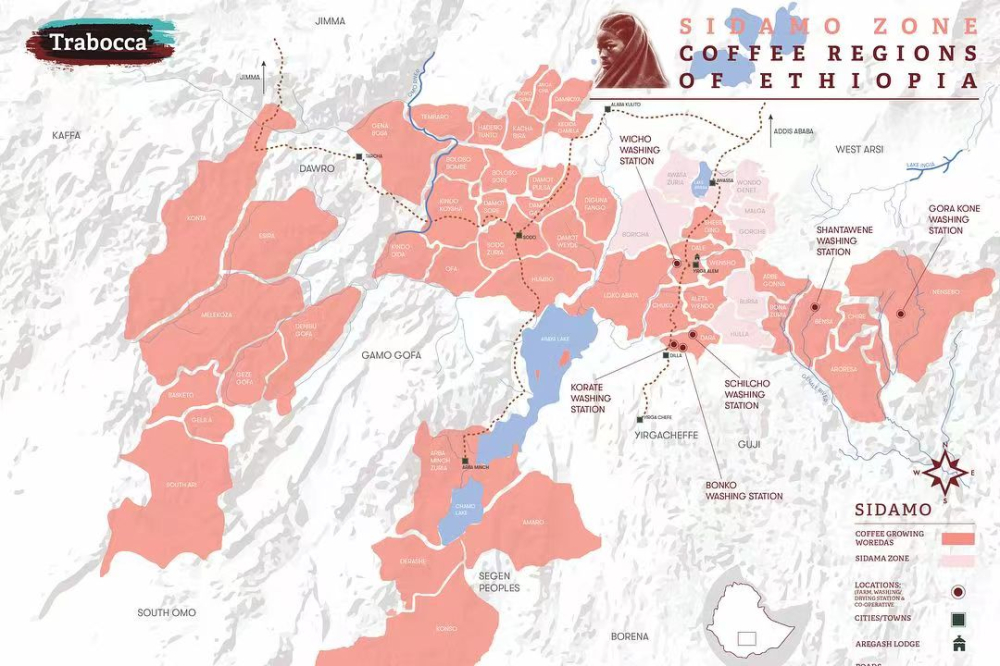
The coffee flavor expression of Sidamo is extremely rich. This area has multiple soil types, a unique microclimate, and a large number of unclassified native coffee varieties; the territory is covered with high mountains, highlands, plateaus, valleys, and plains, with complex and varied terrain. Geologically, it is volcanic soil, nutrient-rich and well-drained, with a soil layer nearly two meters deep, and the topsoil is dark brown or brown.
Sidamo is located at the southernmost end of the Ethiopian Highlands, with an altitude range of about 4,600 to 7,200 feet (part of Sidamo Province). It is a well-known specialty coffee region in southern Ethiopia, adjacent to Kenya, located southeast of Jimma and directly south of the capital. Coffee from this region usually has prominent sweetness and is favored by many consumers, with annual production of about 225,000 bags (60 kg per bag). The reason Sidamo coffee flavors are so diverse is precisely the combined effect of different soils, microclimates, and countless native varieties. Within the region, high mountains, highlands, plateaus, valleys, and plains interweave, the terrain is diverse, and the volcanic soil is fertile and well-drained, nearly two meters deep, with dark brown or brown topsoil. The greatest advantage here is that soil fertility is maintained through the cycling of organic matter—fallen leaves from surrounding trees and residual plant roots naturally return to the soil and become fertilizer, so coffee produced in different towns often shows obvious differences and unique character.
In 2010–2012, this region continuously received high scores of 92 to 94 from the authoritative American coffee evaluation website CR, which fully shows that the green bean quality of this region is extraordinary.
Introduction to the Guji Region
The Guji region is located southeast of the well-known Yirgacheffe region.
In terms of administrative division, it belongs to Oromia Region Guji Zone and is a regional green coffee. Just as Yirgacheffe became widely known after gaining fame, Guji also became independent from the broad Sidamo area and became a sub-region (Guji Zone). The Front Street Sidamo coffee in this lot is produced near Dara Woreda town in Sidama Province, by smallholder coffee farmers of Shilcho Coop. The cooperative was established in 1976 and is now a member of the Sidama Coffee Farmer Cooperative Union (SCFCU), the cooperative union of Sidama Province. SCFCU is a large coffee cooperative union in Ethiopia, currently with about 46 member cooperatives under it, ranking second in scale in Ethiopia.
02 | Processing Method
The natural method is the oldest and most primitive way of processing coffee beans. Compared with the washed method, coffee obtained by this drying method is also called "natural coffee" or "sun-dried coffee." Specifically, the harvested coffee cherries are placed directly in the sun to dry for about two to four weeks. Countries with distinct dry and wet seasons usually adopt this method.
1. First, harvest ripe coffee cherries.
2. Initially remove impurities and defective beans.
3. Screen floating beans: pour the coffee cherries into a water tank; ripe, plump cherries will sink to the bottom, while immature or damaged cherries will float to the surface.
4. Sun drying: scoop out the ripe coffee cherries that sank to the bottom of the tank and spread them on a drying yard for sun drying, reducing moisture from 70% to about 10–12%. They need to be turned several times a day so the cherries dry evenly, and at night they must be covered to prevent moisture.
5. Remove the husk: after about two to four weeks of sun drying, the outer layer of the coffee seed has become dry and hard; at this point, use a huller to remove the husk and the process is complete.
03 | Green Bean Analysis
[Front Street Sidamo Lion King, Natural Process]
Ethiopia has nearly 2,000 recorded coffee varieties. Ethiopian coffee varieties are like a "Grand View Garden," with different shapes—long and short, thin and plump—making them difficult to identify one by one, so they are collectively called local heirloom varieties. The beans are mainly medium-sized, and there are also small-seeded dwarf varieties with relatively poor disease resistance; the plants are tall and robust, with a medium tree shape.
04 | Roasting Analysis
This green coffee bean is relatively small, green with a yellow tinge, with poor uniformity and not high moisture content. The roasting target is set around light-medium roast, on the one hand to preserve bright acidity, and on the other hand to present layered tropical fruit-like flavor and aroma.
In the first roast batch, the drop temperature was relatively high, with a charge temperature of 200°C and relatively high heat as well. During roasting, it was found that this bean was from a very high altitude and had a very hard bean texture. To avoid uneven roasting caused by uneven green bean size, a roasting approach of extending dehydration, gradually lowering heat, and ensuring a steady rise was adopted; when the beans reached the yellowing point, completed dehydration, and showed signs before first crack, the heat was reduced respectively to avoid scorching the bean surface, and the beans were dropped from dense first crack to before the end of first crack, shortening the caramelization reaction time and preserving the cleanliness of the flavor and the floral and fruity aroma.
Roaster: Yangjia 600g semi-direct fire
Charge when the drum temperature reached 200°C, set airflow to 3, after 30s adjust heat to 160°C, keep airflow unchanged, turning point at 1'35'', maintain heat; at 4'50'' the bean surface turns yellow, the grassy smell completely disappears, entering the dehydration stage, reduce heat to 120°C, adjust airflow to 4;
This Front Street Sidamo Lion King natural is close to floral, with relatively obvious fruitiness; smooth, balanced, and with a lively, varied layered feel.
05 | Brewing Analysis
Recommended brewing method: pour-over
Grind size: fine granulated sugar (80% passing rate on China No. 20 standard sieve)
V60 dripper, 15 g coffee, water temperature 91–92°C, water-to-coffee ratio 1:15
Bloom with 30 g hot water for 30 seconds, in stages; pour in circles until 125 g and stop, then slowly pour to 225 g, total time 2 minutes 03 seconds
The above content is compiled by CoffeeHunters, a coffee news website.


