








What Makes Gesha Coffee Bean Lots Gold Label?
Gesha Village in Ethiopia's Kaffa forest grows only Geisha varieties on a 500-hectare farm with its own washing station and lab. Its Gold Label lots make up just 5 percent of annual production, with quality close to auction lots. One example is an Oma 114 lot using the Gesha 1931 variety, sun-dried, which the estate graded as Gold Label.
The estate was founded after Adam Overton and Rachel Samuel met Willem Boot while working on a coffee documentary in the Gera forest. Unlike most Ethiopian coffee, which comes from smallholder cooperatives, Gesha Village applies a strict grading system across estate-grown gesha coffee bean lots, separating top-tier selections for competitions and specialty buyers.
Deep in the Kaffa forests of Ethiopia, there is a coffee estate modeled on the operation of Panama's Hacienda La Esmeralda—Gesha Village. It upends Ethiopia's tradition of cooperative-based production, operating as a large 500-hectare farm, growing only Geisha varieties, and establishing a strict grading system. Among these, the Gold Label lots account for only 5% of annual production, with quality nearly on par with auction lots, making them a frequent choice for competitors in coffee events around the world. This time, Front Street Coffee has acquired a Gold Label Geisha from the Oma 114 lot, using the Gesha 1931 variety, sun-dried processing. This article will outline Gesha Village's grading system and variety background, and share Front Street's roasting and brewing insights.

For more specialty coffee knowledge, please follow our WeChat official account: Front Street Coffee (FrontStreet Coffee)
Friends familiar with Front Street articles may have noticed that most Ethiopian coffees appear in the form of cooperatives, and estate-level beans are quite rare. However, in Ethiopia's Kaffa forests, there is an estate called Gesha Village, which draws on the business approach of Panama's Hacienda La Esmeralda and implements graded sales of the Geisha coffee beans grown on the estate. Today, Front Street will give everyone a brief introduction to Gesha Village's grading system and get to know Gesha Village's Gold Label Geisha coffee beans.
What kind of place is Gesha Village Estate?
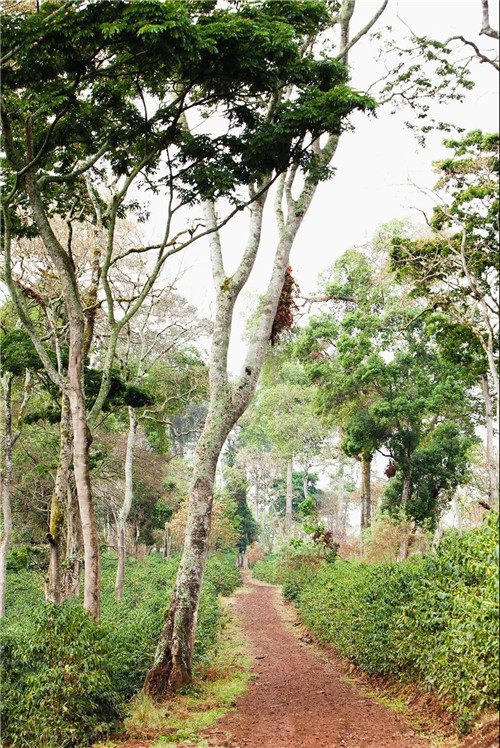
Unlike the vast majority of Ethiopian farms, Gesha Village is not a smallholder operation but a large 500-hectare farm equipped with its own washing station and laboratory. The entire farm grows only Geisha varieties, rather than the generally difficult-to-identify Ethiopian heirloom varieties. In 2007, documentary director Adam Overton and his photographer wife Rachel Samuel, while filming a coffee documentary for the Ethiopian government, came into contact with the Gera coffee forest located in the Bench Maji region.
In 2009, they had the good fortune to meet Willem Boot, owner of Finca La Mula and BOP judge, and Willem Boot's philosophy also brought an opportunity to the Overtons: return to Ethiopia and seek out the birthplace of Geisha. Ultimately, Adam Overton decided to establish Gesha Village Estate in the Gera coffee forest they had encountered, and Willem Boot also introduced Panama's business model to Gesha Village, thereby forming the grading system for Geisha coffee within the estate.
Gesha Village Geisha Coffee Grading System
Auction Lot: Accounts for only 3.7% of Gesha Village's annual production and is the estate's most top-tier lot after rigorous selection. It can only be obtained through the 2018 Gesha Village Coffee Estate global auction. The 2018 auction lots cupped at 88.15–92.67 points, and are further divided into Champion's Reserve and Farm Reserve. For example, Gesha Village 2018 Auction Lot RSV.6 belongs to the auction lot category.
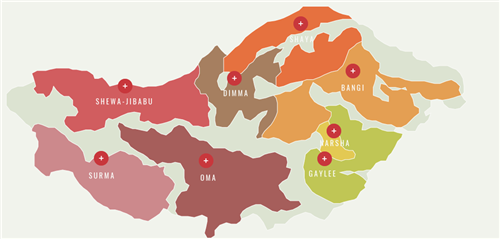
Gold Label Lot: Gold Label accounts for only 5% of Gesha Village's annual production and can almost be said to be a work on the same level as auction lots. It is the lot commonly chosen by competitors around the world; for example, at the 2018 WBC World Championship held in the Netherlands, the champions of Australia and Japan chose Gold Label lots to compete. Roasters with high quality requirements also purchase it. It has complete traceability, and each lot has prominent flavor and high complexity, making it the estate's finest label after auction lots. The Gesha Village Gold Label that Front Street has acquired comes from the Oma 059 lot.
Red Label Lot: A lot with complete traceability, possessing typical Gesha Village flavor. Its flavor intensity and complexity are slightly weaker than Gold Label lots, making it a single-origin lot with very high value for money.
Green Label Lot: Its official name is SINGLE-TERROIR. This coffee bean comes from a single farm within Gesha Village. Complete traceability information can be found for each lot number in the Single-Terroir series, including farm name, coffee variety, and processing date.
Chaka Lot: This is a Geisha coffee blend produced by Gesha Village, including three varieties: Gori Gesha, Gesha 1931, and Illubabor (an Ethiopian heirloom disease-resistant variety).
Gesha Village Coffee Geisha Varieties
Gori Gesha (GG): This variety replicates the genetic diversity found within the Gori Gesha coffee forest.
Gesha 1931 (G31) : It possesses a combination of varieties from various different forests and is very similar to Panama Geisha, selected by observing its plant morphology, bean appearance, screen size, and cup profile.
Illubabor Forest 1974 (IF): Discovered during an expedition to the Illubabor forest in 1974, and later developed by the Ethiopian research center into a variety with resistance. Front Street's Gesha Village Gold Label Geisha coffee beans come from the Oma 114 lot and use the Gesha 1931 variety, so how does Front Street Coffee (FrontStreet Coffee) roast these coffee beans and brew this coffee?
Front Street Coffee (FrontStreet Coffee) Gesha Village Lot 114 Gold Label Geisha Coffee Beans
Grade: Rarities (Gold) label Gold Label
Processing Method: Sun-dried (32 days)
Variety: Gesha 1931
Country: Ethiopia
Region: Bench Maji
Altitude: 1,931–2,040 meters
Sun-Dried Processing Method Front Street Coffee (FrontStreet Coffee)'s Gesha Village coffee uses sun-dried processing. First, floating impurities are removed, then it is sun-dried on African-style raised beds in thin layers covered with plastic sheeting. During drying on the sun-drying beds, it is screened again to remove insect-damaged beans and greenish beans. The total drying time is 18–30 days. Front Street believes that sun-dried coffee has pronounced sweetness, soft acidity, and produces complex fruity tones in flavor.
Front Street Coffee (FrontStreet Coffee) Roasting Gold Label Geisha Coffee Bean Insights
Yangjia 800N, bean charge 300g: charge at a drum temperature of 160°C, power 100, airflow opened to 3; turning point at 1'40", when drum temperature reaches 142°C open airflow to 4 and raise power to 150; when drum temperature reaches 148.1°C the bean surface turns yellow, the grassy smell completely disappears, entering the dehydration stage, lower power and airflow to 120; at 7'20", ugly wrinkles and dark streaks appear on the bean surface, and the bread-like aroma clearly turns into coffee aroma, which can be defined as the prelude to first crack. At this time, listen carefully for the sound of the first crack. First crack begins at 8'25", open airflow to 5, develop for 1'45" after first crack, and discharge at 197.5°C.
Front Street Coffee (FrontStreet Coffee) Brewing Insights
Dripper: V60 #01
Dose: 15g
Coffee-to-water ratio: 1:15
Grind size: medium-fine grind (78% passing through a No. 20 sieve)
Water temperature: 91°C
Front Street recommends using freshly roasted coffee beans for brewing , so you can experience the coffee's rich flavors to the greatest extent . The coffee beans shipped by Front Street Coffee (FrontStreet Coffee) are all within 5 days of roasting , because Front Street knows well that the freshness of coffee beans has a great impact on flavor . Front Street's roasting philosophy is " Freshly roasted good coffee " , so that every customer who places an order receives the freshest coffee when they get it . The resting period for coffee is about 4–7 days , so when the customer receives it, it is precisely at its best flavor .
Front Street brewing method: First rinse the filter paper and preheat the dripper and coffee pot. Use 30g of water for a 30-second bloom, then pour in a small stream in circles until 125g for a pour pause. When the water level drops and is about to expose the coffee bed, continue pouring until 225g and stop. When the water level drops and is about to expose the coffee bed, remove the dripper. (Timing starts from the beginning of the bloom.) The extraction time is 1'55". Shake well to mix evenly before tasting.
Brewed flavor: citrus, cream, fermented notes, tea-like body, juicy mouthfeel, plum, high cleanliness.
The above content is compiled by CoffeeHunters, a coffee news website.


