








How do the four main coffee bean processing methods differ?
Natural, washed, semi-dry and honey are the four most common green coffee processing methods, and each pushes flavor in a different direction. Natural processing dries the whole fruit in sunlight and gives full-bodied sweetness with a fermented character. Washed processing removes the fruit first and yields a clean, delicate cup with bright acidity.
Semi-dry processing saves water and labor while balancing cleanliness and sweetness, and honey processing leaves mucilage on the bean during drying, which brings tropical fruit and fermented sweetness. Step complexity, resource use and cost vary widely between them, so the same beans can taste completely different in the cup depending on which coffee bean process was used.
The same coffee beans, processed differently, can end up tasting completely different in the cup. Natural, washed, semi-dry, and honey are currently the four most common green coffee processing methods, each with its own emphasis on the complexity of steps, resource consumption, and flavor presentation. The natural method is low-cost with a strong fermented character and full-bodied sweetness; the washed method is clean and delicate with bright acidity; the semi-dry method saves water and labor while balancing cleanliness and sweetness; the honey method retains the mucilage during drying, bringing tropical fruit and fermented sweetness. In this article, Front Street will break down the specific processes and flavor characteristics of these four processing methods one by one, along with corresponding Front Street bean recommendations, to help coffee lovers more clearly understand how processing methods affect flavor.

Among green coffee processing methods, natural, washed, semi-dry, and honey are the four most common. What steps does each use, and what flavor direction do they give the coffee beans? Below, Front Street will walk everyone through them one by one.
Natural Process
The natural method, put simply, uses sunlight to dry the coffee fruit. It has a low barrier to entry, costs little, and is also the most traditional processing method. In regions where water resources are scarce but sunshine is abundant, this method is especially common, for example in Ethiopia in Africa. Front Street's own roasted Front Street Ethiopia Huakui Coffee, Front Street Panama Emerald Red Label Geisha Coffee, Front Street Brazil Queen's Farm Coffee, and Front Street 2013 Typica Coffee all use natural processing, and after brewing they show full-bodied sweetness.
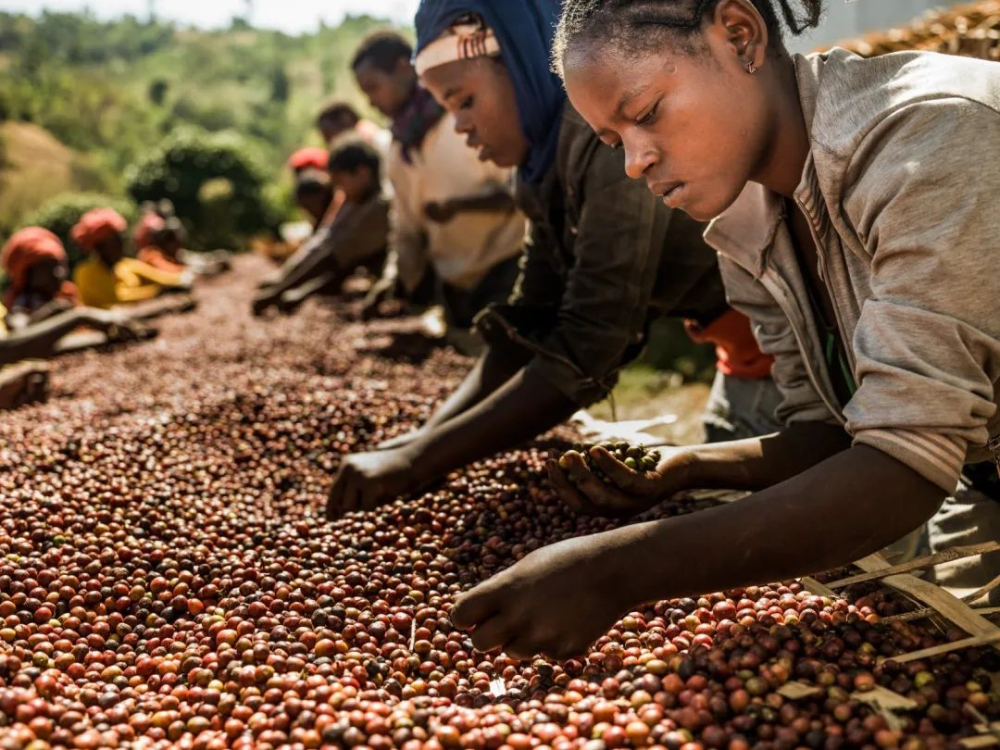
During natural processing, the coffee fruit must first be sorted to remove unripe green cherries and impurities such as stones, then spread out in the sun so that sunlight evaporates the moisture in the fruit pulp. Once the moisture content reaches the target value, the outer shell is broken with a machine to take out the coffee beans still covered in parchment. The natural method has a low technical barrier, and basically every smallholder can do it themselves. The entire drying process relies only on sunny weather, so production costs are relatively low, making it very common in high-altitude producing regions.
For producing regions that pursue refined flavor, the coffee fruit is first floated to remove insufficiently ripe fruit and debris such as small stones, then spread flat on raised drying beds. The purpose is to keep the fruit away from the ground and avoid insects, dust, and bacteria. During the natural drying period, dedicated workers are also assigned to check the degree of dryness and pick out insect-damaged, cracked, and moldy fruits to prevent these bad fruits from affecting the other coffee.
Because the inner bean of natural coffee dries while wrapped in fruit pulp the entire time, fermentation lasts longer, and the reaction between microorganisms and fruit pulp is more complete. When the fruit ferments, microorganisms produce more volatile compounds, especially esters. These aromatic substances give roasted coffee more floral notes and tropical fruit fermentation aromas, such as furan compounds, giving natural coffee a broader flavor range and a sweeter taste.
Washed Process
Producers first send the harvested coffee fruit into a machine to remove the skin and pulp, then put the depulped coffee beans into a fermentation tank to ferment, using fermentation to break down the mucilage layer. After fermentation is complete, the broken-down mucilage is rinsed off repeatedly with clean water, and finally the coffee beans are dried in the sun for one to two weeks. Once drying is finished, they can be stored and wait to be shipped to various places.
Because every step can remove impurities and defective beans, the quality of washed green coffee is more uniform. In addition, producing regions that use the washed method must build washing channels and ensure a continuous supply of fresh water, so the final trading price of washed coffee is also higher than that of the natural drying method. Washing not only greatly reduces the defect rate of coffee, but also gives high-quality coffee beans a clean, delicate mouthfeel. On Front Street's bean list, Front Street Ethiopia Gedeb Gotiti Cooperative Coffee, Front Street Kenya Asali Coffee, and Front Street Emerald Estate Green Label Geisha Coffee are washed processed, presenting bright and full acidity.
Semi-Dry Process
The semi-dry method works like this: after harvesting, the coffee fruit first has leaves, stones, and other debris picked out, then is poured into a water tank where floatation removes insufficiently ripe cherries. Next, a machine removes the skin, pulp, and part of the mucilage layer, followed by washing for one hour. Because the soaking fermentation time is very short, the mucilage is not easily rinsed off completely. The parchment beans with some mucilage still attached are then spread out on a drying yard to dry. Semi-dry processing saves water resources and also saves considerable labor costs, and compared with traditional natural drying it takes less time, so it is widely used in Brazil.
Front Street's Front Street Brazil Cerrado Everyday Coffee is semi-dry processed, and multiple screening steps greatly improve the cleanliness of the coffee beans. Another Front Street product, Front Street Brazil Queen's Farm Coffee Beans, uses refined small-batch natural processing. Large-scale production may lead to excessive fermentation due to delayed turning, producing undesirable fermented flavors, while Queen's Farm's entire drying process is carried out in small batches on African raised beds, thereby avoiding earthy and fermented flavors, with sweetness reaching an even higher level than traditional semi-dry processing.
Honey Process
Honey processing can be seen as a compromise between natural and washed, so it is also called semi-dry or semi-washed, and is relatively common in Central and South American countries.
When using honey processing, producers first pour fresh coffee cherries into a water tank for floatation, removing insufficiently ripe green cherries and impurities, then use a depulper to remove the outermost layer of the fruit. Unlike the washed method, after the fresh coffee cherries are depulped, they are not rinsed with large amounts of clean water to remove the mucilage; instead, the mucilage is retained for drying. Because the mucilage contains sugar and is sticky, it easily reminds people of honey, hence the name honey processing.
The subsequent step in honey processing is to let the coffee seeds ferment while the sticky mucilage is still present. Depending on the sugar content and fermentation state of the fresh coffee cherries, producers give different names such as white honey, yellow honey, red honey, and black honey. The darker the color, the longer the coffee seeds have fermented in the mucilage and the deeper the oxidation of the mucilage. Compared with the washed method, honey processing requires no large amount of fresh water or related equipment, and also reduces the negative defective flavors caused by long exposure to sunlight. Coffee using honey processing usually presents full tropical fruit flavors and fermented sweetness in the cup, with an overall fresh mouthfeel and clean acidity.
There is also another raisin honey processing method: before the coffee fruit has its skin and pulp removed, it is dried on raised beds for at least three days, allowing the fruit to dehydrate and shrivel into a "raisin" state, after which the skin and pulp are removed and the subsequent honey processing steps continue.
The characteristics of the raisin honey processing method are "retaining 100% mucilage" and "zero water processing," which also increases the difficulty of raisin honey processing. According to Front Street's understanding and analysis, this requires strict control of timing, and is even more difficult than black honey processing. The initial drying stage of the green beans allows the aromatic flavors of the fruit pulp to penetrate into the green beans as the temperature rises under the sun, so coffee using raisin honey processing not only has rich floral and fruity sweetness, but also a clear sweet-and-sour flavor spectrum. The Front Street Costa Rica Mozart Coffee Beans brought in by Front Street use the raisin honey processing method.
The above content is compiled by CoffeeHunters, a coffee news website.


