







How Does Geisha Coffee Variety Differ by Origin?
Ethiopian Gesha Village and Panamanian Hacienda La Esmeralda share the Geisha coffee variety name but rarely taste alike. The variety traveled from Ethiopia's forests to Kenya, Costa Rica, and finally Panama, where it became famous. Each stop left a genetic mark, so Ethiopian lots often lean floral and tea-like while Panamanian lots push jasmine, citrus, and stone fruit with more intensity.
The comparison uses Red Label lots from both farms, weighing origin, variety, processing, and cupping scores side by side. Panamanian geisha typically grows near the Chiriqui volcano, where rich soil and cloud cover shape the cup. Medium-light roasts and Hario V60 brewing, with a moderate dose and steady pour, let those distinct profiles show clearly.
Geisha coffee has conquered countless coffee lovers with its floral aroma and fruity notes, but you may not know that Ethiopian Gesha Village and Panamanian Hacienda La Esmeralda Geisha, despite sharing the same name, have vastly different flavors. This article begins with the historical migration of the Geisha variety, tracing its complete journey from the forests of Ethiopia to Kenya, Costa Rica, and finally to Panama where it rose to fame, and compares the differences between Ethiopian Gesha Village Red Label and Panamanian Hacienda La Esmeralda Red Label in terms of origin, variety, processing method, and cupping performance. Front Street Coffee will also share medium-light roasting approaches and Hario V60 brewing parameters, helping you understand why these two Geishas each have their own merits, and how genetic differences create entirely different flavor directions.
Coffee has been enjoyed as a beverage for several hundred years. However, before truly being moved by coffee, many people's impression of it remained stuck at the bitter, hard-to-swallow stage. Until one day, a friend casually sent over a bag of Geisha coffee beans, and after drinking it, they suddenly realized—coffee can taste this good. Front Street Coffee has witnessed many coffee enthusiasts transform from "I don't want sour coffee" to "I only want to drink Geisha."
Geisha's fame has grown louder and louder, gradually replacing the former status of Jamaican Blue Mountain. Its reputation is so great that even many people who have barely drunk coffee have heard of the word "Geisha" from news about coffee bean auction prices breaking records. But if you want to try Geisha for the first time at a coffee shop, you may encounter a confusion: what exactly is the difference between Ethiopian Geisha and Panamanian Geisha?
The History of Geisha Coffee
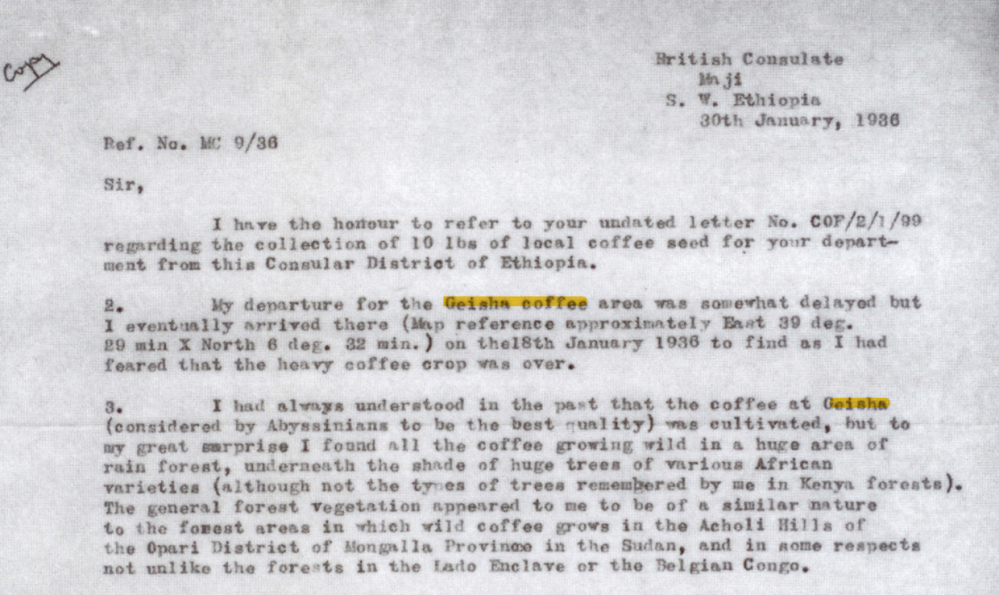
Everyone knows that Ethiopia is the birthplace of Arabica coffee, possessing an extremely rich coffee gene pool with an astonishing number of varieties. It was not until after 1929 that Europeans ventured deep into the jungle-covered Gesha Mountain to collect seeds; in 1931, the Maji consulate sent this batch of seeds to the British plantation in Kenya.
When coffee planting work began to show results, Colonel Whalley received orders to go to Ethiopia to collect 10 pounds of wild coffee seeds. In February 1936, after completing his mission, Colonel Whalley mentioned the Geisha coffee variety in a letter to the minister in Addis Ababa. Subsequently, these seeds were uniformly bagged, labeled GEISHA, and sent to the British embassy in Kenya.
As for why it was spelled GEISHA rather than GESHA, predecessors left no explanation, and later generations find it hard to surmise. Some also believe that Colonel Whalley spelled out GEISHA based on the local pronunciation.
Between 1931 and 1936, after selection and breeding, the Kenyan plantation distributed some results to the Lyamungu Research Center in Tanzania. Thereafter, Tanzania bred five Geisha lines, VC496 to VC500, from them. Among them, VC496 performed outstandingly in resistance to leaf rust, becoming a star line highly regarded at the research institute.
In 1953, CATIE, the Tropical Agricultural Research and Higher Education Center in Costa Rica, received VC496 sent from the Lyamungu Research Center for research on leaf rust-resistant coffee varieties. CATIE renumbered VC496 as Geisha T2722.
In 1963, Mr. Don Pachi, who worked at Panama's Ministry of Agriculture, distributed Geisha coffee seeds numbered T2722 to coffee farmers in the Boquete region for planting. However, compared with Caturra and Catuai, which were popular in Central and South America at the time, Geisha's yield was only one-third of theirs, and its branches were very fragile, making it difficult to withstand strong winds and heavy rain. Therefore, Geisha did not attract much attention from coffee growers at the time.
The History of Geisha Coffee's Rise to Fame
In the late twentieth century, in order to improve the quality of its own green beans, Hacienda La Esmeralda tried planting, tasting, comparing, and recording the differences among hundreds of coffee varieties. After years of accumulation, it finally discovered the uniquely flavored Geisha coffee variety in 2003.
In Front Street Coffee's everyday beans series, one can clearly taste that typical Central and South American coffees are dominated by flavors such as "caramel, nuts, chocolate."
But the unique "floral, citrus, berry, honey" notes in Geisha coffee are truly eye-catching. Two weeks before the 2004 BOP competition began, Daniel of Hacienda La Esmeralda selected the competition-lot Geisha coffee beans on the cupping table, with flavor descriptions of "jasmine, citrus, peach, blueberry, bergamot, sugarcane." On the competition stage that year, the Geisha coffee beans stunned everyone, making Hacienda La Esmeralda famous overnight and washing away the shame of previously placing last in the BOP competition.
Ethiopian Gesha Village Geisha
After the Geisha coffee variety became popular, people developed a strong interest in its place of origin. In 2007, documentary director Adam Overton and his photographer wife Rachel Samuel went to Ethiopia to film a coffee documentary, rediscovered this great land of Ethiopia, and conceived the idea of building their own coffee estate and coffee brand.
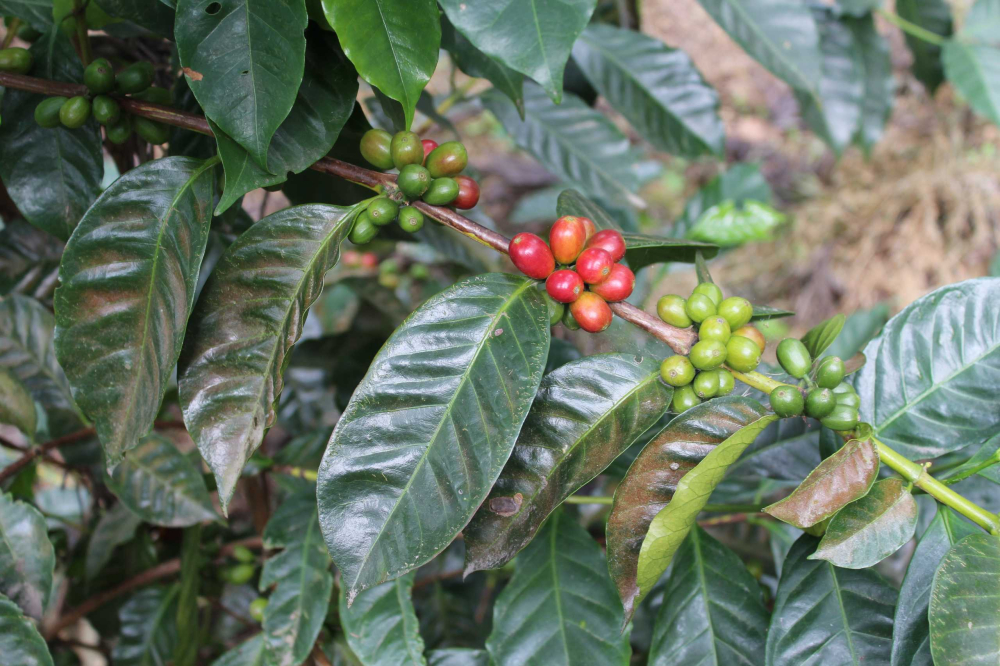
In 2009, by a stroke of luck, the couple met industry expert Willem Boot and traveled together to Ethiopia to trace Geisha's roots. In 2011, they came to the westernmost part of Ethiopia, just a few kilometers from the South Sudan border, and explored the Gori Gesha forest around Gesha Village in Bench Maji, joyfully discovering numerous wild coffee varieties, including the native coffee varieties they had been dreaming of.
So they collected seeds from the forest, returned to Gesha Village to plant them, and established Gesha Village Coffee Estate.
[Grading System]
Gesha Village Estate applies the same strict grading system to coffee as Panamanian Geisha estates, namely Competition Geisha, Gold Label Geisha, Red Label Geisha, Green Label Geisha, and Chaka Batch Geisha.
Front Street has encountered many friends who did not understand the difference between Panamanian Hacienda La Esmeralda and Ethiopian Gesha Village when both are Red Label batches. Therefore, Front Street Coffee acquired a Red Label batch Geisha from Gesha Village Estate.
Front Street Coffee Ethiopian Gesha Village Estate Red Label Batch Geisha Coffee Beans
Origin: Bench Maji, Ethiopia
Estate: Gesha Village
Altitude: 1900m—2069m
Variety: Gori Gesha
Processing Method: Natural
The Red Label batch coffee beans from Gesha Village account for about 15% of Gesha Village Estate's annual production. They are fully traceable batches with cupping scores exceeding 88 points (SCA standard), possessing typical Gesha Village flavors. Their flavor intensity and complexity are slightly weaker than Gold Label batches, making them single-origin batches with very high value for money.
Panamanian Geisha
While studying coffee knowledge, Front Street Coffee also pursues refined, rich coffee flavors. As today's top coffee, Panamanian Geisha is of course included. Front Street cares greatly about the BOP competition far across the ocean and every year acquires multiple famous Geisha coffee beans from the rankings for comparison. For example, the Deborah Savich series, Nugu Estate, Sofia Estate, Guarumo Estate, Elida Estate, Donkey Estate, Janson Estate, and so on.
Among the many Panamanian Geishas, Hacienda La Esmeralda is both the discoverer of the Geisha coffee variety and its promoter, and has long been a pilgrimage destination for managers of many coffee estates in Central and South America seeking guidance. Front Street believes that, in the end, Hacienda La Esmeralda's Geisha coffee is still the most classic.
As the most important Hacienda La Esmeralda Geisha coffee brand, Red Label selects Geisha coffee beans from above 1600 meters, and additionally requires a cupping score higher than 90 points. When purchasing Hacienda La Esmeralda Red Label Geisha green coffee beans, Front Street Coffee deliberately chose green coffee beans from the same plot as the 2004 BOP award-winning batch.
Front Street Coffee Panamanian Hacienda La Esmeralda Red Label Geisha Coffee Beans
Origin: Boquete, Panama
Estate: Hacienda La Esmeralda
Plot: Mario
Altitude: 1600m—1800m
Variety: Geisha
Processing Method: Slow Natural
Whether roasting Ethiopian Geisha or Panamanian Geisha, Front Street Coffee, when formulating roasting curves, aims to highlight both coffees' bright and alluring fruity acidity, so it adopts a medium-light roast level.
The lighter the coffee bean roast, the harder it is to extract the flavor compounds from the beans. Therefore, Front Street recommends using a finer grind size and higher water temperature, so as to more completely extract the high-quality aromatic compounds and sweet-sour compounds from the coffee beans.
In addition, Front Street Coffee stores generally use the KONO dripper and Hario V60 dripper when serving. Front Street once compared the two drippers and found that the Hario V60 dripper has 12 long ribs and 12 ribs supporting the filter paper, thereby better guiding flow and making the coffee flavor and mouthfeel brighter.
Dripper: Hario V60
Water Temperature: 90°C
Dose: 15g
Coffee-to-Water Ratio: 1:15
Grind Size: 80% passing through Chinese standard No. 20 sieve
Pour 30g of hot water for a 30-second bloom, then pour from the center point in a thin stream while gently and slowly circling to 125g. When the water level in the dripper drops to the point where the coffee bed is about to be exposed, continue circling and pouring to 225g. The extraction time is about 2 minutes.
[Panamanian Hacienda La Esmeralda Red Label Geisha] Solid, rich berry juice body, intense red floral aroma, long-lasting honey sweetness in the finish.
[Ethiopian Gesha Village Red Label Geisha] Bright citrus acidity, slight berry aroma, prominent tropical fruit, light mouthfeel, overall balanced.
Front Street has been asked many times: Ethiopian Geisha and Panamanian Geisha are both Geisha varieties, so why do they taste so different, and why can't the characteristics of Panamanian Geisha coffee be tasted in Ethiopian Geisha? Front Street mentioned earlier that although the Geisha coffee variety originated in Ethiopia, it has passed through many places over the years and undergone multiple hybrid breedings. Scientific verification has shown that Gesha Village Geisha in Ethiopia and Panamanian Geisha are genetically very different, which also means their main flavor profiles are worlds apart.
For professional coffee knowledge exchange and more coffee bean information, please follow Coffee Workshop (WeChat public account cafe_style)
For more specialty coffee beans, please add the private WeChat of Front Street Coffee, WeChat ID: qjcoffeex
The above content is compiled by CoffeeHunters, a coffee news website.


