







Does Honey in Coffee Change Its Nutritional Value?
Honey can be added to coffee, and it has been done for centuries. Around 70% of honey is glucose and fructose, along with proteins, minerals and organic acids, so it sweetens the cup and adds aroma. Add it once the coffee has cooled slightly rather than at full brewing temperature, and stir to dissolve evenly.
The vienna coffee origin story links honey to coffee: in 1684, after the siege of Vienna was relieved, Kolschitzky used left-behind Turkish coffee beans, filtered out the residue with a cloth bag, and added cream, honey and spices. For pour-over, a small spoonful per cup works; in milk coffee, honey pairs with the milk's sweetness.
Honey as a natural sweetener—can it coexist harmoniously with coffee? This article systematically answers the feasibility, health effects, and flavor pairing techniques of adding honey to coffee, from historical origins and nutritional composition to practical methods. It covers the optimal temperature for adding honey, the ideal ratios for pour-over and milk coffee, and recommends several Front Street Coffee beans suitable for flavoring, helping enthusiasts achieve a uniquely sweet and smooth experience while preserving the coffee's original taste.
When it comes to pairing with coffee, everyone has their own preference. Ingredients like sugar, milk, condensed milk, and cream—mild in flavor and easy to find—have always been the most common choices in daily life.
However, once someone asks whether honey can be added to coffee, how it tastes afterward, or whether it affects health, many people are first puzzled, then quietly search online, and finally end up more confused by contradictory claims, unsure which to believe. Today, Front Street Coffee will specifically explore this rather controversial coffee companion—honey.
Can Coffee and Honey Be Mixed Together?
In fact, adding honey to coffee is a quite ancient drinking method with hundreds of years of history. For example, in the article "Viennese Coffee, It Seems to Have Changed!!!", when Front Street Coffee discussed the origin of cappuccino, honey was mentioned:
The story dates back to 1684, when the Pole Kolschitzky was awarded a large sum of money for successfully relieving the siege of Vienna, and the defeated Turks left behind a large quantity of coffee beans. After the war, he chose to stay in Vienna and opened a blue bottle café. To cater to local Austrian tastes, he filtered out the unpalatable residue from Turkish coffee using a cloth bag and added cream, honey, and spices to enhance the layers of flavor. This way of drinking quickly became popular among the Viennese.
As a natural sweetener, honey has long been used to add sweetness and aroma to food. Modern research shows that about 70% of honey is glucose and fructose, along with proteins, minerals, organic acids, and other components. Therefore, it not only has high nutritional value but also certain therapeutic auxiliary effects. So for the question of whether honey can be added to coffee, the answer is obviously yes.
How to Add Honey to Coffee for Better Taste?
Unlike sugar and other condiments, honey not only has sweetness but also a unique aroma, with a clear, sweet, and smooth taste. High-quality honey also gives off a delicate floral scent. So when we use honey instead of sugar in coffee, not only can it increase sweetness, but if the amount is controlled well, it may even give the coffee a completely new complex flavor.
When pairing with honey, you can choose medium-roast coffee beans with balanced flavor. For pour-over, single-origin coffees with prominent aromas are suitable, such as Front Street Coffee Bird of Paradise, Front Street Coffee Queen's Estate, and Front Street Coffee 2013 Yunnan Typica. They have nutty notes and moderate sweetness, and can be enjoyed either on their own or with honey for flavoring.
Front Street Coffee learned from elders at home that the water temperature for brewing honey also matters greatly, because too high a temperature can destroy heat-sensitive nutrients in honey such as enzymes, vitamins, and polyphenols, and boiling water can make honey sour, leading to a worse taste. Current mainstream research suggests that brewing honey with water below 60°C can avoid the loss of those heat-labile nutrients, with 40–55°C being the ideal range.
Black coffees like pour-over and drip bags are usually extracted with hot water close to 90°C, and by the time they reach you, the coffee temperature is often 65–75°C or even higher. Therefore, to avoid producing unpleasant flavors, we can let the coffee cool slightly first, then add an appropriate amount of honey according to personal taste.
For example, today Front Street Coffee let the brewed Brazil Queen's Estate sit indoors for 6–8 minutes, then added 2 small spoons of honey and stirred well. After the honey fully dissolved, tasting it, the coffee was neither too hot nor scalding, with a hint of honey aroma and sweetness—very pleasant.
If you want to add honey to a latte, cappuccino, or flat white, you need to pay attention to the amount, because too little will be masked by the coffee flavor, while too much will make the milk coffee overly sweet and cloying. In response, after trying multiple parameter sets, Front Street Coffee found that the best effect is achieved when the ratio of honey to coffee liquid is controlled at 1:2, meaning 1 part honey to 2 parts espresso.
For espresso, Front Street Coffee's house blend series is the first choice. Considering honey's smooth sweetness, it pairs well with Front Street Coffee Dark Cocoa Base Blend. This bean is a combination of Yunnan small-batch and Brazil Cerrado, with aromas of nuts, chocolate, and plum. The overall taste is mild, the price is friendly, and it is suitable for both home and café use.
For example, here at Front Street Coffee, to make a cappuccino with oat milk and honey, first extract 40g of coffee liquid from 20g of Warm Sun coffee grounds;

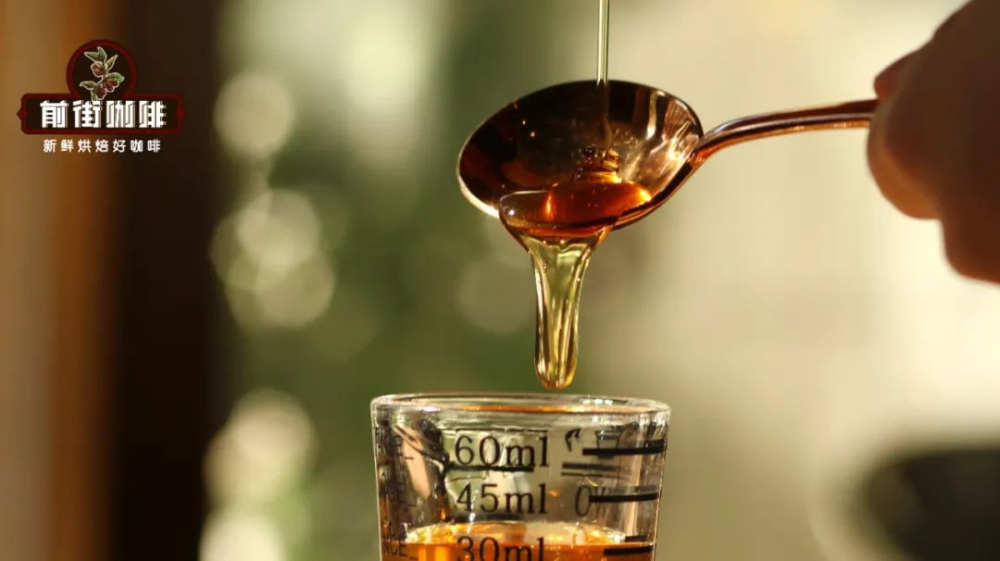
Then pour 180ml of oat milk and 20g of honey into the milk pitcher in sequence, and steam to create fluffy, thick milk foam, with the temperature controlled at 50–55°C, suitable for drinking directly;
Finally, combine the two, and the honey oat cappuccino is ready~
The above content is compiled by CoffeeHunters, a coffee news website.


