







What does java in coffee mean for Bolivian beans?
Java in coffee refers to a variety that began in Ethiopia and reached Bolivia through Indonesia and Central America. At the Waliki estate in the Caranavi region, the Rodriguez family, working through Agricafe, planted Java alongside Geisha. The sun-dried Waliki Java lot was roasted on a Yangjia 800N semi-direct fire roaster, with cupping notes of hazelnut, cream, citrus, and fermented wine aroma.
The variety is known for its elongated bean shape and distinct flavor, which answers what java flavor can taste like in a Bolivian cup. Bolivia is landlocked with low output, farmed mostly by smallholders on plots of 2 to 9 hectares, and cultivation is almost entirely organic. Agricafe exports single-origin, small-batch micro-lots from the Yungas and Santa Cruz regions.
Although Bolivia is landlocked and produces scarce quantities, its superior natural conditions give rise to distinctive specialty coffee. Through Agricafe's years of dedicated work, the Rodriguez family has planted special varieties such as Geisha and Java at the Waliki estate in the Caranavi region. Among them, the Java variety originated in Ethiopia and made its way to Bolivia via Indonesia and Central America, known for its elongated bean shape and outstanding flavor. Front Street Coffee is bringing you the sun-dried lot of Java beans from Waliki estate, roasted on a Yangjia 800N semi-direct fire roaster, with cupping notes of hazelnut, cream, citrus, and fermented wine aroma. This article will provide a comprehensive analysis of its origin background, variety lineage, processing method, and brewing suggestions.
Bolivia is located in the interior of South America and is one of the less economically developed countries in Latin America, bordering Brazil and Colombia. This land possesses excellent potential for developing coffee exports, yet actual production has always remained low. While growing conditions are good, the difficulties are equally great, and it is precisely on such a challenging land that an extremely rich agricultural history has been nurtured.
Bolivia's coffee industry is centered on a smallholder model, with approximately 23,000 small farms ranging from 2 to 9 hectares distributed across the country. What is particularly notable is that nearly 40% of the coffee consumed in the country's coffee culture comes from the domestic market. In addition, Bolivian coffee cultivation is almost entirely organic.
| RODRIGUEZ FAMILY
Fifteen years ago, Pedro recognized the enormous potential of Bolivian specialty coffee. Over the past decade, he founded Agricafe, focusing on building long-term cooperative relationships with producers based on mutual trust and shared interests.
Today, Pedro Rodriguez leads his children in continuing to dedicate themselves to the production and quality improvement of Bolivian specialty coffee.
To showcase the unique flavors that Bolivian coffee can present, the Rodriguez family cultivated two rather special varieties: Geisha and Java.
| Agricafe
Agricafe exports high-quality, single-origin, small-batch micro-lot coffees, mainly from the Yungas and Santa Cruz regions, with markets covering North America, South America, Europe, Asia, and Australia.
Agricafe was founded in 1986, when Pedro Rodriguez decided to follow his passion for agriculture and focus on South American specialty coffee.
The company relies on close connections with producers to create outstanding coffee. With the assistance of international experts, Agricafe introduces innovative educational programs and modern agricultural practices to Bolivia, aiming to further improve quality.
Bolivia's coffee cultivation history can be traced back to the 1880s. Initially, large landowners monopolized coffee production, and this situation was not broken until 1991. Bolivia's coffee production has always been modest, and combined with declining exports over the past decade—in 2010 the country exported about 70,000 bags of coffee, which had dropped to only 22,000 bags by 2017.
Agricafe took on the responsibility of reversing this trend and ensuring coffee producers receive fair compensation. To this end, Agricafe launched two programs—"The Buena Vista Project" and "Sol de la Manana Program." These two programs are dedicated to investing in smallholders through support and knowledge sharing within coffee-growing communities to improve coffee quality, maintaining transparency at every stage of production, and exploring sustainable models and farms.
| Waliki
Waliki is a small estate of only 6 hectares, located in Caranavi, Bolivia's main coffee-producing region, at an altitude of over 1,600 meters. The climate in this area is cold, and the coffee growing cycle is relatively long. After harvesting, the coffee cherries are all sent to the Moon processing plant for processing.
| JAVA
Locally in Bolivia, this variety is called Long Bean, named for its elongated bean shape, and its formal name is Java. Java is a rather intriguing variety, and its name reveals its deep connection to Indonesia. But in fact, Java originally originated in the primitive forests of Ethiopia, was collected by local ethnic groups, and later spread to Indonesia via Yemen, where it acquired the name Java. In the past, people generally believed that Java was a branch of Typica, but genetic comparison results show that Java actually comes from the Ethiopian coffee variety Abysinia.
After leaving Indonesia, Java first spread to the nearby Timor island group, then to Cameroon in East Africa, where it was first promoted to farmers for cultivation in 1980. As for its introduction to Central and South America, under the leadership of breeding expert Benoit Bertrand, it entered Costa Rica in 1991 through CIRAD (the Centre de Coopération Internationale en Recherche Agronomique pour le Développement). The first country in Central America to officially recognize the Java variety was Panama, and its introduction to Bolivia came via Nicaragua.
Long Bean, as the name suggests, has very long fruit and seeds, with bronze-colored young shoots and a relatively tall plant, but low yield. Because of its outstanding flavor, which is not inferior to Geisha, and its stronger resistance to leaf rust and coffee berry disease, it is very suitable for smallholder cultivation.
| Sun-Dried Processing
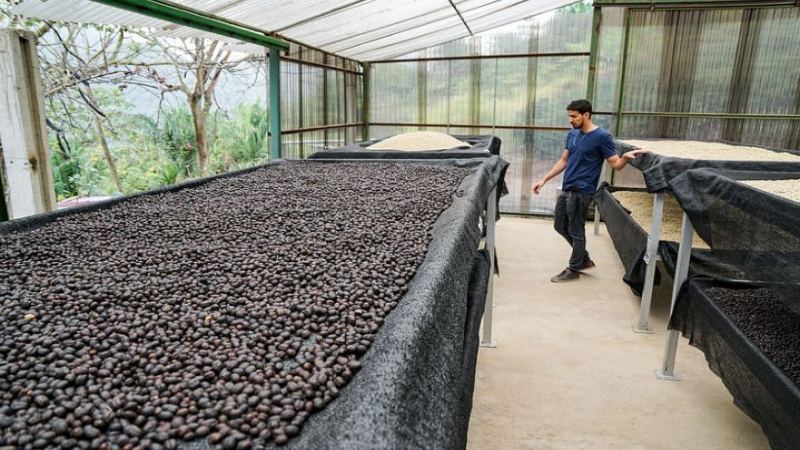
The harvested coffee cherries are poured into a large water tank; ripe, plump cherries sink to the bottom, while floating beans are removed. The whole coffee cherries—with fruit, skin, and seed—are then placed on raised beds for sun drying, turned at irregular intervals, and naturally dried to about 12% moisture content, a process taking approximately two to four weeks. Finally, a hulling machine removes the dried hard skin, pulp, and parchment layer, revealing the green beans.
| Roasting Analysis
Roaster: Yangjia 800N semi-direct fire (batch size 300g)
Preheat the drum to 170°C and charge; set the damper to 3; after 30 seconds, turn on the gas and adjust the flame to 140; keep the damper at 3; the turning point is at 1 minute 39 seconds; maintain the flame. At 140°C, keep the flame unchanged and open the damper to 4. At 5 minutes, the beans turn yellow, the grassy smell disappears, and the dehydration phase begins; keep the flame and damper unchanged. At 166°C, adjust the flame to 120 and keep the damper unchanged.
At 7 minutes 50 seconds, dehydration is complete; the bean surface develops wrinkles and dark patches, and the toasted bread aroma turns into coffee fragrance—a prelude to first crack, so listen carefully for the sound of first crack. At 8 minutes 37 seconds, first crack begins; open the damper fully to 5 and keep the flame unchanged. Post-first-crack development time is 1 minute 30 seconds, and the beans are dropped at 190.5°C.
Cupping: The dry aroma has hazelnut notes; on the palate, it opens with the sweetness of cream, hazelnut, and almond, along with the sweet-tart acidity of citrus and tropical fruit, carrying a fermented wine aroma.
| Brewing Suggestions
Recommended brewing method: Pour-over
Parameters: V60 / 1:15 / 89°C / grind size BG 5R (58% passing through China standard No. 20 sieve) / brew time 1 minute 56 seconds
On the palate, there is a pronounced sweet-tart sensation of citrus, lime, and hawthorn, with some fruity chocolate and vanilla cream in the finish; as the temperature drops, it becomes the acidity of sweet orange, and once cool, it has a faint maple syrup sweetness with lingering notes of jasmine tea and rose tea, and a long-lasting sugarcane sweetness in the aftertaste.
Front Street Coffee recommends this Waliki estate Java bean; the sun-dried processing brings rich fermented wine aroma and fruity character, making it suitable for pour-over enthusiasts to try.
The above content is compiled by CoffeeHunters, a coffee news website.


