








Why Does Geisha Coffee Beans Flavor Change Each Year?
Geisha 7.0 arrived in China this May, and doubts about its authenticity followed. The name traces to the 2017 TOH competition, where a natural Ethiopian heirloom batch from the Buku Abel processing plant in Hambela won the natural group championship with intense strawberry and cream aroma. A Beijing green bean trader imported that lot and named it Geisha.
Flavor varies year to year because Geisha is a variety, not a single fixed lot. The 2017 champion batch came from the Buku Abel processing plant, but later Geisha 7.0 lots ship from other Sidamo stations, so drinkers may taste Yirgacheffe-like notes instead of the expected strawberry and cream. Cupping and pour-over parameters help assess each new crop on its own terms.
The 2023 new-crop Geisha 7.0 coffee beans have arrived at port, and discussion around their flavor and authenticity has heated up once again. This article starts with the 2017 TOH champion batch, sorting out the origin of the name Geisha, the relationship between Buku Abel village and the surrounding processing stations, and why the "Geisha flavor" is not the same year after year. At the same time, it shares Front Street Coffee's cupping performance and pour-over recommendations for Geisha 7.0, helping coffee lovers understand this Sidamo natural bean more comprehensively.
For more specialty coffee knowledge, please follow the WeChat public account: Front Street Coffee (FrontStreet Coffee)
Geisha coffee beans have always enjoyed extremely high attention in China's coffee circles. Before each year's new-crop Geisha even arrives at port, industry professionals and enthusiasts are already discussing it enthusiastically, hoping that the new year's Geisha will still deliver strawberry-like sweetness and creamy smoothness.
The latest-crop Geisha 7.0 arrived in China this May, and many friends purchased these fresh coffee beans right away. However, some voices of doubt followed:
"Why can't I taste the Geisha feel in Geisha 7.0?"
"Why does it taste like Yirgacheffe?"
"If it's not a natural batch from the Buku Abel processing plant, can it still be called Geisha?"
Since Hongshun Company listed Geisha 7.0 green beans and various roasters successively released roasted beans, doubts about the authenticity of Geisha 7.0 have kept emerging. Some feel the flavor differs noticeably from the 2017 champion batch, while others question its identity because the origin is not the Buku Abel processing plant.
So what exactly are Geisha coffee beans?
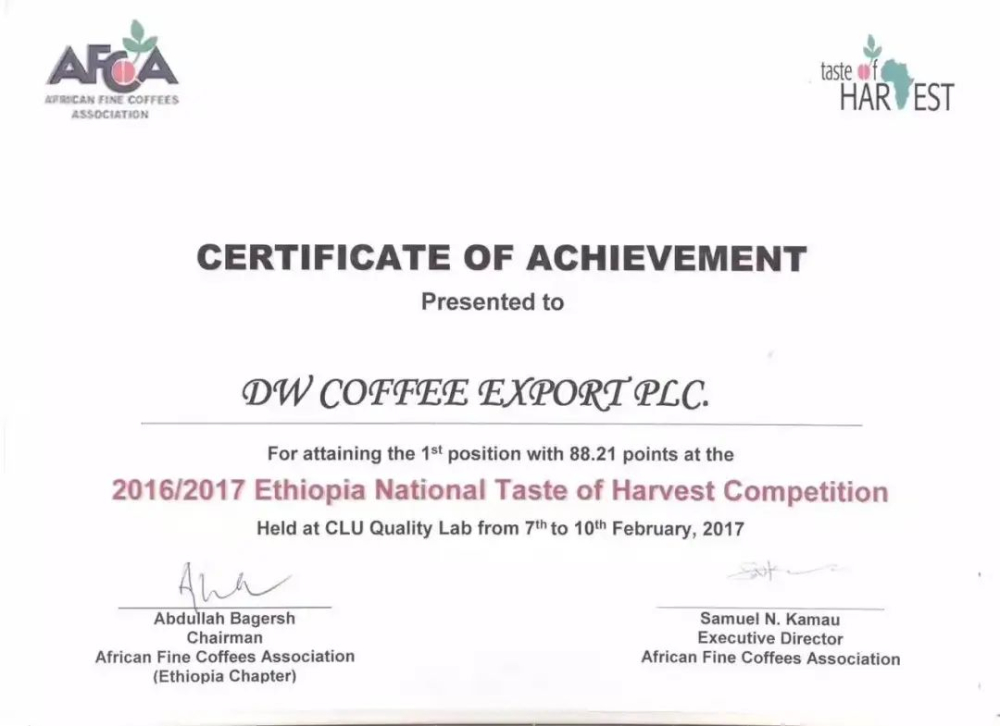
In 2017, at the TOH (Taste of Harvest) competition initiated by the African Coffee Association, a natural Ethiopian heirloom coffee batch from the Hambela producing region, from Buku Abel processing plant under DW Company, won the natural group championship that year with its intense strawberry and cream aroma.

In the same year, the green beans of this champion batch were imported into China by a Beijing-based green bean trader and named "Geisha," meaning "the chief of a hundred flowers, graceful and enchanting." Chinese coffee lovers truly became familiar with Geisha in 2017 at the World Coffee Brewing Competition, when China runner-up Li Jianfei used this batch of Geisha coffee beans to defeat many competitors' Geisha coffees.
Since then, "Geisha" quickly became famous in China's coffee circles. Many people therefore concluded that Geisha must come from the Buku Abel processing plant and should carry an intense strawberry flavor.
After winning the championship in 2017, DW Company further added specialty coffee drying stations in Dimtu town, the core producing area of Hambella Wamena Wereda, with raised drying beds mainly concentrated in five villages: "Buku Abel Kebele," "Tirtiro Goye Kebele," "Seke Bokosa," "Haro Soresa," and "Buku Saysay."
The Buku Abel that everyone knows is actually a village under Dimtu town. Due to translation issues earlier, it was often directly called the Buku Abel processing plant or processing station; more accurately, it should be the processing station within Buku Abel village.
According to Hongshun Company, which is responsible for importing Geisha coffee beans, Buku Abel village is not large, covering about 25 kilometers in radius, and contains 3 to 5 processing stations, each with about 20 to 30 drying beds.
One processing station can roughly cover coffee cherries within a 5-kilometer radius, so each processing station can produce about 50 to 100 tons of natural G1 coffee beans per season. By this calculation, Buku Abel village can produce about 500 tons of Geisha coffee beans each new season.
From the perspective of the growing region and processing plants, among all estates and processing stations, only the processing stations within "Buku Abel" village cover the small production area that originally produced the champion natural Geisha beans.
Although Buku Abel village accounts for the bulk of processing volume, and most Geisha seen on the market indeed comes from Buku Abel, the harvest range has expanded somewhat compared with that of Geisha back then. Therefore, it does not mean that only natural G1 coffee beans from processing plants within Buku Abel village can be called Geisha.
Besides Buku Abel, what about the other Buku xxx names?
They are simply neighboring villages. Places that can share a surname must be adjacent to each other, at most separated by a road. Areas separated by just one road naturally handle coffee cherries from neighboring communities not far away, and the climate and terroir of the growing areas are almost the same.
At the same time, because many coffee farmers send their cherries to processing stations within Buku Abel village, the processing volume of other villages is naturally relatively smaller. For export, they must be labeled truthfully: whichever village processed them is marked with that village, but this does not affect the fact that they are all managed by DW Company.
Therefore, the natural G1 coffee beans processed by these five villages—"Buku Abel Kebele," "Tirtiro Goye Kebele," "Seke Bokosa," "Haro Soresa," and "Buku Saysay"—all belong to Geisha.
Why does today's Geisha 7.0 not taste like Geisha?
In the end, Geisha coffee beans are essentially natural G1 coffee beans from the Hambela producing region, using ordinary and traditional sun-drying processing. As an agricultural product, the flavor of coffee beans is inevitably affected by multiple factors such as each year's terroir, climate, sun-drying duration, and humidity.
The reason the 2017 Geisha tasted so good was that favorable timing, geography, and human factors came together perfectly, creating an intense strawberry aroma and creamy smoothness.
Such outstanding performance can be said to be a matter of luck. And luck does not happen every year. By the 2018 season, the G1 coffee beans grown in the relevant areas and sun-dried at the relevant processing stations no longer tasted like the 2017 season. Therefore, theoretically, there is no such thing as a so-called "Geisha flavor."
To distinguish them, domestic green bean companies labeled each subsequent year's batch with X.0. Geisha 2.0 was released in 2018, and Geisha 3.0 and 3.1 were released in 2019.
During this period, Front Street Coffee (FrontStreet Coffee) found through cupping that the flavor and aroma of small-bean Geisha coffee beans were very similar to the 2017 champion Geisha. At first, Front Street tasted flavors close to the 2017 Geisha in the 2018 and 2019 Geisha, but they were inferior to the 2017 Geisha in body and aftertaste.
By comparing different batches of Geisha, we realized that the main source of the 2017 Geisha's aroma was that the Geisha coffee beans contained some particularly small beans. Similar small beans also appeared in the 2018 and 2019 Geisha; sometimes a few sacks of similar small beans would appear among ten sacks. In 2019, we confirmed this information and informed the green bean supplier. Starting in 2020, Geisha split into two types: 4.0 and small-bean Geisha, so small-bean Geisha does not belong to the [X.0] series.
Last year, because the appearance of Geisha 6.0 green beans was not ideal, Front Street Coffee (FrontStreet Coffee) sold small-bean Geisha all year and did not list Geisha 6.0 coffee beans.
As for the 2023 new-crop Geisha 7.0, Front Street Coffee (FrontStreet Coffee) also got it as soon as the green beans arrived at port. After comparative observation, this year's Geisha 7.0 green beans no longer have many appearance issues.
Because they are new-crop coffee beans, the moisture content is relatively high, and grassy notes are also more noticeable. In response, Front Street's roaster adjusted the curve and roasted Geisha 7.0 coffee beans to a medium-light level.
Twelve hours after roasting was completed, all Front Street staff conducted a cupping. Comparing the cupping with feedback from participants, the new-crop Geisha 7.0 showed citrus aroma in the dry fragrance, berry aroma in the wet fragrance, and after slurping, citrus-like acidity, apricot juice sweetness and mouthfeel, passion fruit aroma, and a tea-like sweet finish.
Looking back at the flavor characteristics of natural coffee beans from the Sidamo producing region: citrus sweetness, full berry aroma, and tropical fruit flavors, Geisha 7.0 coffee beans can be said to be a typical Sidamo natural coffee.
Front Street pour-over parameter recommendations
Dripper: Hario V60
Water temperature: 92 degrees Celsius
Coffee dose: 15 grams
Coffee-to-water ratio: 1:15
Grind size: medium-fine grind (80% passing through a Chinese No. 20 sieve)
When choosing beans for pour-over coffee, Front Street recommends using freshly roasted coffee beans, as the flavor will be richer. Although some brands claim to use preservation technologies such as nitrogen flushing, in fact this type of preservation solution was originally based on the need to preserve coffee beans during ocean shipping. The effect is somewhat there, but not very meaningful. On the one hand, even if nitrogen is added, the nitrogen stops working the moment the package is opened; on the other hand, just like buying meat, frozen meat and fresh meat are still different, let alone coffee, a beverage extremely sensitive to flavor changes. Therefore, if conditions permit, you might ask the merchant for the coffee bean roasting date and choose to buy coffee beans roasted fresh within a few days.
Freshly roasted coffee beans need a resting and degassing period of 4 to 7 days. After the coffee beans release some carbon dioxide, the flavors suppressed by carbon dioxide are released, and at this time the coffee's flavor is richest.
First pour 30 grams of hot water to completely wet the coffee grounds and bloom for 30 seconds. Starting from the center point, pour in a thin stream and slowly circle to 125 grams. When the water level in the dripper drops to the point where the coffee bed is about to be exposed, continue pouring, again slowly circling to 225 grams and stop. When the water in the dripper has completely dripped into the server below, remove the dripper. The total extraction time is about 2 minutes.
The above content is compiled by CoffeeHunters, a coffee news website.


