







How Does a Long Brew Affect Pour-Over Extraction?
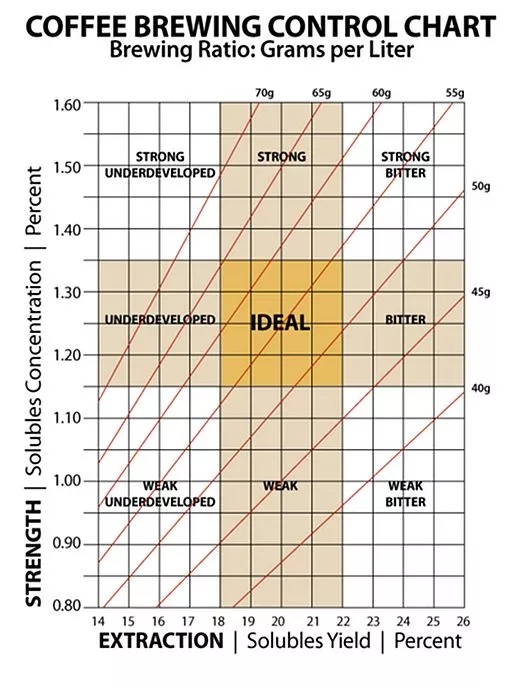
A long brew in pour-over usually pushes extraction past the Golden Cup range of 18% to 22% extraction yield and 1.2 to 1.4 TDS, which turns the cup bitter, dry, and hollow. Under-extraction sits below that range and tastes sharply acidic, salty, and thin. Adjust grind size, pour force, and water temperature to move back toward balance.
Under-extraction happens when water carries out too few soluble compounds, leaving sweetness behind; over-extraction pulls out the bitter, woody material that makes up the bulk of the bean. Correct a long brew first with a coarser grind, then check the pour: a softer stream and fewer aggressive pulses slow the flow and keep the bed even.
Extraction is the core step in pour-over coffee, yet many enthusiasts are often troubled by under-extraction and over-extraction. Starting from the basic principles of extraction, this article explains the standard range of the Golden Cup, and compares in detail how the two imbalanced states manifest in flavor and mouthfeel. It then addresses common issues such as excessively long brewing time, improper pouring force, and the influence of dripper material, offering actionable adjustment suggestions one by one, including grind size correction, water stream control, and fine-tuning of water temperature, to help you achieve a consistently balanced and delicious cup in your daily pour-over.
Front Street was recently chatting with a few friends when the topic turned to extraction. Once extraction comes up, you can't avoid two situations that give many coffee enthusiasts a headache—under-extraction and over-extraction. What exactly are the differences between them? And how should they be corrected during pour-over?
Extraction
Let's first clarify what extraction actually means.
Coffee extraction, put simply, is the process in which water flows through the coffee grounds, dissolving and carrying out the flavor substances inside the coffee. This involves many variables, such as water temperature, grind size, water volume, and stirring technique—any single parameter can affect the final extraction result. We generally divide extraction results into three categories: under-extraction, Golden Cup extraction, and over-extraction.
Golden Cup Extraction
So-called Golden Cup extraction means the brewed coffee's concentration falls between 1.2~1.4 TDS, while the extraction yield is in the 18%~22% range—this is considered to have reached the ideal extraction range. Anything that has not yet entered this range is under-extraction, while anything exceeding this range is classified as over-extraction.
Under-extraction & Over-extraction
Under-extraction means water carries out too few substances from the coffee grounds, leaving a large amount of soluble material still in the coffee bed. Such coffee presents a sharp acidity on the palate, noticeably insufficient sweetness, with a hint of saltiness, an overall thin body, and a finish that dissipates quickly.
The reason is that during extraction, small-molecule substances like acids and salts are released first, followed by sweetness, and finally bitterness. Because the total amount of extracted substances is insufficient to balance the acids released in the earlier stage, the acidity of the whole cup appears overly prominent and lacking harmony.
Over-extraction
The soluble substances in coffee beans make up about 30%, but what we actually need to extract is at most only 20%—once this proportion is exceeded, it is over-extraction. Because too many substances are dissolved out, the coffee exhibits pronounced burnt bitterness, off-flavors, and astringency.
So, how should we make adjustments?
Many friends experience over-extraction when making espresso, and the root cause often lies in not choosing the right coffee beans. The darker the roast, the more caramelization products there are, and the easier it is to bring out bitterness when extracting espresso. Therefore, Front Street suggests that if you don't like bitterness, choose medium or light roast beans, with priority given to Front Street Fruit Ding Ding·Yirgacheffe, Front Street Flower Butterfly·Panama, Front Street Sidra·Colombia, and Front Street Mozart·Costa Rica.
Apart from the beans themselves, bitterness in coffee is most likely caused by problems in the following areas:
1. Brewing time too long
Many people understand that the various substances in coffee are released at different rates under the action of hot water, and the large-molecule components dominated by bitterness and astringency tend to dissolve concentratedly in the final stage. Therefore, once coffee has astringency, it is usually accompanied by unpleasant bitterness. From the logic of extraction, the longer the steeping time, the stronger the flavor, and the more likely bitter and astringent substances are released in the later stages.
So in order to achieve reasonable extraction in coffee, brewing duration must be controlled. Taking a single serving of 15~16g of coffee grounds as an example, Front Street recommends a total time not exceeding 2 minutes 30 seconds. If your actual brewing exceeds this duration and you do indeed taste bitterness and astringency, then you need to adjust parameters according to the specific situation.
For example, if after brewing a large amount of wet, sticky, muddy grounds remains on the surface of the coffee bed, it indicates that too many fines have caused water retention, and the grind size should be coarsened;
If most of the coffee grounds are deposited at the bottom and the surface looks quite flat, it is most likely that the pouring force was too weak, the coffee bed was not lifted up, and water was forced to slowly seep through the thick layer of grounds, thus lengthening the brewing time. The solution is to appropriately increase the water flow after blooming, so that the water level rises as much as possible to two-thirds the height of the dripper.
2. Water stream scouring force too strong
According to Front Street's observations, astringency caused by pouring mainly occurs in two situations: one is unstable water flow causing uneven extraction of particles, making the coffee both sour and astringent; the other is commonly seen among friends who habitually use a strong stream to stir the coffee bed, which easily scours out off-flavors and astringency during the later stage of extraction.
Unlike other parameters, pouring is a hands-on skill that requires repeated practice. To achieve even brewing, Front Street recommends using a vertical water stream, maintaining a distance of 3~4cm from the coffee bed, and then slowly pouring in circles.
3. Dripper extraction efficiency too high
For many beginners, dripper material is one of the most easily overlooked causes of over-extraction. For example, ceramic drippers have a higher specific heat capacity; preheating them in advance allows the entire pouring process to maintain good heat retention, but at the same time it quietly increases the coffee's extraction efficiency, thereby raising the probability of astringency appearing in the final stage.
Therefore, when we taste astringency in coffee, and the dripper being used happens to be ceramic, and the first two factors have already been ruled out, then we might as well start with temperature and try lowering the brewing water temperature by 2~3°C to reduce the risk of over-extraction.
The above content is compiled by CoffeeHunters, a coffee news website.


