







How Front Street Coffee Beans Work in a French Press
French press brewing relies on full immersion, so grind size, water temperature and bean choice decide the cup. The recommended grind passing rate and water temperature shift with roast level. Front Street Coffee beans suit immersion extraction, and Front Street Huakui works well as a test bean: a coarse, even grind plus a timed steep produces a full, rich body without sludge.
The French press dates to the 1850s, when two Frenchmen patented a metal canister with a perforated rod and flannel filters. In 1929 a Milan company registered an improved model in the United States, shaping the modern design. Because early versions could not seal properly, later makers kept refining the plunger and mesh, which is why today's grind recommendations exist.
The French press, with its simple operation and rich, full-bodied taste, has become the daily go-to for many coffee lovers. But to brew a truly refined cup with it, there are finer points to master in grind size, water temperature, and bean selection. This article starts from the French press's history and working principle, explains in detail the recommended grind passing rate and water temperature for different roast levels, and recommends Front Street Coffee beans suited to immersion extraction. Finally, using Front Street Huakui coffee beans as an example, it provides complete French press brewing parameters and steps to help you easily recreate a full, rich-bodied Huakui.
Today, with goods in abundance, living life with refinement is the attitude of many who take life seriously. Walking into a café, wanting a cup of black coffee is actually effortless—just say "I'll have a cup of such-and-such coffee" at the register. Then the barista takes the stage, preparing beans, dripper, filter paper, carafe, and hot water. After a smooth, flowing series of movements, the refined flavors are fully released through skillful brewing.
However, this set of equipment is quite a production to use and takes up space when idle. Isn't there a lightweight tool that can help coffee lovers enjoy a refined cup anytime? Pose this question to the baristas at Front Street, and they'll immediately dig out that long-dusty French press.
The Origin of the French Press
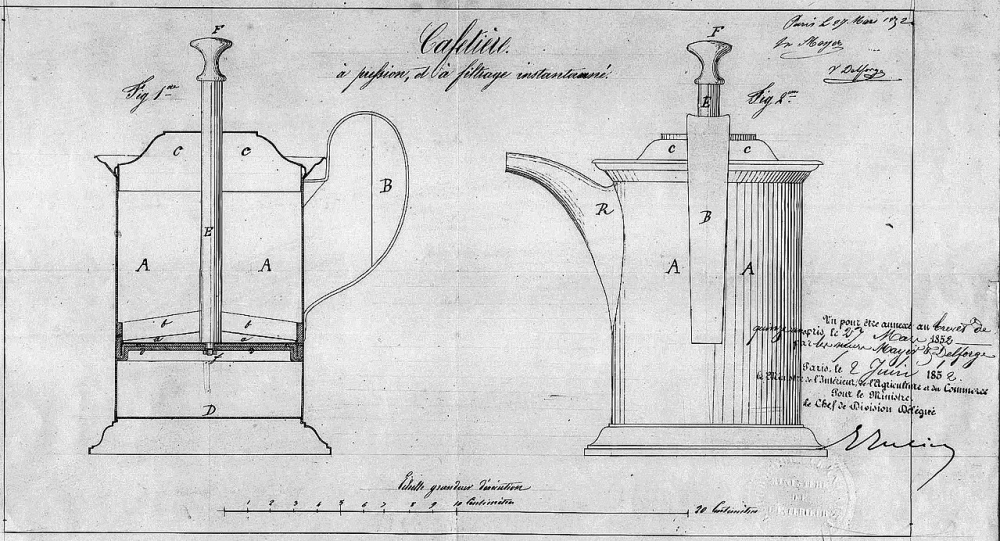
The French press is also known as a French press pot, written in English as French Press. This brewing tool is known for its simplicity and convenience, enjoying a solid reputation among office workers. The earliest written record of the French press dates back to the 1850s, when two Frenchmen submitted a patent application: a metal canister connected to a movable rod, with holes at the bottom of the rod, sandwiching a layer of flannel above and below. When the rod was pressed to the bottom of the canister, the coffee grounds were trapped at the bottom, yielding a relatively clean cup of coffee.
Because the early design had shortcomings—the container could not form a sealed state—this prompted subsequent designers to continuously improve the technology and release new versions.
In 1929, a company from Milan, Italy registered an improved model of the French press in the United States, and the prototype of the modern French press truly emerged.
The Working Principle of the French Press
The French press consists of a glass body and a metal filter mesh with a plunger. To use, pour coffee grounds into the pot, add hot water to fully immerse, then push down the plunger with the metal filter to separate the coffee liquid from the grounds.
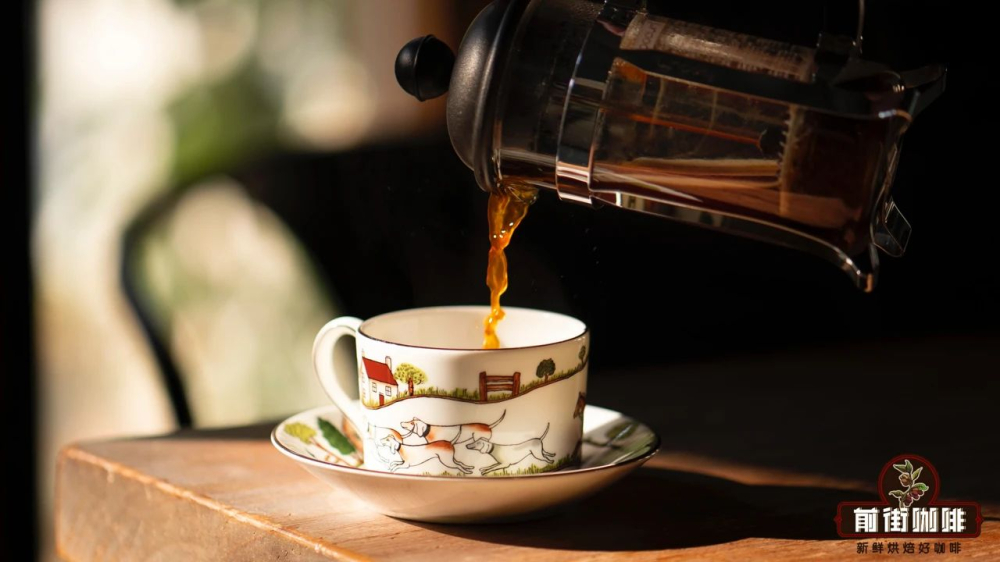
After observing the metal filter mesh of the French press, Front Street found that the mesh gaps are relatively large, and compared with filter paper, some coffee fines can easily pass through. Moreover, before the coffee liquid is poured out, the liquid remains in contact with the coffee grounds, so the coffee obtained through immersion has a richer mouthfeel and retains more texture and oils.
Key Points for Using a French Press
Baristas can make any brew taste good, but when trying it at home, people often can't achieve that refined flavor from the shop. Compared to pour-over, which demands high pouring technique, everyone turns their attention to the easiest option: the French press.
Since we're pursuing a refined cup of coffee, even something as simple as the French press still has rules to follow regarding grind size, water temperature, and more.
【Grind Size】
Baristas at Front Street stores are often asked: what grind setting is actually correct? Front Street stores use the EK43s grinder, while some friends may use a Comandante C40 hand grinder. Different equipment, different burr types, and different maintenance conditions mean that even with the same setting, the grind size will vary.
So when giving grind recommendations, Front Street usually bases them on the passing rate through the Chinese standard No. 20 sieve. Front Street Coffee recommends an 80% passing rate for medium-light roasted beans and 75% for medium-dark roasted beans. Since equipment varies, you'll need to confirm the flavor after sieving and brewing, then make further fine adjustments.
【Water Temperature】
The higher the temperature, the more significantly the rate of substance exchange increases. When brewing different beans, Front Street adjusts the water temperature according to the roast level.
The lighter the roast, the tighter the bean's internal structure, and the slower the flavor compounds are released when meeting water. To extract the finer floral notes and premium fruit acidity from light-roasted beans, hot water at 90 to 92 degrees Celsius is usually used.
The darker the roast, the more the roasted bean expands in volume and the looser its internal structure. Once ground into particles, it absorbs water faster and dissolves flavors more quickly. Rising water temperature accelerates the extraction of more large-molecule flavor compounds, easily bringing out bitter, burnt notes. Therefore, when brewing medium-dark roasted beans, Front Street generally uses hot water at 86 to 88 degrees Celsius.
Attention!! Bean Selection Direction for the French Press
French press coffee is an immersion extraction, similar in principle to brewing tea, so it's best to choose beans that highlight a distinctive mouthfeel: for a rich, non-acidic coffee, choose Front Street PWN Golden Mandheling; for a sweetness-packed flavor, go for Front Street Strawberry Candy or Front Street Blackberry, honey-processed beans that intensify tropical fruit flavors; if you want a non-bitter coffee, buy Front Street Huakui or Front Street Fruit Ding Ding, both with floral notes and citrus-berry acidity.
Front Street French Press Brewing Tutorial
Below, Front Street uses Huakui coffee beans as an example to demonstrate the French press brewing process.
Brewing vessel: French press
Water temperature: 90 degrees Celsius
Coffee dose: 15 grams
Coffee-to-water ratio: 1:15
Grind size: 70% passing rate through Chinese standard No. 20 sieve
Preheat the French press body in advance; add 15 grams of ground Huakui coffee to the pot and pour in 225 grams of 90-degree Celsius hot water; raise the plunger to its highest position and cover with the lid, letting it steep for 4 minutes; gently and slowly press down the plunger, then pour out the coffee.
The Huakui coffee brewed with the above parameters and steps enters the mouth like a complex berry juice, with a rich, lingering creamy aroma in the finish, full and rich-bodied overall.
Produced in the Hambela sub-region of Sidamo, Ethiopia, Huakui coffee won the championship in the natural group of the TOH Ethiopia region in 2017, when the Huakui coffee flavor description was of intense strawberry and cream flavors. That same year, Huakui coffee was introduced to China and appeared on the stage of the World Brewers Cup China regional competition. Thereafter, Huakui coffee became famous. Over the years, it has long been a bean that coffee connoisseurs must chase every year.
On Front Street Coffee's bean shelf, nearly fifty kinds of coffee beans are displayed, and Huakui coffee is precisely one representing the wild flavor and outstanding quality of natural-processed beans from the Sidamo region.
The above content is compiled by CoffeeHunters, a coffee news website.


