







How Should Yunnan Coffee and Typica Be Brewed?
Yunnan coffee has moved from instant-coffee raw material to a specialty origin with experimental processing, and its flavor is being redefined rather than fixed. Cultivation began in 1904, when a French missionary planted the first coffee tree in Dali. Typica came first, but from the 1980s farmers replaced it with higher-yielding Catimor, which still dominates the market.
Typica remains worth brewing on its own. The article traces Arabica varieties across Yunnan's small-bean regions and gives a pour-over recipe for sun-dried Typica grown in Lincang, specifying dose, ratio, water temperature, grind size, and a three-stage pouring rhythm to bring out a cleaner, more balanced cup.
Yunnan coffee has drawn increasing attention in the specialty market in recent years. From a former raw material for instant coffee to today's endless stream of experimental processing methods, its flavor image is being redefined. But what exactly should Yunnan coffee taste like? And what is the history and difference between Typica and Catimor? This article starts with the history of cultivation, traces the changes in Arabica varieties in Yunnan's small-bean producing regions, focuses on the Typica coffee that Front Street grows in Lincang, and provides a specific pour-over recipe for sun-dried Typica, including dose, ratio, water temperature, grind size, and a three-stage pouring rhythm, to help you brew a cleaner, more balanced side of Yunnan coffee.
For more specialty coffee knowledge, please follow our WeChat public account: Front Street Coffee (FrontStreet Coffee)
In the past, when people mentioned Yunnan coffee, most first thought of it as the raw material for instant coffee. Nowadays, when Yunnan coffee comes up again, many enthusiasts picture a series of experimentally processed beans with rather poetic names. If Front Street asked you: what exactly does Yunnan coffee taste like? You might pause first, then think of vivid descriptors like winey or peachy, but on second thought it feels not quite right, and you cannot help asking back: right, so what does Yunnan coffee really taste like? (Thinking.jpg) Yunnan coffee Cultivation history and story
The starting point of Yunnan coffee can be traced back to 1904, when the French missionary Pierre-Marie Théophile Didon planted the first coffee tree in Dali, Yunnan, and coffee cultivation in mainland China began there. Since Typica was the first to be planted in Yunnan, why is Catimor the most common Yunnan coffee on the market today? When people think of Yunnan's most famous crop, many think of tea. Unlike tea, which can become a daily consumer product, in the eyes of older farmers, the coffee tree was merely a cash crop, and they basically did not drink it. Yet Typica also requires meticulous management, is time-consuming and labor-intensive, and does not yield much. Relying on it alone to improve economic returns was simply not worthwhile.
So by the 1980s, Yunnan cut down all its Typica coffee trees and switched to Catimor introduced from Brazil. The logic at the time was simple: since they did not drink it themselves, whether it tasted good or not did not matter; the key was low planting cost and high yield. Just like that, Catimor was promoted on a large scale in Yunnan. Because its flavor performance was not outstanding, and because the only processing methods at the time were natural and washed, these Yunnan coffee beans became raw material for the instant coffee industry.
It was not until recent years, as specialty coffee continued to grow and coffee bean processing methods became increasingly novel, that flavor quality improved through various innovative processing techniques. Yunnan coffee also noticed this trend and used experimental processing methods to make up for Catimor's shortcomings in flavor. Those who tried it praised it highly, and so Yunnan coffee began to become active in the specialty market.
However, Front Street has always believed that good food cannot be separated from the quality of the ingredient itself. For example: a cabbage with lots of coarse fiber can be made into a state-banquet-level "boiled cabbage in clear broth"; while a naturally tender cabbage only needs to be blanched in boiling water and drizzled with a little soy sauce. If judging by texture and the cabbage's own flavor, the latter is definitely better; if judging only by surface seasoning, the former is more eye-catching. For this reason, since 2014, Front Street has been growing the ancestor of Yunnan coffee, Typica, in Lincang, Yunnan. Let us first distinguish the differences between Typica and Catimor varieties
Catimor is a combination of Arabica and Robusta. Robusta has strong resistance to leaf rust, is rich in oils, has high yield, and is easy to cultivate; after crossing with Arabica's Typica, Catimor carries about 25% Robusta genes, which improves leaf rust resistance, retains rich oils, and also possesses some of the rich flavors of the original Typica species. Therefore, most estates in Yunnan choose to plant Catimor on a large scale. Front Street believes that Catimor grown in Yunnan presents flavors of nuts, brown sugar, and plum, but its overall cleanliness is not as good as Typica.
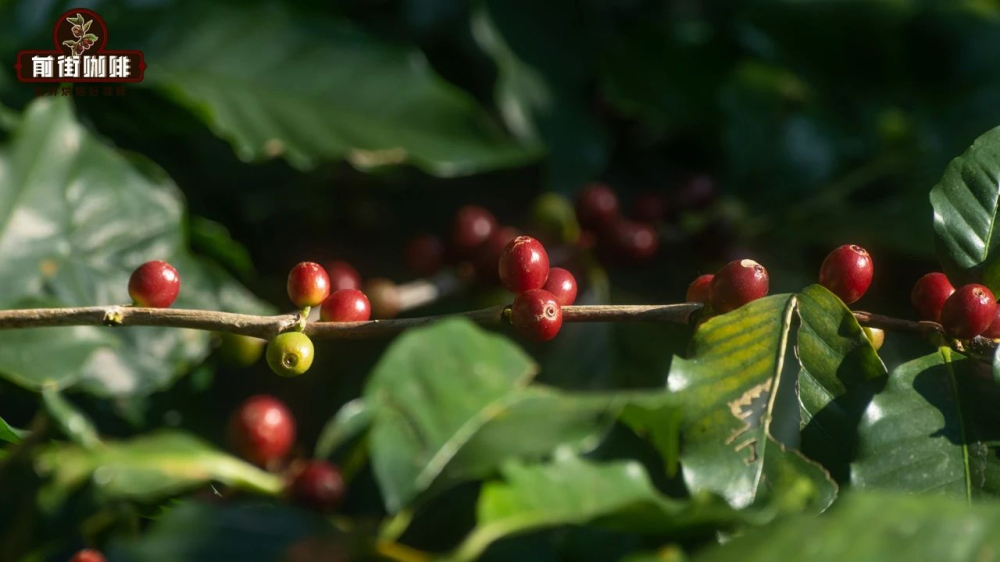
Typica originated in Ethiopia and southeastern Sudan and is one of the oldest varieties of Arabica. Its top leaves are copper-red, hence it is called red-top coffee, and it is also known as the old-variety small-bean coffee. It has low yield and is difficult to cultivate, so its price is considerably higher than ordinary small-bean coffee; but its flavor performance is excellent, and it is recognized as a specialty coffee variety. The Typica coffee beans Front Street grows in Yunnan have refined acidity, a licorice-like sweetness, slightly lower body, and overall balance.
Yunnan coffee beans under traditional processing methods
The Yunnan Typica grown by Front Street uses natural processing. The harvested and selected coffee cherries slowly develop under the sun, and the pulp and mucilage ferment slightly, giving the coffee beans fermented aromas and a smooth mouthfeel; at the same time, the sugars in the pulp are absorbed by the coffee beans, forming sweet aromas after roasting. Therefore, under natural processing, Front Street's Yunnan Typica coffee beans show plum-like acidity, a black tea-like tea sensation, and a brown sugar finish.
How do you brew Yunnan Typica coffee beans so they taste good?
Choose 15 grams of coffee powder, with a recommended coffee-to-water ratio of 1:15; if you want clearer flavor, you can use 1:16. Choose a V60 dripper, with a brewing water temperature of 88°C, the aim being to make the acidity softer; the grind size is medium grind (about 78% passing through a Chinese standard No. 20 sieve).
Three-stage extraction pouring: first pour 30 grams of water for a 30-second bloom. Then pour in a small stream in circles until 125 grams, at which point pause; when the water level drops and is about to expose the coffee bed, continue pouring until 225 grams and stop. When the water level drops and is about to expose the coffee bed, remove the dripper. (Start timing from the beginning of the bloom.) The extraction time is 2'10".
The above content is compiled by CoffeeHunters, a coffee news website.


