







How Does the Coffee Belt Shape Jamaican Blue Mountain?
Jamaican Blue Mountain coffee is defined by strict CIB (Jamaica Coffee Industry Board) regulation, three growing regions, grading standards, and washed processing. The Blue Mountains lie in eastern Jamaica within the coffee belt, with the highest peak at 2,256 meters, the tallest point in the Caribbean. Altitude divides the crop into Blue Mountain, High Mountain, and Jamaican coffee grades.
Coffee reached Jamaica in the eighteenth century: in 1717 King Louis XV of France ordered plantations established, and by the mid-1720s Governor Nicholas Lawes introduced Arabica seeds from Martinique and promoted cultivation in St. Andrew. The name Blue Mountain comes from the blue haze seen on the peaks. Buyers should note the difference between genuine Blue Mountain and Blue Mountain flavor labels.
Blue Mountain coffee is one of the most prestigious coffees in the world, but products labeled "Blue Mountain" on the market are a mixed bag, and few people truly understand the system behind it. What exactly makes Jamaican Blue Mountain coffee special? And how does the CIB (Jamaica Coffee Industry Board) regulate quality and certification? This article will sort through the historical origins of Blue Mountain coffee, the geographical conditions of the Blue Mountains, the washed processing method, the division of its three major producing regions, the grading standards, varietal characteristics, the origins of Japan's priority purchasing rights, how to identify authentic versus fake Blue Mountain, and the essential difference between "Blue Mountain flavor" and genuine Blue Mountain. It will also introduce Blue Mountain product information recommended by brands such as Front Street Coffee, helping coffee lovers gain a comprehensive understanding of this legendary bean.
For more specialty coffee knowledge, please follow the WeChat official account: Front Street Coffee (FrontStreet Coffee)
Even those outside the coffee world have mostly heard of the name Jamaican Blue Mountain; open Taobao and search, and the screen is full of phrases like "Blue Mountain flavor" and "Blue Mountain blend." What exactly makes Blue Mountain so memorable? Let's talk about the story behind Blue Mountain.
Jamaica's coffee-growing history dates back to the eighteenth century. In 1717, King Louis XV of France ordered coffee plantations to be established in Jamaica; by the mid-1720s, Sir Nicholas Lawes, then Governor of Jamaica, introduced Arabica seeds from Martinique and promoted their cultivation in the St. Andrew region. Coffee trees were thus introduced to Jamaica and planted in the Blue Mountains, and were subsequently divided by altitude into Jamaican Blue Mountain coffee, High Mountain coffee, and Jamaican coffee—different grades with vastly different prices.
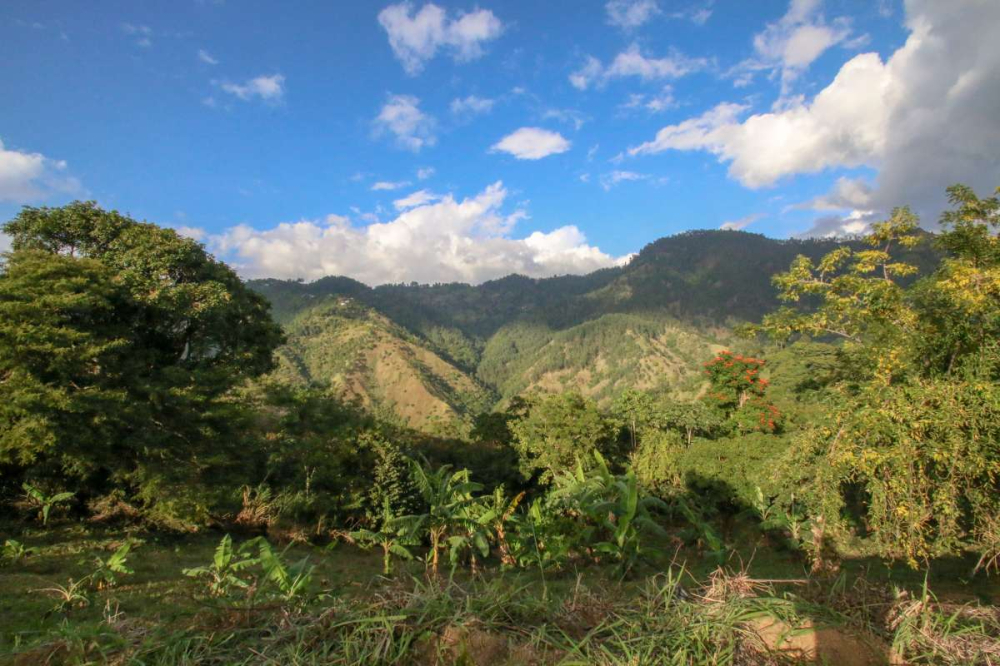
The Blue Mountains lie in the east of the island of Jamaica, surrounded by the Caribbean Sea. On clear days, sunlight strikes the azure sea, and the peaks refract a brilliant blue glow like seawater—hence the name Blue Mountain. The highest peak of the Blue Mountains stands at 2,256 meters above sea level, the highest point in the Caribbean region and a famous tourist destination. Located within the coffee belt, the area has fertile volcanic soil, crisp unpolluted air, a humid climate, and year-round fog and rain, with average annual rainfall of about 1,980 mm and temperatures holding around 27 degrees. It is precisely this terroir that produces the world-renowned Jamaican Blue Mountain coffee and makes it one of the most expensive coffees in the world.
True Blue Mountain coffee is arguably one of the coffees grown under the most favorable conditions in the world; Jamaica's weather, geological structure, and topography combine to provide an exceptionally ideal environment. Only coffee produced in designated areas may bear the name Jamaican Blue Mountain, and this area lies in northeastern Jamaica, near Kingston. The ridge running across Jamaica extends all the way to the eastern part of the island, and the Blue Mountains rise over 2,100 meters above sea level. The cool, foggy, rain-heavy climate gives this fertile land well-balanced moisture. Local growers use a mixed planting method, with coffee trees growing alongside banana and avocado trees on terraces.
In addition, the terrain is extremely steep, making harvesting very difficult, and nearly all coffee pickers are women. The coffee trees all grow on rugged slopes, and the picking process is exceptionally hard—only skilled local women workers can handle it. During picking, only perfectly ripe coffee cherries must be selected; underripe or overripe ones will both affect coffee quality.
Processing method
Washed processing: Blue Mountain is only ever washed
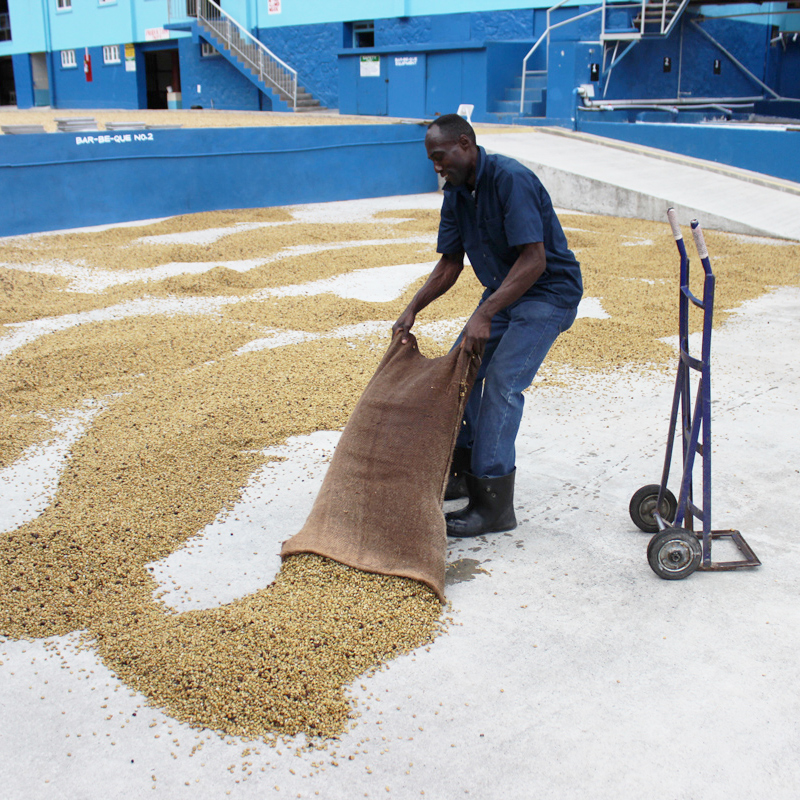
Washing and fermentation are used to remove the skin, pulp, and mucilage. Farms using the washed method must build washing tanks and be able to channel a constant supply of fresh water. During processing, the skin and pulp are first removed, then the beans are fermented for 12–18 hours; afterward, the fermented beans are moved back and forth in the tank, using the friction between the beans and the force of flowing water to wash the coffee beans until they are smooth and clean. After washing, the beans are still wrapped in the parchment, with a moisture content of about 50%, and must be dried in the sun to bring the moisture content down to 12–14%, otherwise they will continue fermenting and become moldy and spoiled. The beans are then sorted and stored in dedicated warehouses; these steps must be strictly controlled, or coffee quality will suffer.
The three major producing regions of Blue Mountain coffee
The Blue Mountain region has only 6,000 hectares of cultivated area, so it is impossible for all coffee labeled "Blue Mountain" to be grown there. Another 12,000 hectares are used to grow two other types of coffee (non-Blue Mountain): High Mountain Supreme coffee and Jamaican coffee.
Today the St. Andrew producing region remains one of the three major Blue Mountain coffee regions, the other two being the Portland region and the St. Thomas region. Some small estates also grow Blue Mountain coffee, such as Wallenford Estate, Silver Hill Estate, and J. Martinez's Atlanta Estate. Even the largest estate owners in the area count as small-scale growers by international standards, and many of them are small landholders whose families have worked this land for two centuries.
Currently, the marks that can represent the origin of Blue Mountain coffee include six types—such as the Mavis Bank Central Factory (M.B.C.E), the Blue Mountain Coffee Cooperative Factory (M.H.C.C.T.), the Portland Blue Mountain Coffee Cooperative Factory (P.X.X.S.H.), the Coffee Industry Association (Wallenford), the Coffee Industry Association (St. John's Peak), and Blue Mountain Mist (J.A.S)—and some estate grades will also be noted on the barrels.
Next, let's introduce a few of the more common Blue Mountain coffee brands:
Coffee Trades
The estate is named CLYDESDALE, and the company's coffee factory is in the backyard of the CIB office building, while the estate is located about halfway up Blue Mountain at around 1,200 meters. Jamaica's two other most important Blue Mountain coffee companies are Wallenford and Mavis Bank; both were originally state-controlled, with Wallenford's output exceeding 60% of Jamaica's total Blue Mountain production and Mavis Bank's exceeding 20%, and it is one of the few companies holding all three grades: Jamaican Blue Mountain, Jamaican High Mountain, and Jamaican Select coffee.
WALLENFORD
WALLENFORD Estate is located in the heart of Jamaica's Blue Mountains—on the slope of the Catherine's Peak at about 1,524 meters above sea level. The estate began planting Blue Mountain coffee in 1790, and the year-round cold, foggy climate gives the coffee cherries a sweet, full body, producing exceptionally unique, high-quality Blue Mountain beans.
Moreover, while the Jamaican government sold off and privatized most estates, WALLENFORD ESTATE was the only one retained and directly managed and operated by the Jamaican government; its quality control process is the strictest, and rather than overpursuing commercial operation, it takes preserving the reputation of Jamaican Blue Mountain coffee as its mission.
1. The Jamaica Coffee Board's official registered logo, used for certification and inspection of exported Jamaican Blue Mountain coffee;
2. The Jamaica Coffee Industry Board (CIB)'s officially registered BLUE MOUNTAIN COFFEE® trademark, marking the packaging of authentic Jamaican Blue Mountain coffee;
3. The WALLENFORD COFFEE COMPANY registered trademark, marking the packaging of WALLENFORD Blue Mountain coffee.
Mavis bank
The Munn family began operating Mavis Bank in 1885, at a site slightly higher in elevation than the current one, called Strawberry Hill. Mavis Bank processes coffee cherries at high altitude; they invested in brand-new equipment, and the trial-production beans improved greatly because of a truly flaw-free processing routine. This coffee has a mild, smooth mouthfeel and good body, sometimes recalling the aroma of high-mountain Dong Ding oolong tea.
R.S.W Blue Mountain
R.S.W Blue Mountain Estate is located in the mountainous area of southeastern Jamaica; R.S.W refers to 100% Blue Mountain coffee produced by its Resource, Sherwood Forest, and Whitfield Hall estates. The coffee grown in these three areas ranges from about 700 to 1,600 meters in elevation, and the mountains are year-round shrouded in cool mist and clouds, which is very favorable for coffee tree growth; after harvesting, all the cherries are gathered at the Sherwood Forest washing station for processing.
Clifton Mount Estate
Clifton Mount is an ancient coffee-producing area in Jamaica that is still in normal operation today, and Clifton Farm is the only one in Jamaica to carry the "Rainforest Alliance" mark. Front Street Blue Mountain No. 1 coffee comes from Clifton Farm and uses traditional washed processing.
As early as the mid-eighteenth century (around 1750), Clifton Farm began growing and producing coffee. Its coffee-growing and processing areas sit at an average of 4,300 feet (1,310.64 meters); sufficient altitude, mild afternoon cloud and mist drifting through the mountain forests for shade, ample sunlight, and mineral-rich growing soil provide good growing conditions for the coffee trees and also extend the ripening time of the coffee cherries.
Gold Cup
Founded in 2003, Gold Cup was co-founded by Dr. Charles Lyn and a team of several farmers from the legally designated Blue Mountain region. It is located in St. Andrew at Mount Lebanon, about 975–1,280 meters above sea level, and the Abbey Green estate in St. Thomas, about 1,158–1,585 meters above sea level, are both partners; the well-known Abbey Green is also currently one of the largest estates in Jamaica's Blue Mountain region.
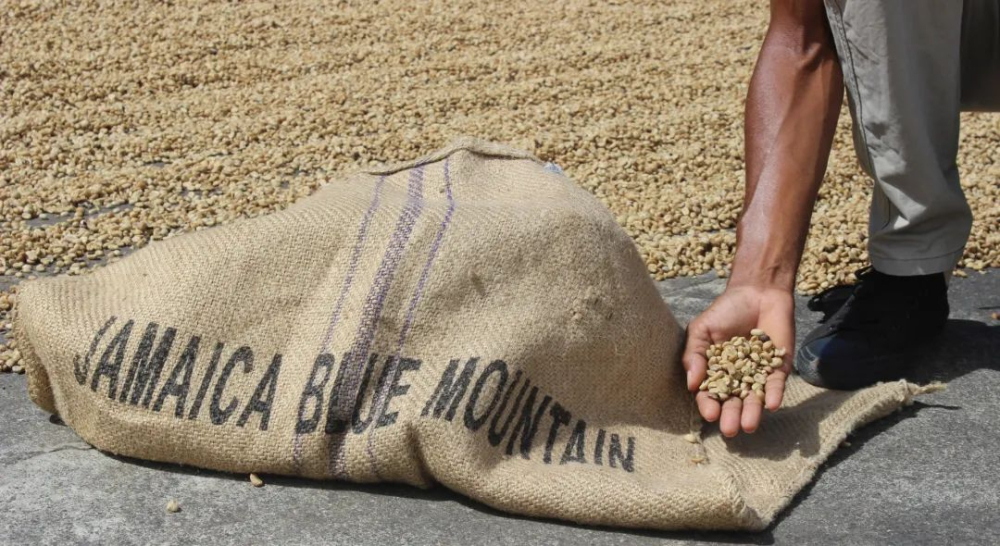
To ensure the best quality and quality control, Gold Cup invests heavily in post-processing, for example by updating post-processing hardware such as new depulping equipment, and by managing the stages of green bean processing, drying, and roast sample testing. The company is also the largest shareholder of the well-known BMCP processing plant; fully ripe red cherries harvested from high-altitude blocks in St. Thomas and St. Andrew are sent to an affiliated washing station, where the first stage of processing still involves pre-removing floaters, after which they enter the Blue Mountain Coffee Processors LTD plant for drying. After sorting and sun-drying, they rest for 8 weeks, then are graded by green bean size, density, color, and appearance, and finally cupped to confirm whether there is any potential imperfection. All procedures are completed under the guidance and control of the Jamaica Coffee Industry Board (CIB), and all specifications are executed according to Jamaica's highest domestic standards. The green bean quality is especially reflected in its flagship brand "Amber Estate."
Gold Cup currently has two brands, "Amber Estate" and "BMCP" from the Blue Mountain Coffee Processors LTD plant; the independent Amber Estate is its top flagship brand, with coffee cherries 100% harvested from Abbey Green and Mount Lebanon estates, and strictly selected from the highest-quality green beans graded by the Blue Mountain Coffee Processors plant.
Blue Mountain coffee variety
The variety of Blue Mountain coffee is Typica.
Typica has bronze-colored tips on its top leaves, an oval or slender pointed bean shape, a tall tree with slightly slanting branches at an angle of 50–70 degrees, and elegant flavor, but it is weak in constitution and poor in disease resistance, and each tree's coffee yield is very low, producing few cherries.
The Typica tree has one distinguishing feature at the leaf tip: it is copper-red, hence the name red-tipped coffee. The opposite leaves of the coffee tree are long oval, with smooth surfaces; the branches at the ends are very long and few in number; the flowers are white and bloom at the base where the leaf stalk joins the branch. Ripe coffee cherries look like cherries and are bright red.
How did Japan's priority purchasing rights come about?
When Blue Mountain coffee is mentioned, everyone knows that a large portion was bought up by Japan back then, so Blue Mountain coffee is hard to find outside Japan. There is a history behind this as well.
The Jamaican government established the Jamaica Coffee Industry Committee in 1950; this committee set quality standards for Jamaican coffee and supervised their enforcement to ensure the quality of Jamaican coffee. The committee issues a special official seal for Jamaica's exported green coffee and roasted coffee, and because Japanese loans were used to improve production quality, the market was guaranteed.
By 1981, another 1,500 hectares or so of land in Jamaica had been cleared for coffee planting, and another 6,000 hectares of coffee land were subsequently invested in. In fact, today's Blue Mountain region is a small place with only 6,000 hectares of planted area, and it is impossible for all coffee labeled "Blue Mountain" to be grown there. Another 12,000 hectares are used to grow two other types of coffee: High Mountain Supreme coffee and Jamaican coffee.
According to the Jamaica Coffee Board's 2013 export statistics, of the limited Blue Mountain bean quota, 85% was exported to Japan, 5% to the United States, 5% to Europe, and 5% to other countries. But in the global consumption distribution of authentic Jamaican Blue Mountain coffee, according to International Coffee Association statistics, China actually accounts for 15% of consumption. This is because part of Japan's, Australia's, and Europe's Jamaican Blue Mountain coffee share is exported to Taiwan through directly operated branches.
Blue Mountain classification and grading:
The history of Jamaican coffee can be traced back to the eighteenth century, when the British introduced coffee tree species to Jamaica and planted coffee in the Blue Mountains, further divided into high-altitude Jamaican Blue Mountain coffee, Jamaican High Mountain coffee, and Jamaican coffee, with different grades determining different prices.
(1) Jamaican Blue Mountain coffee
Blue Mountain coffee and High Mountain coffee are each further divided into four grades. In terms of quality, from top to bottom, they are: NO.1, NO.2, NO.3, and PB, where PB means peaberry. According to CIB standards, only coffee grown above 666 meters in elevation is called Jamaican Blue Mountain coffee; the best of the best, it is coffee produced in Jamaica's Blue Mountains at about 2,000–2,256 m, and because it grows on perilous mountainsides, yields are small, the beans are large and of good quality, and the flavor is balanced, combining appropriate acidity, bitterness, aroma, body, and sweetness. It is recognized worldwide as the finest, so the price of national-treasure Blue Mountain No. 1 is the highest among all Blue Mountain coffees.
(2) Jamaican High Mountain coffee
Coffee produced below 666 meters in Jamaica's Blue Mountain region is called High Mountain coffee; it is second only to Blue Mountain coffee in quality and is called by industry insiders the brother variety of Blue Mountain coffee. Because Jamaican Blue Mountain coffee yields very little, if you want to taste Jamaican-style coffee, Jamaican High Mountain coffee is your best choice.
(3) Jamaican coffee
Coffee grown outside the Blue Mountain range is called Jamaican coffee. Chinese coffee professionals originally had a common misconception that only coffee grown in the Blue Mountain area above 1,800 meters in elevation could be called Blue Mountain coffee. In fact, on the mountain crown above 1,800 meters in the Blue Mountains there is only one estate, Amber, which belongs to a person of Chinese descent; the estate owner's surname is Lyn (林), with ancestral roots in Guangdong, China. The estate has only 30 hectares of land and very low output. Blue Mountain coffee is mainly distributed across five mountainous areas of the Blue Mountains: John Crow, St. John's Peak, Mossman's Peak, High Peak, and Blue Mountain Peak.
True Jamaican Blue Mountain coffee has certificate authentication:
The Jamaican government used to always insist that all Blue Mountain coffee be roasted in Jamaica to ensure unchanged quality. In fact, roasting is a fine art, and doing it well requires experience, training, and expensive equipment. From the consumer's perspective, coffee beans should be obtained and drunk immediately after roasting. Roasting coffee in Jamaica could not satisfy this requirement. Now, Jamaica's green coffee beans can already be exported.
CIB
Jamaica is the only country in the world with a government coffee management agency—the Jamaica Coffee Industry Board (CIB for short), under Jamaica's Ministry of Agriculture and Fisheries. CIB's functions include planting technology guidance, processing training, fair trade, and quality supervision—a whole series of matters concerning the quality and brand of Jamaican Blue Mountain. CIB's board members are all estate owners in Jamaica above a certain scale (due to shifts in the industry, newly certified Jamaican Blue Mountain estates now require an area of more than 50 hectares).
CIB stipulates that only Blue Mountain coffee beans produced in Jamaican Blue Mountain regions above 2,200 feet can be called Jamaican Blue Mountain, and their grades are divided by bean size into NO.1, NO.2, NO.3, and hand-selected PB, among which the basic standard for NO.1 Blue Mountain green beans is beans of 17 screen or above, a defect rate below 3%, and a moisture content of about 13%. To date, the only green bean processing method for Blue Mountain coffee is washed; there is no sun-dried or other processing method.
At present, the Jamaica Coffee Board can issue certificates for all Blue Mountain coffee exported on the market.
There are three types of certificates:
(1) Quality certification certificates issued by the Jamaica Coffee Board
(2) Authorized sales certificates issued by Blue Mountain coffee producers.
(Blue Mountain coffee is distributed by 4 Jamaican government-licensed processors and exported by 16 licensed exporters.)
(3) Certificate of origin for Jamaican Blue Mountain coffee
Quality certification certificates all state the time and quantity. The Jamaica Coffee Board randomly takes one package from the submitted Blue Mountain coffee for inspection, and if it meets the conditions for Blue Mountain coffee, the certificate is issued.
The Blue Mountain coffee that Front Street Coffee (FrontStreet Coffee) recently imported from the place of origin has this certificate.
Among all coffees, only Blue Mountain is packed in barrels; other coffees are exported in burlap sacks. It is said that this comes from the mid-eighteenth century, during the British colonial period, when flour was shipped from Britain to Jamaica, and the empty barrels were recycled to transport coffee and rum. Today's barrels are made from wood from American temperate forests; the advantage of barrels is that they absorb and release internal and external moisture without undergoing too much change, easing sudden temperature changes during transport. In addition, barrel packaging seals off coffee aroma and can maintain the best coffee quality, but the added cost is relatively high.
So how should Blue Mountain coffee best be roasted?
Simply put, roast Blue Mountain thoroughly from the inside out, and on the basis of roasting it through, use a relatively good roasting approach to express this bean's flavor.
Caramelization is the single most influential stage for coffee flavor. After six to seven minutes of roasting, the green beans have absorbed a large amount of heat and initiated pyrolysis reactions; the first crack sound appears, some sugars convert into carbon dioxide, moisture continues to evaporate, and new aromatic components gradually develop, forming the so-called coffee oils and combining with hundreds of aromatic substances such as nicotinic acid, citric acid, quinic acid, malic acid, acetic acid, and caffeine.
Roast curve: charge when the drum temperature reaches 170°C, set the damper to 3, after 1 minute adjust the heat to 140°C with the damper unchanged, roast until 5'10'' at a temperature of 153°C, when the bean surface turns yellow, the grassy smell completely disappears, and dehydration is complete; adjust the heat to 115°C and the damper to 4;
At the 8'00" minute, ugly wrinkles and dark streaks appear on the bean surface, and the toast aroma clearly turns into coffee aroma, which can be defined as the prelude to first crack. At this point, listen carefully for the sound of the first crack; at 8'12" first crack begins. Reduce the heat to 90°C, open the damper fully (adjust the heat very carefully, not so low that there is no crack sound), and drop at 201.3°C.
Cupping
A perfect and subtle balance of acidity, body, and aroma. Its acidity is bright and delicate. Its body is velvety smooth. Its aroma has a slight penetrating quality, accompanied by floral, spicy, and citric tones. After entering the mouth, there is a faint cocoa aftertaste.
The taste is very clean, complex, very mild, chocolate-sweet, with very strong body. The flavor is rich and mellow; the coffee's sweetness, acidity, and bitterness are perfectly matched, with no bitterness at all, only a moderate and perfect acidity, and a long-lasting fruity finish.
Dry aroma: roasted peanut, hazelnut, melon, chocolate-like
Wet aroma: rose-tea, caramel, honey, black chocolate, almond skins, silky mouthfeel, brightness
So how should we drink this Blue Mountain coffee bean?
Dripper choices for everyday brewing: V60 dripper, Kalita wave, and KONO are all fine
Taking the KONO dripper as an example:
Parameters: 15g coffee, water temperature 86–88°C, grind medium granulated sugar coarseness (Chinese standard No. 20 sieve, 75% pass-through), i.e. EK43s setting 10.5, water-to-coffee ratio close to 1:15, total time about 2 minutes
Technique: bloom with 30g water for 30s, then slowly pour to about 125g and pause; when the water level drops and is about to expose the coffee bed, start pouring again up to 225g.
Tips:
Blue Mountain is roasted relatively dark; if the water temperature used is too high, it will easily produce astringency and also carry a very obvious smoky flavor.
How to identify real versus fake Blue Mountain?
1 Appearance: Blue Mountain green beans are bluish-green, very neat in appearance, medium-small in size, with slightly upturned ends; after roasting they expand a great deal in volume and become very plump.
2 Grinding: genuine Blue Mountain coffee beans grow at high altitude, and their cell structure is relatively loose; when hand-grinding, it feels very crisp, pleasant, and continuous, with no sense of resistance.
3 Aroma: the aroma is very intense and dense; so-called blended Blue Mountain coffee does not have this aroma.
4 Taste: genuine Blue Mountain coffee has a balanced, rich mouthfeel, with no single flavor standing out or missing—something no other coffee bean can match, and the most crucial point for identification.
So what is Blue Mountain flavor coffee?
The so-called "Blue Mountain blend" actually has nothing to do with Blue Mountain. This situation arose because early Blue Mountain coffee was rare and expensive, so operators used mixed beans plus dark roasting to create coffee close to Blue Mountain's mouthfeel based on that flavor profile; therefore conscientious merchants on domestic and international markets tell customers that these are composite Blue Mountain, blended Blue Mountain, Blue Mountain flavor, or Blue Mountain-style coffee beans, not true Blue Mountain coffee.
True Blue Mountain and Blue Mountain flavor are two different concepts; generally, other bean types are roasted to imitate coffee with a mouthfeel similar to Blue Mountain coffee. "Blue Mountain blend" beans are mixed, differ greatly in shape, and are relatively easy to identify. Also, do not believe in "supreme Blue Mountain" at a few dozen yuan per pound or "Blue Mountain coffee" at a dozen or so yuan per cup.
Not everything labeled "Blue Mountain" is real Blue Mountain—hopefully this helps everyone tell the difference!
The above content is compiled by CoffeeHunters, a coffee news website.


