








How is a pour-over coffee blending recipe built?
Coffee blending for pour-over starts with one main bean chosen for inclusiveness, high sweetness, body, and stable quality, then one or two companion beans that harmonize the flavor. Front Street's Autumn Blend uses Yunnan Arabica as the main bean and Brazil Cerrado as the companion, producing a clean cup with soft, layered acidity and medium-high sweetness.
Blended coffee beans are usually associated with espresso, where two to five beans are mixed before roasting or roasted separately and combined. For pour-over, the goal differs: keep the theme clear and avoid stacking too many components, which blurs the flavor and makes balance harder. Each candidate bean was checked against at least three roasting curves and cupping scores before the Yunnan Arabica was selected.
Autumn has arrived. What should a blend suitable for pour-over look like? Starting from the original development intent, this article documents in detail the birth process of Front Street's Autumn Blend. We discuss the general impression of what blended beans are used for, and settle on a combination approach using Yunnan Arabica as the main bean and Brazil Cerrado as the companion bean. By analyzing the main bean's inclusiveness, sweetness, and stability, as well as the companion bean's role in harmonizing flavors, we ultimately create a clean and clear pour-over blend with soft, varied acidity and medium-high sweetness. The article also mentions general principles of coffee blending and Front Street's commitment to fresh roasting, making it suitable for coffee enthusiasts to reference.
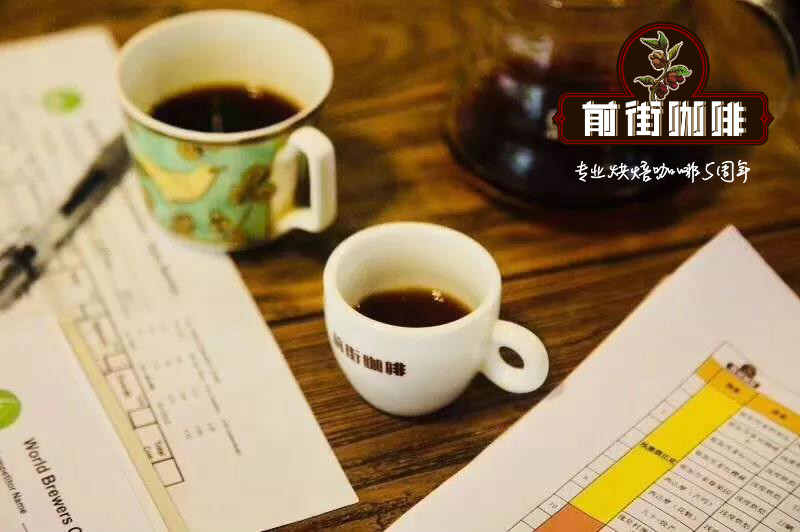
Autumn has arrived, and following the thinking of this season, I also want to design a pour-over blend suitable for autumn drinking. In this blend, I hope to present a clean and clear flavor profile, a soft entry, layered and varied acidity, and a finish with medium-high sweetness.
Generally, when people mention blended coffee beans, their first thought is often espresso. Mixing 2 to 5 kinds of beans before roasting, or roasting them separately and then blending, allows the strengths and weaknesses of different beans to complement each other, ultimately making a cup of coffee that is mellow and rich in aroma.
[Blending Approach]
In the early stage of development, we first had to clarify what flavor the theme of "autumn" should express: it does not need an overly heavy mouthfeel, but it must have the flavor of fruits harvested in autumn, and it has to be sweet! Everyone agreed to choose one main bean and then pair it with 1 to 2 companion beans to harmonize the flavor; if too many beans are used, the main theme becomes blurred, and the flavors become messy and difficult to balance.
[Determining the Main Flavor Bean]
As the main bean in the formula, it must have good inclusiveness, relatively high sweetness, a certain degree of body, and sufficiently stable quality. To meet these conditions, we repeatedly searched our database—each coffee had at least three roasting curves and cupping scores. By comparing their evaluations, advantages, and disadvantages, we finally selected our Yunnan Arabica from among dozens of beans. [Front Street Yunnan Arabica] is our local coffee. At the source, quality control can be well managed, and it also has slight acidity and nutty flavors, a balanced mouthfeel, and a long sweet aftertaste, making it suitable as the base of a blend.
However, Front Street Yunnan Arabica is slightly lacking in terms of origin uniqueness. If viewed as an espresso formula, the first choice would of course be Brazilian coffee beans from South America. As the world's largest coffee producer, Brazil holds a pivotal position in the industry, and precisely because of its high yield, it uses a stable semi-washed processing method to reduce the influence of external factors, making the coffee flavor relatively consistent from year to year.
[Finalizing the Companion Bean]
Generally speaking, single-origin Arabica coffee is already enough to make a very good cup of coffee; it has a fresh aroma, a soft mouthfeel, and a sweet aftertaste. "Blending" means combining coffees from different origins, each with its own unique taste, aroma, and mouthfeel. By mixing and adjusting according to the flavors you like, you can create your own exclusive coffee.
After cupping comparisons and research on coffee characteristics, we chose Front Street Yunnan Arabica and Front Street Brazil Cerrado. They share nutty aromas, and then we used a medium-dark roast so that its balance and roast-related flavors could increase the layering and body of espresso, adding value to Yunnan. Thus we arrived at the espresso beans recommended by many baristas for espresso machines and moka pots—Front Street Dark Cocoa Blend.
Finally, so that everyone can experience the most complete coffee aroma, Front Street ensures that every bag of coffee beans is roasted within 5 days, and supports shipment within 24 hours after placing an order, ensuring that the coffee beans are fresh and making extraction more stable.
The above content is compiled by CoffeeHunters, a coffee news website.


