







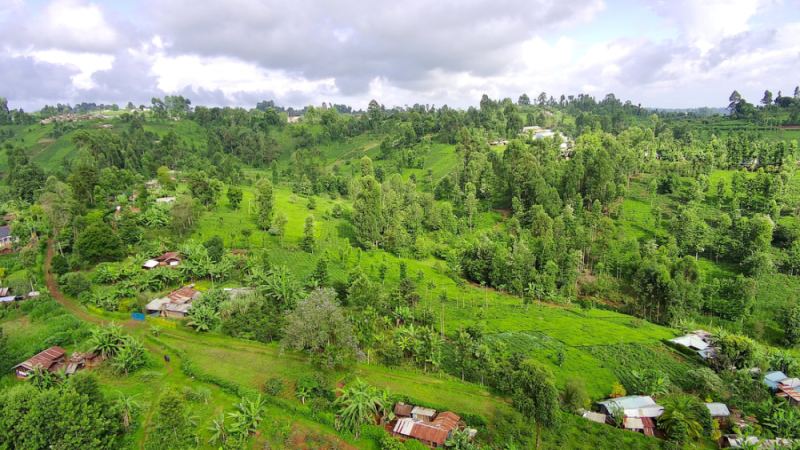
Kenya AA, with its bright acidity and tomato-like flavor profile, has become a favorite among many pour-over enthusiasts. This article explores Kenya's growing regions, variety evolution, and unique K72 washing process to analyze the origins of its flavor. It also provides Front Street Coffee's recommended grind size, water temperature, coffee-to-water ratio, and staged pouring plan tailored to the beans' plump and hard texture. Whether you want to recreate a cup of clean, transparent tomato-like coffee or understand the extraction logic of Kenyan beans, you'll find practical parameter references here.
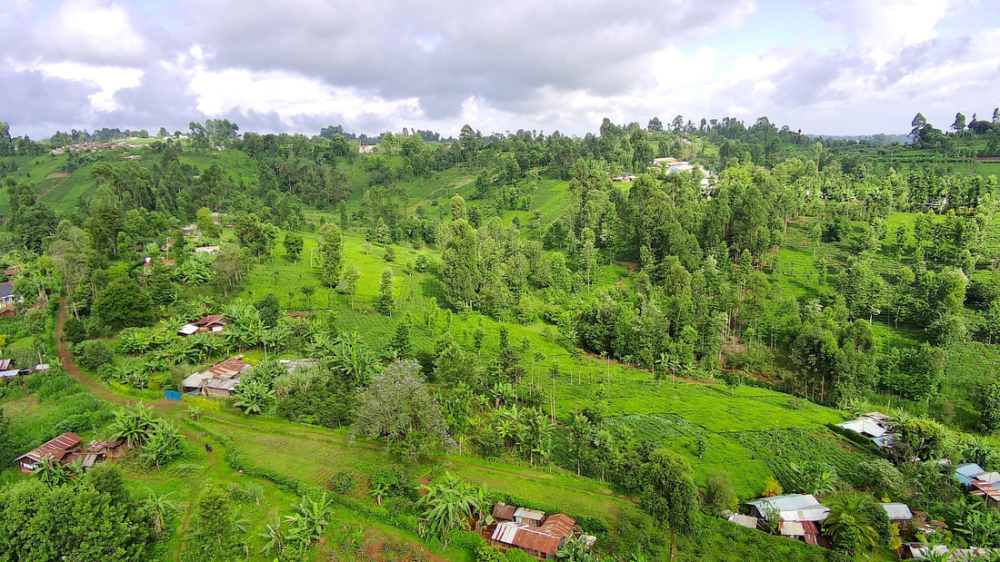
For more specialty coffee knowledge, please follow our WeChat official account: Front Street Coffee (FrontStreet Coffee)
Kenya is located in East Africa, with the equator passing through its center. It borders Somalia to the east, Tanzania to the south, Uganda to the west, Ethiopia and Sudan to the north, and the Indian Ocean to the southeast. The country's terrain is mainly plateau, with an average elevation of about 1,500 meters. Kenya has diverse climate types, all within the tropical monsoon zone. The coastal areas are hot and humid, while the highlands have a mild climate, with occasional snowfall in mountains over 3,500 meters. The highest annual temperature is about 26°C, and the lowest about 12°C. South of the equator, the climate is mainly tropical forest and savanna; the coastal areas have a tropical climate with high temperatures and rain year-round; moving inland, the climate becomes increasingly arid, with desert and semi-desert areas in the north accounting for about 56% of the country's land area. Due to monsoon influence, Kenya does not have distinct four seasons, only rainy and dry seasons.
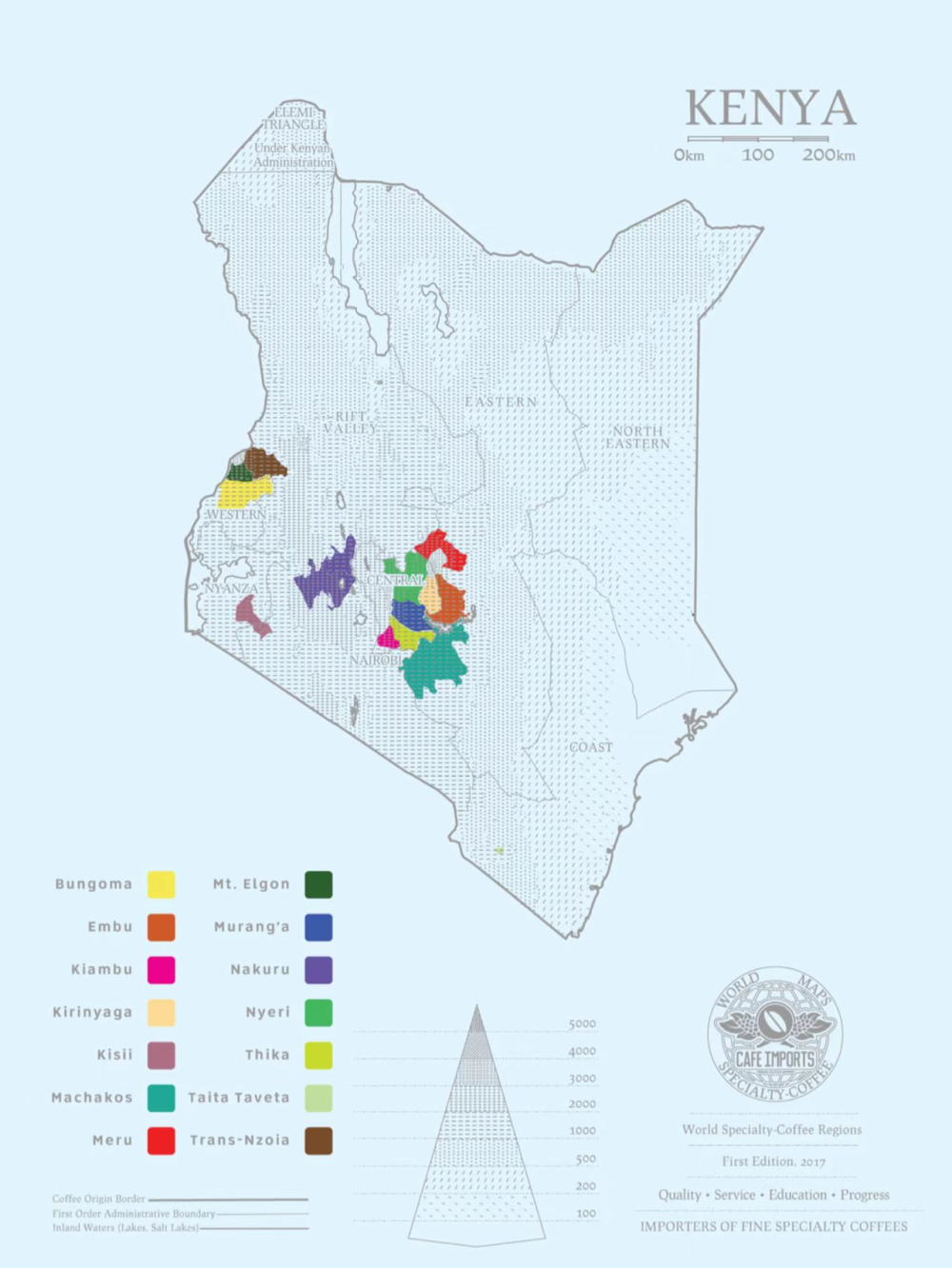
Kenya's coffee-growing areas are mostly distributed between 1,300 and 2,000 meters above sea level; average temperatures range from 15 to 24°C, and annual rainfall is about 900 to 1,200 mm. The high-altitude plateau areas around Mount Kenya provide ideal growing conditions for coffee, including the Aberdare Range, Nyanza, Kisii, Bungoma, Kericho, and Nakuru. The Arabica varieties grown in these areas were originally introduced from Ethiopia.
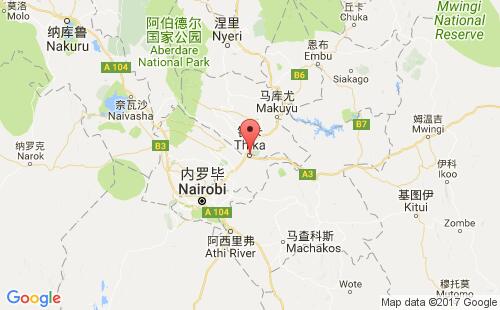
Central Kenya produces the largest quantity of coffee, and the highest quality coffee also comes from this region. Meanwhile, producing areas such as Kisii, Trans-Nzoia, Keiyo, and Marakwet in western Kenya, as well as Thika in the south, are also gaining increasing attention.
As early as the 1930s, Kenya used the Scott Laboratories for seed screening, selecting and breeding SL28 and SL34 and promoting them nationwide. These two varieties possess exceptionally outstanding berry-like acidity and were later introduced by some Central American estates. The variety of the Costa Rican COE champion bean the year before last was precisely SL28 and Geisha.
Since then, Kenya has continued to invest in developing varieties resistant to leaf rust. Ruiru11 was the first successful variety recognized by the Kenya Coffee Board, which can be understood as Kenya's version of Catimor. When Front Street cupped Kenyan coffee beans mixed with Ruiru11, they found that the sweet and sour taste was slightly weaker and carried a certain miscellaneous flavor. This also confirms that variety has a significant impact on flavor.
Front Street believes that the bright acidity in Kenyan coffee is inseparable from the local characteristic K72 washing process. The conventional washing process involves soaking in a fermentation tank for 24 to 48 hours before drying. Kenya's process, however, is: first complete 24 hours of washing fermentation, then remove the detached mucilage, ferment again in a clean water tank for 24 hours, then clean again, continue fermenting for 24 hours, totaling 72 hours. This high-intensity washing method can stably control quality while presenting bright acidity and a clean, sweet taste.
Next, let's look at Kenya's coffee grading system. Kenyan coffee beans are classified by bean size, with the highest grade being AA, followed by AB. The advantage of grading by size is that, after variety selection, larger beans usually represent plumpness and high quality, and are also quite friendly to roasting. In this way, the overall quality consistency of Kenyan coffee can be guaranteed. Although we can still distinguish specific flavor differences among producing areas such as Nyeri, Kirinyaga, and Kiambu, they generally all possess Kenya's characteristic bright acidity, tomato-like and berry-like flavors—that is, you can recognize it as Kenyan coffee from the first sip.
After understanding the background information of Kenyan coffee beans, you can formulate a brewing plan based on the beans' characteristics. Kenya's high altitude, volcanic soil, excellent varieties, and meticulous processing together create coffee beans that are plump, large, hard in texture, and good in appearance.
To avoid clogging during brewing, Front Street recommends not producing too many fines during grinding. You can use a better-quality grinder or use a sieve to remove fines. The grind size should be based on a 75% pass rate through a No. 20 standard sieve.
Regarding water temperature, this Kenyan coffee is suitable for brewing at a higher temperature, which can fully bring out its fruity sweetness (tomato-like). Front Street recommends using a water temperature of 93°C.
For the coffee-to-water ratio, Front Street recommends 1:16. Kenyan coffee itself has a solid mouthfeel, and even when brewed to a 16x coffee-to-water ratio, it does not appear thin at all. The concentration brewed at 1:16 is very soft, and the bright dark plum acidity paired with the sweet and sour aroma of tomato is very comfortable.
Regarding the amount of coffee, if using a small V60 dripper, Front Street recommends using at least 15 grams of coffee grounds; if using a large V60 dripper, it is recommended to use at least 25 grams of coffee grounds.
When pouring, you can raise the coffee bed appropriately and reduce large circular pouring. This can thin the coffee bed thickness and achieve full extraction, avoiding edge channeling and bottom clogging.
First, pour 30 ml of water for blooming, lasting 30 seconds; in the second stage, pour 120 ml of water, pouring in circles from the center outward. After the surface is fully covered with golden foam, pour in circles, shrinking back to the center point, until the coffee bed height reaches 1/2 of the short rib.
In the third stage, pour 90 ml of water, pouring in a coin-sized circle. After all the coffee liquid has dripped into the server, end the extraction. The total time is 2 minutes (with a 10-second tolerance).
Using this brewing method can highlight the tomato-like aroma and sweetness of Kenyan coffee, while also ensuring a solid yet transparent dark plum acidity.
The above content is compiled by CoffeeHunters, a coffee news website.


