







Jamaica Blue Mountain Coffee: Origin, Grading System, and How to Spot the Real Thing
Blue Mountain coffee comes from the Blue Mountains of Jamaica, a Caribbean island where volcanic soil and high altitude create ideal growing conditions. Cultivation began in the early 18th century, but the coffee gained international recognition only after 1953. The Jamaica Coffee Industry Board, established in 1948, set grading standards to sell limited beans at different prices. The Typica variety and barrel export specifications help distinguish authentic Blue Mountain No. 1 from common imitations labeled "Blue Mountain flavor."
Authentic Blue Mountain No. 1 beans carry official certificates and come from estates like Clifton Mount, which supplies Front Street Coffee. Japanese capital long dominated the trade, adding to the coffee's mystique. When buying, look for the Typica variety and proper barrel markings. For brewing, a pour-over with water just off boil highlights the clean, mild flavor. These details matter whether you are purchasing beans or preparing a cup at home.
Blue Mountain coffee is probably the most famous — and most easily counterfeited — name in the coffee world. Products labeled "Blue Mountain flavor" are everywhere on the market, but they are far removed from genuine Jamaican Blue Mountain coffee. This article takes you back to Jamaica's Blue Mountains, tracing the history of Blue Mountain coffee from its cultivation in the early 18th century to its rise to international fame in 1953, explaining the altitude grading, cultivation norms and quality control standards set by the CIB (Jamaica Coffee Industry Board), describing how Japanese capital long dominated the Blue Mountain coffee trade, and offering practical ways to identify authentic Blue Mountain No. 1 coffee beans — from the characteristics of the Typica variety and barrel export specifications to the three types of official certificates. Finally, we introduce the Clifton Mount Estate washed Blue Mountain No. 1 that Front Street Coffee has supplied for years, complete with full pour-over parameters and flavor description, so you have a solid reference whether buying or brewing.
When it comes to coffee, Blue Mountain is almost the most widely known name — even people who don't normally drink coffee have probably heard of it. Today, e-commerce sites and convenience store shelves are flooded with coffee powders branded "Blue Mountain flavor" or "Blue Mountain blend," but these products have nothing to do with authentic Blue Mountain coffee. In this issue, Front Street explains how to recognize genuine Blue Mountain No. 1 coffee beans, so please look carefully before placing your order.
The origins of Blue Mountain coffee
The Blue Mountains sit on the island of Jamaica, with the highest peak exceeding 2,100 meters. This mountain region is covered with nutrient-rich volcanic soil and is surrounded on all sides by the Caribbean Sea; the air is clean and the humidity abundant, supplying the coffee trees with ample water and nutrients. The cultivation history of Blue Mountain coffee dates back to the early 18th century, but it didn't truly make its name internationally until 1953.
Jamaica's land area is limited, so growing good coffee means going to higher altitudes — and the only part of the island meeting this condition is the Blue Mountains, which means actual production of quality coffee beans is quite limited. The Jamaica Coffee Industry Board (CIB), established only in 1948, set about making a detailed classification of coffee production in the Blue Mountains, with a very direct aim — to sell the limited beans at different prices according to grade and secure higher returns. What the CIB established at the time included grade classification, cultivation technology upgrades, Blue Mountain coffee bean grading, export quality control and related certification. /Grading of Blue Mountain
The Blue Mountains have an overall elevation of 2,256 meters, and the local government designates areas above 1,700 meters as a natural ecological reserve where commercial crop cultivation is prohibited. As is well known, quality coffee depends on the day-night temperature difference brought by high altitude; this temperature difference slows the growth of the coffee fruit, allowing it to accumulate richer flavors. Accordingly, the CIB ruled that only beans from coffee trees grown between 910 and 1,700 meters may bear the name "Jamaica Blue Mountain Coffee"; those from 460 to 910 meters may only be called "Jamaica High Mountain Coffee"; and those below 460 meters are classified as "Jamaica Prime Coffee."
/Upgrades in cultivation technology
Jamaica initially planted the genetically excellent Typica variety, with cultivation techniques provided by the British. Britain has accumulated 300 years of experience in coffee cultivation, so the techniques themselves were not a problem — what was lacking was standardization. The CIB therefore strictly implemented all cultivation metrics and introduced more modern methods, steadily improving quality.
/Quality control of Blue Mountain coffee beans
The CIB is equally strict about screening Blue Mountain coffee beans. Blue Mountain No. 1 requires a bean size of 17/18 screen, with defective beans making up no more than 2%; Blue Mountain No. 2 requires 16/17 screen, with defective beans no more than 2%; Blue Mountain No. 3 requires 15/16 screen, with defective beans no more than 2%; in addition, there is Blue Mountain Peaberry, which requires a bean size of 10MS, with defective beans also no more than 2%.
Why is Blue Mountain coffee known to everyone?
The plan was good, but implementing it required substantial funds, and the Jamaican government could not come up with the money. Japan extended a helping hand in 1696, and thereafter purchased large quantities of Jamaican coffee beans for many years. To thank Japan for its assistance, before 2000 nearly 90% of Blue Mountain coffee was bought up by the Japanese.
The first introduction of Blue Mountain coffee beans into mainland China was in 2004, handled by Camlon Green Bean Company, whose founder came from Japan and which set up a branch in China. At that time, drinking a cup of Blue Mountain coffee in China was not entirely impossible, but usually only welcome hotels had a chance of carrying Blue Mountain coffee beans, since demand was small and the price high. Very few people had tasted it, and faced with such precious beans they naturally praised it to the skies; word spread from one to ten to a hundred, and it ultimately became a myth that everyone knew it tasted good even without having tried it. Times have changed, and buying Blue Mountain coffee beans is no longer difficult today; since 2011 Jamaica has exported directly to China. Even so, you still need to keep your eyes open when buying.
How can you tell whether the Blue Mountain coffee beans you bought are genuine? "Blue Mountain coffee bean variety"
Authentic Blue Mountain coffee beans are 100% Typica. Typica is the oldest coffee variety, with a clean taste, and has always been favored by connoisseurs. According to Front Street's cupping, authentic Blue Mountain No. 1 has an extremely balanced flavor, with acidity, sweetness and bitterness each in its place without overpowering one another. Typica coffee trees have longer terminal branches and sparse branching, white flowers that bloom at the base where the leaf stalk meets the branch, and ripe fruit that is bright red and cherry-shaped; the coffee beans themselves are oval or slender-pointed.
"Coffee beans are exported in wooden barrels"
Jamaica is the last country still exporting coffee beans in wooden barrels, with three export specifications: 70 kg, 30 kg and 15 kg. "Genuine Jamaican Blue Mountain coffee comes with certification"
At first Jamaica insisted on exporting only roasted Blue Mountain coffee beans, but long-distance transport causes roasted beans to steadily lose flavor, and by the time they reach consumers only a woody taste may remain. Later the Jamaican government relaxed the restrictions and allowed the export of green Blue Mountain coffee beans. There are three types of certificates: the quality certificate issued by the Jamaica Coffee Board; the authorized sales certificate issued by Blue Mountain coffee producers (Blue Mountain coffee is distributed by 4 processing producers licensed by the Jamaican government and exported by 16 licensed exporters); and the certificate of origin for Jamaican Blue Mountain coffee. The quality certificate states the time and quantity, and the Jamaica Coffee Board randomly selects one package from the submitted Blue Mountain coffee for inspection, issuing the certificate only if it meets the conditions for Blue Mountain coffee.
Where can you buy authentic Blue Mountain coffee beans? The Blue Mountain No. 1 coffee beans sold by Front Street Coffee come from Clifton Mount Estate in the Blue Mountains.
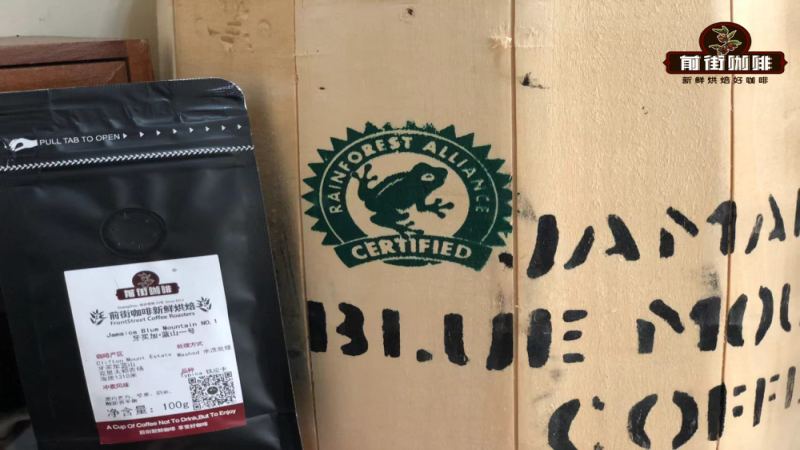
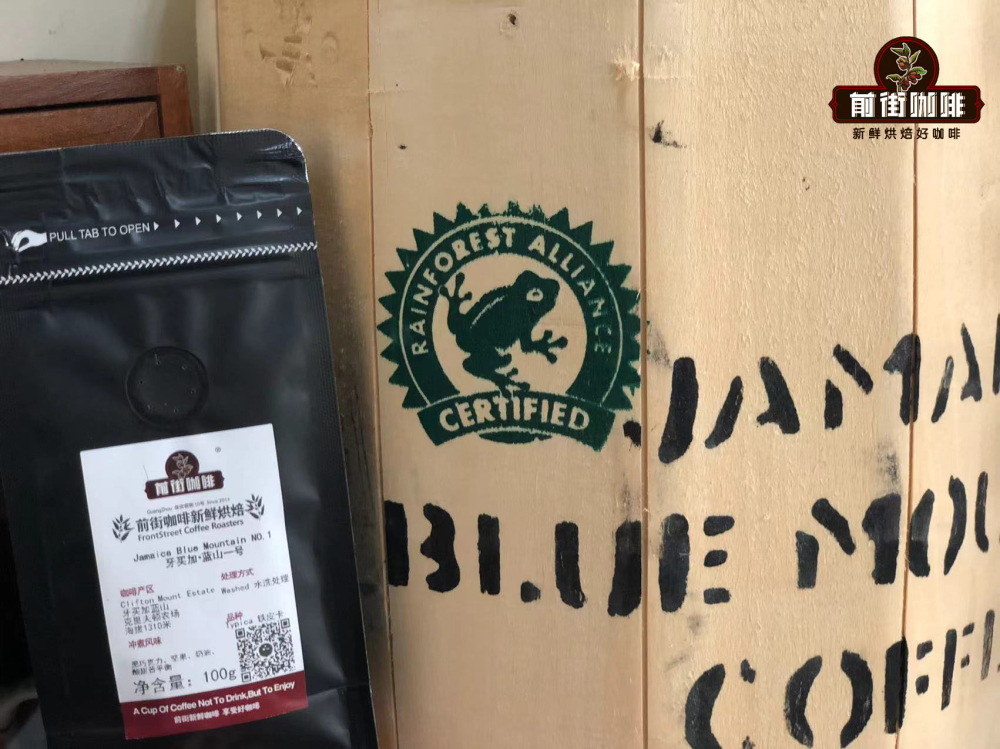
Clifton Mount Estate is the only Blue Mountain estate in Jamaica with the "Rainforest" certification mark, planted at an altitude of 1,310 meters. It can be called the most innovative estate in the entire Blue Mountain region; in 2019–2020 it successively launched a natural-process version of Blue Mountain No. 1 coffee and Blue Mountain Geisha coffee. Before that, all Blue Mountain coffee sold externally was washed Typica. Front Street Coffee also once listed natural-process Blue Mountain coffee beans and Blue Mountain Geisha coffee beans, but in small batches that sold out quickly; only the washed Blue Mountain No. 1 coffee beans are a product Front Street Coffee supplies year-round.
Flavor profile of Front Street Coffee's washed Blue Mountain No. 1 coffee beans
Blue Mountain No. 1 coffee has a very clean flavor and is especially suited to pour-over. Front Street recommends a KONO dripper; brewing water temperature: 88–87°C; dose: 15 g; coffee-to-water ratio: 1:15; recommended grind: medium grind (75% passing a Chinese standard No. 20 sieve).
Front Street's brewing method: first bloom with 30 g of water, then after about 30 seconds pour 95 g of water in a small stream, circling in the center; that is, when the water reaches 125 g, pause, and when the water level drops and is about to expose the coffee bed, pour again to 230 g to finish; when the water level drops and is about to expose the coffee bed, remove the dripper (timing starts at the beginning of the bloom). Extraction time is 2 minutes 5 seconds. Flavor profile of Blue Mountain No. 1 coffee: black cocoa, nuts, cream, caramel biscuit; overall balanced, rich and enticing.
The above content is compiled by CoffeeHunters, a coffee news website.


