








What separates the main arabica coffee bean varieties?
Arabica accounts for roughly 70 percent of global coffee production and usually grows above 1,200 meters. After the species spread from the Arabian region into Europe, growers split it into two foundational groups, Typica and Bourbon, based on where each was introduced. Mutation and hybridization then produced many more named varieties, including Geisha.
Geisha's path shows how varieties travel. It was first found and cultivated in Ethiopia's Geisha forest, sent to a research institution in Kenya, then moved through Uganda and Tanzania, on to Costa Rica, and finally into Panama, where it became famous. Altitude, terrain, and harvesting methods in places like Brazil, Colombia, Jamaica Blue Mountain, and Hawaii Kona shape flavor and price.
Arabica coffee accounts for about 70% of global coffee production, and its cultivation typically requires an altitude of over 1,200 meters. After this variety was introduced from the Arabian region to Europe, it was divided into two foundational categories—Typica and Bourbon—based on the differences in where it was introduced, and subsequently many branches emerged through genetic mutation and hybridization. This article will begin with the dissemination path of Geisha, sort out the respective characteristics, advantages, and disadvantages of Typica and Bourbon, and extend to representative producing regions such as Brazil, Colombia, Jamaica Blue Mountain, and Hawaii Kona, analyzing how altitude, terrain, and harvesting methods affect the flavor expression and pricing positioning of coffee beans.
For more specialty coffee knowledge, please follow the WeChat official account: Front Street Coffee (FrontStreet Coffee)
Ethiopia is the birthplace of coffee, and the number of local wild coffee varieties is extremely large. The cultivation altitude of Arabica coffee is usually no less than 1,200 meters, and its share of total global coffee is higher than that of Robusta, at about 70%. This variety first spread to Europe through the Arabian region, and according to different places of introduction, it was distinguished into two major categories: Typica and Bourbon. On this basis, genetic mutation and hybridization also gave rise to many distinctive subdivided varieties.
As one of the three major coffee varieties, Arabica encompasses a quite rich range of categories. Front Street here sorts out the relevant members of the Arabica family for everyone. The Arabica varieties planted in different countries vary, but there are certain connections among them. Take the world-famous Panama Geisha as an example: it is not a native variety of Panama, but was first discovered and cultivated in the Geisha forest in Ethiopia.
After Geisha was discovered in Ethiopia, it was first sent to a research institution in Kenya, then gradually introduced to African regions such as Uganda and Tanzania, then moved to Costa Rica, and finally entered Panama. After the Geisha variety took root in Panama, it immediately rose to become one of the world's top coffee beans.
As Geisha's fame continued to rise, more and more producing regions began to introduce this variety. Even Jamaica Blue Mountain joined the ranks of cultivating Geisha, which shows just how popular its flavor is.
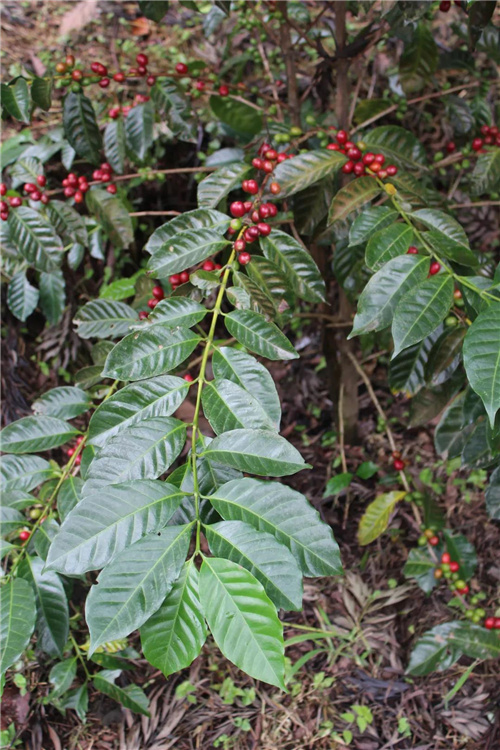
Since Jamaica Blue Mountain coffee has been mentioned, Front Street will take the opportunity to introduce the local Arabica varieties. Jamaica mainly cultivates Typica, with a tree height of about 4 to 5 meters, side branches extending horizontally, young leaves bronze-colored, and a relatively long tree lifespan. Typica can be said to be one of the coffee varieties with the most outstanding flavor expression, with especially prominent sweetness, but it has an obvious shortcoming—low yield and weak disease resistance, making it highly susceptible to leaf rust.
For this reason, there are not many places that still insist on planting Typica today, and most producing regions have switched to cultivating Typica's variant—Bourbon. Bourbon originated from a genetic mutation after coffee trees from Ethiopia were transplanted to the island of Bourbon in France, and it has now spread to East Africa, Brazil, and other places. The Bourbon tree is 4 to 5 meters tall, with side branches growing diagonally upward and green leaves. Although this tree species resembles Typica in appearance, it is sturdier than Typica and has a higher yield. Bourbon is also a category with excellent flavor among Arabica. Compared with Typica, its yield advantage is obvious. Although it is also prone to disease, its higher yield compensates for this shortcoming to a certain extent.
Speaking of Bourbon, Front Street must mention Brazil, this major coffee-producing country. Brazil's coffee varieties are mainly Bourbon, and after Bourbon mutated in Brazil, many Bourbon branches with different flavors were derived. For example, Yellow Bourbon is currently seen only in the state of São Paulo, Brazil, while the recessive genetic mutation of Red Bourbon and Yellow Bourbon produced Pink Bourbon. These two varieties are scarce in number and quite precious. Front Street has also put these two coffee beans on the shelves, one being Yellow Bourbon from Brazil's Queen's Farm, and the other being Colombia's Isabella Pink Bourbon coffee beans.
According to Front Street's understanding, Ethiopia has more than 3,000 native coffee varieties, from which people have selected several varieties for cultivation. The coffee varieties in the Yirgacheffe region are highly distinctive, with very rich floral and fruity aromas, making them among the highest-grade coffee varieties. As the world's largest coffee-producing country, Brazil's picking techniques and processing technology are already quite mature, no longer relying on manual picking but using machine operations. However, this also brings a problem: the ripeness of coffee cherries is uneven. In addition, most of the Arabica produced in Brazil is planted in plains, which is not conducive to the accumulation of flavor substances. Therefore, Brazilian coffee generally has a relatively flat flavor, not as balanced and richly layered as Colombian coffee.
Brazilian coffee and the Arabica produced in Colombia have quite similar flavors, one reason being that the two countries are geographically adjacent. Some may ask, since they are so close, why do the tastes still differ? This involves terrain and climate factors. One major difference between Arabica and Robusta lies in terrain requirements. Arabica is mostly planted at higher altitudes, while Robusta has very low soil requirements and is usually planted at low altitudes. The higher the altitude, the greater the density and hardness of the coffee beans, and the longer the fruit maturation time, allowing more sugar to accumulate inside, so the flavor is naturally better than that of low-altitude coffee beans. This is also why some countries or producing regions grade coffee beans by hardness or altitude.

Therefore, it is only natural that low-altitude Brazilian coffee beans are inferior in taste to high-altitude Colombian Arabica. However, high-altitude cultivation also increases the difficulty of harvesting coffee cherries. Front Street gives an example: in a plain terrain like Brazil's, when planting coffee trees, one only needs to leave enough spacing between trees for machines to pass through, which can save part of the labor and thereby reduce costs. In contrast, the Colombian coffee beans mentioned earlier by Front Street are planted on the high mountain slopes of the Andes, where machines simply cannot enter, so harvesting can only rely on manual labor, and the price will naturally be correspondingly higher.
However, nature always has its surprises. When people generally believe that only Arabica above 1,200 meters in altitude can have a rich flavor, there will always be exceptions that break the convention. According to Front Street's understanding, Kona coffee beans from Queen's Farm in the Hawaiian Islands are at an altitude of only about 1,100 meters, but thanks to Hawaii's island climate, the coffee produced still has an outstanding flavor. It can be seen that cultivation altitude is one of the conditions for measuring the quality of Arabica coffee, but it is not the only standard.
The above content is compiled by CoffeeHunters, a coffee news website.


