







Why Does the Yirgacheffe Ardi Cooperative Suit the Arabica Coffee Bean?
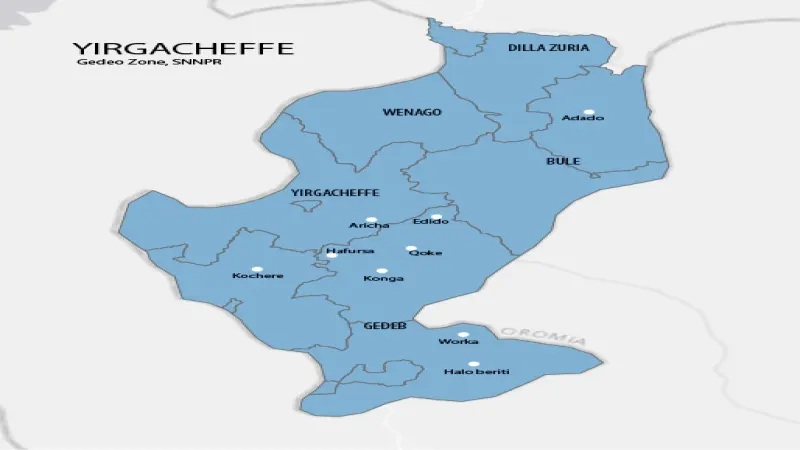
Yirgacheffe sits in southwestern Ethiopia, once a small town under the Gedeo Zone, with wetlands, abundant water and elevations that swing between 15 and 25 degrees Celsius. Those conditions, plus wide day-to-night temperature shifts, make it a strong environment for the arabica coffee bean and give the region its floral, citrus character.
In 2010 the Ethiopia Commodity Exchange separated Yirgacheffe from Sidama because traders kept asking for beans from that specific town. The Ardi cooperative's improved natural processing builds on that reputation. A washed Yirgacheffe is a clean, low-cost entry point for beginners, with white floral aroma and lasting sweetness.
Yirgacheffe is one of Ethiopia's most recognizable specialty coffee regions, and its distinctive floral and citrus notes have captivated countless coffee enthusiasts. Starting from its geographical environment and the history of the region, this article traces how Yirgacheffe became an independent, well-known region apart from Sidama, and focuses on the origin of the name of the Ardi cooperative and its improved natural processing method. At the same time, the article also recommends Front Street Coffee's washed Yirgacheffe as an affordable choice for beginners, with a clean taste and rich floral aroma, suitable for daily brewing practice.
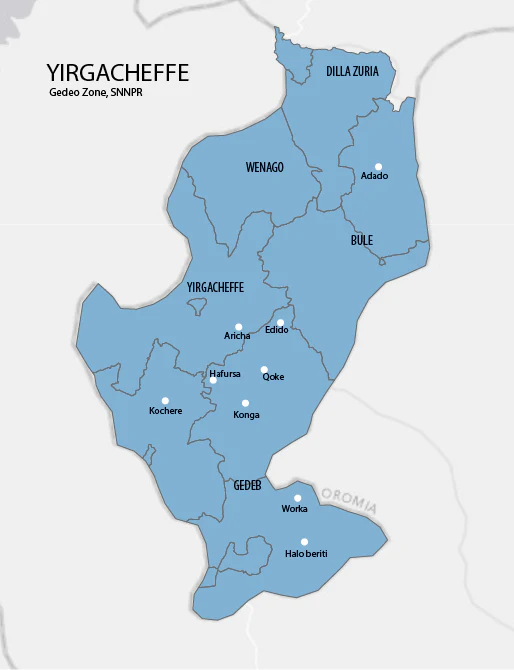
Yirgacheffe is located in southwestern Ethiopia and was originally, in administrative terms, a small town under the Gedeo Zone. It has natural wetlands and abundant water resources, with an average annual temperature hovering between 15 and 25 degrees Celsius. In addition, the high-altitude terrain brings significant temperature differences between day and night, providing an ideal growing environment for Arabica coffee beans.
In the early days, the small town of Yirgacheffe belonged to Sidama, another renowned coffee region in Ethiopia. As demand in the specialty coffee market for coffee beans with a fresh flavor profile continued to rise, the Ethiopian government began to pay close attention to the coffee produced in the small town of Yirgacheffe.
After that, a consensus gradually formed in the industry: coffee beans produced around the small town of Yirgacheffe have a distinctive floral and citrus character, with a flavor profile clearly different from other areas of Sidama. In addition, because many coffee bean traders specifically requested beans grown in the small town of Yirgacheffe, in 2010 the Ethiopia Commodity Exchange decided to separate the Yirgacheffe region from Sidama, which is how the now widely known Yirgacheffe region came to be.
For beginners who are just getting into specialty coffee, Front Street Coffee's washed Yirgacheffe is a worthwhile first choice. Its taste is clean and crisp, the white floral aroma is rich and prominent, and the sweetness in the finish is lasting. Even Front Street's baristas are extremely fond of it. Beginners can not only experience the classic Yirgacheffe flavor at a relatively low cost, but also accumulate practical experience during the brewing process. It is tasty and inexpensive, with excellent value for money.
Introduction to Front Street Coffee's Yirgacheffe Ardi Cooperative
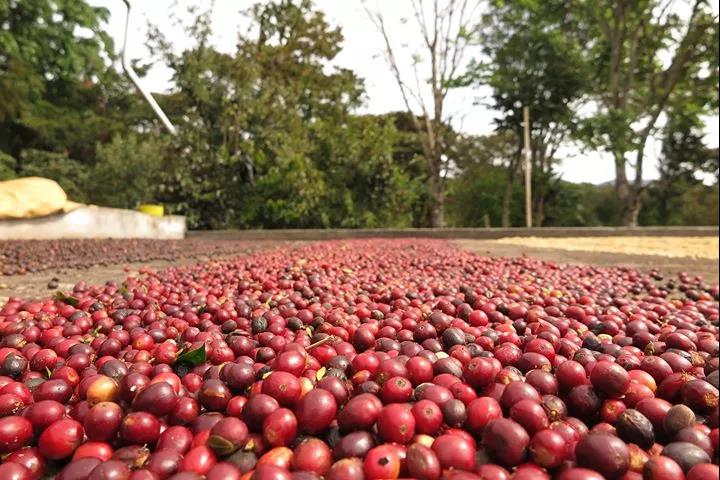
The Ardi Cooperative has 700 smallholder coffee farming families. Its name comes from a 4.4-million-year-old female fossil unearthed in 1992—Ardi. The Ardi processing procedure is extremely meticulous: after ripe cherries are hand-picked, they are placed on raised African drying beds for three weeks of drying. During these three weeks, workers turn them once every two hours and insist on manual stirring every day to ensure even drying, thereby ensuring consistent quality of the naturally processed ripe coffee cherries, finally completing drying and entering the product stage.
The improved natural method adopted by this cooperative optimizes the two main shortcomings of the traditional method: during picking, only fully ripe dark red coffee cherries are selected; before sun-drying, the beans are first screened at the processing station to remove defective beans, making bean size and ripeness more uniform. Then, raised wooden frames or entire drying beds are used for sun-drying, avoiding direct contact between the beans and the ground so they do not pick up off-flavors. During sun-drying, careful attention is required to allow the coffee beans to lose moisture evenly; every three to five days, coffee workers also hand-select and remove bad, moldy beans.
The above content is compiled by CoffeeHunters, a coffee news website.


