








What Sets African Coffee Farms Apart
Africa is coffee's birthplace, and its farms still define some of the most recognizable flavor profiles in specialty coffee. Ethiopia brings floral and citrus notes, Kenya shows berry-like acidity, and Burundi, Rwanda and Uganda offer their own styles. Bright, lively acidity and intense aroma are the through-line across these origins.
By continent, American beans tend to be balanced with soft fruit acidity plus nutty and cocoa notes, while Asian beans lean herbal, spicy and caramel-forward with a heavier body. Uganda coffee beans taste is often grouped with the wider African profile. Acidity drives much of this character, though green bean acids matter less than the acids formed during roasting.
Coffee originated in Ethiopia, Africa, and today Africa remains a core region that cannot be overlooked on the specialty coffee map. From the floral and citrus notes of Ethiopia, to the berry-like acidity of Kenya, and the unique styles of Burundi, Rwanda, and Uganda, African beans have won over countless coffee lovers with their bright, lively acidity and intense aroma. This article systematically sorts out the flavor characteristics, variety backgrounds, grading systems, and processing methods of major African producing regions, while also introducing several cost-effective African beans from the Front Street brand to help you more clearly find the cup that suits your taste.
The birthplace of coffee beans is Ethiopia in Africa, but as it has developed to this day, countries such as Brazil, Colombia, and Guatemala have also become important producing regions.
There are currently many types of coffee beans in the world, and many are labeled by their place of origin to indicate their unique flavors, such as differences in acidity, aroma, body, and softness.
Coffee beans from the three continents have different styles, briefly summarized as follows: [American beans] are generally balanced, with soft fruit acidity along with nutty and cocoa notes; [African beans] are known for rich tropical fruit flavors; [Asian beans] tend toward herbal, spice, and caramel notes, with a heavier mouthfeel.
Many people dislike the sourness in coffee and prefer a full-bodied or even intense taste. But if you want to step into the threshold of coffee tasting, understanding acidity in coffee is the first key. It must be emphasized that the more sour it is, the better it is not. The sweet substances and acidic substances in coffee together form the complex layers of flavor. Some coffees are extremely acidic and irritatingly sharp, yet score very low in professional cupping; while some coffees, although acidic, have an acidity that is sweet with a hint of sourness, round and comfortable, and naturally score higher.
The acidity of coffee
Green beans contain citric acid, malic acid, quinic acid, phosphoric acid, and other acid-related components, but these are not the source of the sour taste felt when drinking. What truly dominates the sour taste is the acid produced during roasting.
Once green beans are roasted, various components undergo chemical reactions and generate new acidic substances. The most representative are the reaction in which chlorogenic acids decompose to produce quinic acid, and the reaction in which oligosaccharides decompose to generate volatile formic acid and acetic acid.
What is the charming acidity in coffee?
First, the acidity of coffee is related to both the green bean itself and the degree of roasting. Especially in some African coffees, their acidity is soft and bright, and when combined with sweetness and a silky mouthfeel, the overall impression becomes particularly full and layered. Other coffees have an extremely irritating acidity with a sharp, stinging sensation, belonging to the extremely sour type.
If a cup of coffee tastes only bitter and sour with nothing else, then the quality of that coffee is worrying. Acidity and astringency are fundamentally different: acidity means that after swallowing the coffee, a mouth-watering sensation appears on both sides under the middle-rear part of the tongue, and only then can it be considered to have acidity; while astringency means that after drinking, the surface of the tongue, throat, and palate produce a numbing, harsh sensation, as if drinking coffee through a piece of gauze.
Astringency is a taste that should not appear in coffee; it means there are defects from green bean to roasting and even brewing. A good cup of coffee should not be bitter and astringent.
For example, we describe African beans as having "bright acidity" and "fruity acidity." Wonderful acidity gives coffee richer meaning.
Inferior: rancid acidity, sharp acidity, extremely high acidity with a stinging mouthfeel, acetic acid
Superior: fruit acidity, fresh acidity, round acidity, soft acidity
African producing regions
Flavor characteristics: charming fruit acidity
African bean flavors: Ethiopian coffee has a relatively strong citrus aroma, while Kenyan coffee has a rich berry aroma, along with the sour aroma of dark plum juice and grapefruit, and a clear sweetness like sugarcane. The citrus aroma of Ethiopia and the berry aroma of Kenya are the most distinct labels of African beans, and also what coffee fans are most fascinated by and study most deeply.
African coffee is generally known for its rich aroma and charming fruit acidity. The acidity is bright, lively, and inspiring, but the body is often on the thin side, and the sweetness is not especially prominent. Due to drought and water scarcity, African coffee mostly uses the natural process for green beans, and the bean shape is often uneven and unattractive, with a relatively high defect rate.
[Ethiopia]
Ethiopia has a history and tradition that can be called the birthplace of coffee. Yirgacheffe and Sidamo are enough to represent Ethiopia's overall flavor, and Ethiopia is also a major exporter of Arabica coffee beans in Africa. The mouthfeel is soft, with a wild, wine-like aroma, slightly acidic, and unforgettable after drinking.
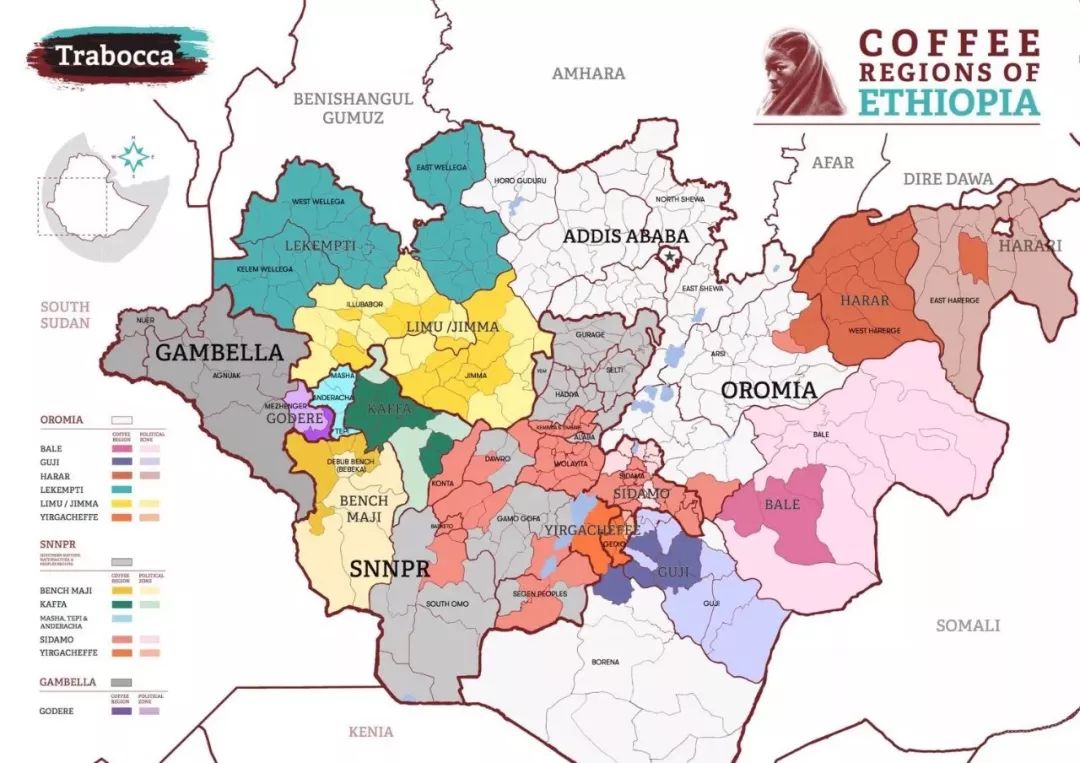
The four major planting systems are distributed across the following nine major producing regions in Ethiopia: Jimma, Sidamo, Yirgacheffe, Harar, Limu, Illubabor, Gimbi (Lekempti), Tepi, and Bebeka.
Yirgacheffe (specialty producing region): altitude 1,800–2,000 meters | garden coffee system |
Yirgacheffe is affiliated with the Sidamo producing region, but because of its unique flavor it has been separated out on its own.
In addition to the small town of Yirgacheffe, it also includes three sub-regions in the surrounding area: Wenago, Kochere, Gelena, and Abaya.
Yirgacheffe encompasses villages, micro-regions, cooperatives, and processing stations of all sizes. In most parts of Ethiopia, coffee farmers still live difficult lives and cannot afford to build household processing workshops, so many processing stations have emerged to centrally purchase coffee cherries from surrounding smallholders for processing, and then sell them to green bean traders. It is recommended to buy Front Street Ethiopia Yirgacheffe Sun-Dried Red Cherry Project. Although there is only information about the Red Cherry Project, sometimes the bean information you get is very detailed, allowing you to learn that this bean comes from a certain village, for example Front Street Yirgacheffe Gotiti, traced back to Ethiopia Yirgacheffe Kochere Gotiti.
The dry aroma of Front Street Ethiopia Yirgacheffe coffee beans gives off a strong fruity scent, with a heavy berry flavor, strawberry, and jam-like aroma.
The wet aroma is like sweet syrup, like thick apricot nectar, dried dark plum, and lemon peel. On the palate it is not intense, with medium body and bright, lively acidity, like fruity black tea.
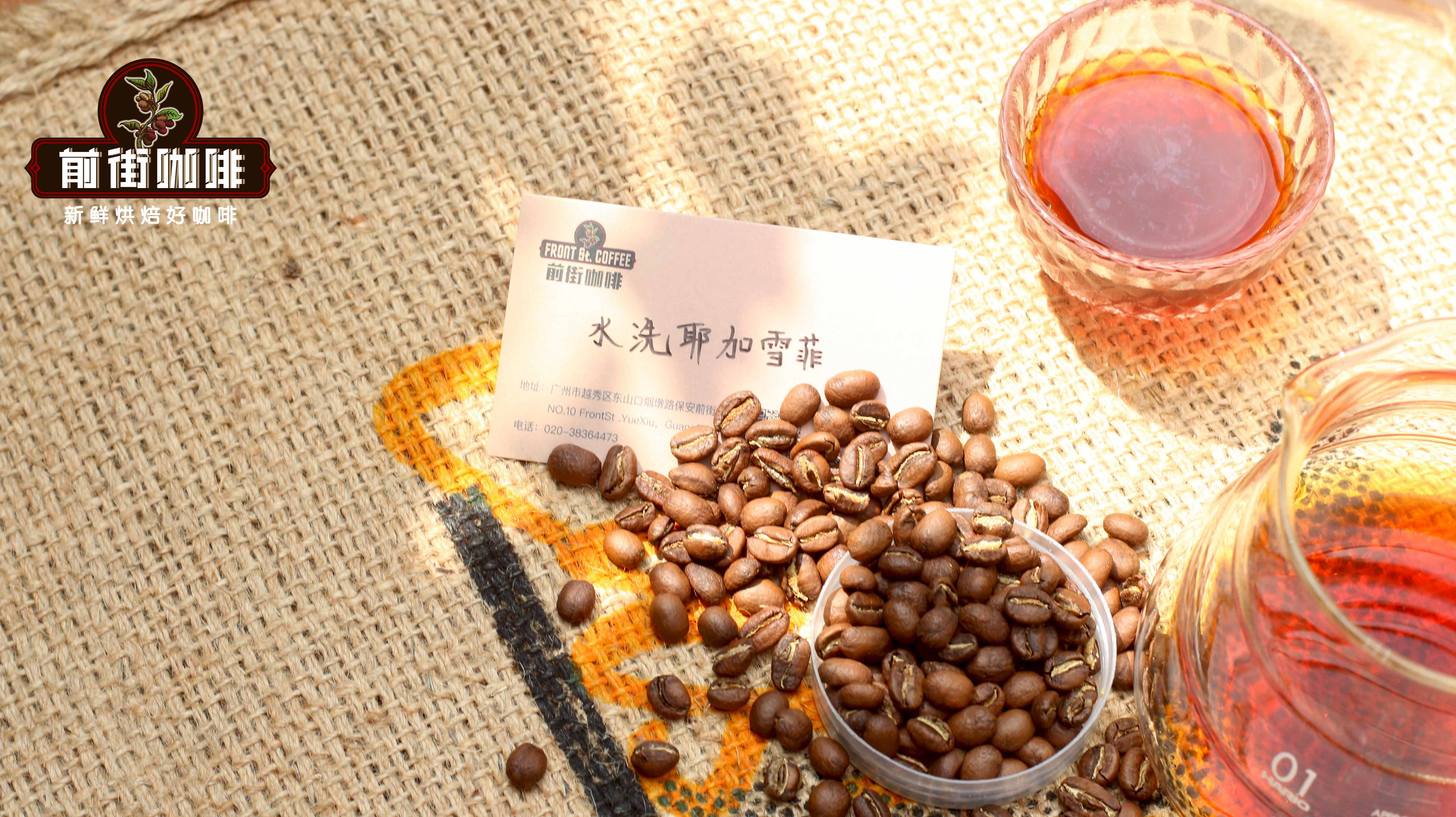
Sidamo (specialty producing region): altitude 1,400–2,200 meters | garden coffee system |
The flavor is similar to Yirgacheffe; finely washed or sun-dried Sidamo also has floral and citrus aromas.
The Sidama producing region is located in southern Ethiopia. Its industry is mainly agricultural, and the coffee-growing areas are located around the Great Rift Valley.
The greatest advantage of this place is that soil fertility is maintained through the cycling of organic matter, using fallen leaves from surrounding trees or plant residues as fertilizer, creating the distinctive characteristics of the coffee produced in the town, or medium-roast flavors: wild ginger flower and bergamot, with blackcurrant notes, grapefruit sweetness, and the comfort of Earl Grey tea.
[What is G1] — Coffee bean grading
Ethiopian coffee beans use a grading method based on the proportion of defective beans. Indonesian beans are mainly divided into 6 grades, namely G1–G6. Ethiopia also uses this method. The highest grades for washed beans are G1 and G2; the highest grade for sun-dried beans is G1.
Washed: Grade-1; Grade-2 (G1>G2). Washed coffees are less likely to carry wild flavors and have a clean, refreshing character. In some Ethiopian washed coffee beans of excellent intrinsic quality, one can sometimes detect obvious lifted lemon, citrus essential oil, jasmine, honey, and other notes, with relatively noticeable acidity and a thin body.

Almost all Ethiopian coffee varieties are local heirloom varieties. Nearly 2,000 varieties have been recorded, among which 1,927 are heirloom varieties, relatively round in appearance and very small in bean size. Most Ethiopian beans belong to heirloom varieties. Unlike the more uniform "internet-famous face" style, they have not been selected and bred by botanists, and their forms vary greatly, so they are often mistaken for defective beans. Uneven color... uneven roasting... uneven size... All of the above: where there is loss, there is gain. The mixing of varieties and the unevenness of particle size are precisely the reasons for the rich flavors and colorful aromas of Ethiopian coffee.
Kenya Kenya
Kenya grows high-quality Arabica coffee beans. The beans absorb almost the essence of the entire coffee cherry, with a slightly acidic, thick aroma. They are very popular among Europeans, especially in the United Kingdom, where Kenyan coffee even surpassed Costa Rican coffee to become one of the most popular coffees.
Front Street Kenya AA coffee, also called Front Street Little Tomato, is the finest among African coffees, with a substantial, full-bodied character, slight acidity, a smooth taste with a hint of wine aroma. AA grade represents Kenya's highest-grade coffee beans. Kenyan coffee cultivation is mainly divided into two types: large estates and cooperatives. The former generally have larger planting areas and independent coffee processing facilities, while most coffee production is completed by a large number of smallholder farmers.
Smallholder farmers form coffee cooperatives. Coffees from different producing regions have their own subtle flavors due to microclimate differences. Overall, they have a rich, intense aroma, bright and vibrant acidity, full and elegant body, and berry flavors.
[Varieties] Kenya [SL28] and [SL34] (direct Bourbon lines), created in 1930 by Scott Laboratories, abbreviated as SL. Agronomists wanted to find a Bourbon that was resistant to pests and diseases and had high yield, and through experiments they obtained SL28. Kenya's high-concentration phosphoric acid soil nurtures the special acidic aroma of Kenyan beans, with a charming plum-fruit acidity when drunk.
Ruiru11 was the first variety successfully recognized by the Kenya Coffee Board, even though specialty coffee buyers remain lukewarm toward this variety. In recent years the Coffee Board launched another variety called Batian. The quality seems to have improved somewhat, and people are optimistic about its future cupping performance.
[Kenyan 72-hour fermentation washed process] is a repeated cyclic process originating in Kenya in which fermentation is followed by washing. It is processed on the day of harvest. The highest-quality cherries are selected for pulping and fermentation. The fermentation time is 24 hours, and after 24 hours they are washed with clean river water. Then they are fermented again with clean river water for 24 hours, washed again, and after repeating the cycle 3 times, reaching 72 hours, it is therefore called the Kenyan-style 72-hour fermentation washed process, abbreviated as [K72].
Kenyan coffee is graded into seven grades according to bean size, and according to taste it is divided from top to bottom into six specification levels. Kenya's best coffee grade is Peaberry (PB), followed by AA++, AA+, AA, AB, and so on in order. Superior coffee is bright and lustrous, delicious, and slightly wine-like.
E: "Elephant bean," oversized, with relatively small production
AA: This is a relatively common grade. The coffee beans are larger in size, with screen size above 18 mesh or 7.22 mm. This type of bean can usually fetch the highest price.
AB: This grade combines A (screen size 16 mesh or 6.80 mm) and B (screen size 15 mesh or 6.20 mm); it accounts for about 30% of Kenya's annual coffee production.
PB (PeaBerry): This is the grading for small round beans. This refers to coffee cherries that develop only one seed rather than the usual two.
Front Street Kenya coffee enters the mouth fresh and clean with black plum and nectarine acidity, with good transparency. After the temperature drops, the acidity carries a corn sweetness, and overall it is very refreshing.
Burundi "Heart of Africa"
Burundian coffee has citrus, berry, and floral notes, and its diverse flavors attract attention. The bean variety is mainly Bourbon, processed by washing. Burundi's geographical environment is suitable for growing coffee. The country is mountainous and has suitable altitude and climate, accommodating many smallholder coffee producers. Smallholder production predominates, with each delivering harvested ripe cherries to processing stations for centralized processing.
Main producing regions of Burundi
Kayanza, located in northern Burundi and adjacent to Rwanda, produces high-quality coffee.
Ngozi, with blackberry and stone fruit flavors.
Mpemba, sometimes with butterscotch and floral tea flavors.
Kirimiro, this area is close to Gitega Province in central Burundi, and its coffee processing company owns the highest-altitude washing station in the country.
The taste is full of wildness, retaining strong flavor and aroma, rich and aromatic, different from most of the high-quality and mild coffees on the market, and highly regarded in Europe. The dry aroma is very intense and in no way inferior to Kenya; on the palate it immediately feels very rich, somewhat like vanilla, with a slightly wild feeling. The coffee is rich, with lower acidity than Kenya, a slightly thicker texture than Kenya, and a shorter finish than Kenya. It has the inherent characteristics of East African beans, yet is also quite unique.
Rwanda
Among these four coffee-producing countries, Rwanda is somewhat better known domestically. It is mountainous and also called the "Land of a Thousand Hills." The country's fertile volcanic soil, stable year-round rainfall, and high altitude provide guarantees for coffee bean cultivation.
Under such natural conditions, Rwandan coffee beans are of very high quality, with a special fruity sweetness as well as rich grassy and floral aromas. Many coffee lovers like Rwandan coffee beans. In specialty classification, first is Front Street Rwanda Red Bourbon. On the palate it combines the berry acidity of Front Street Kenya coffee and the citrus notes of Yirgacheffe, while also carrying the nutty aroma of Brazilian coffee beans.
Main producing regions of Rwanda
Western Province, near Lake Kivu, has Rwanda's famous washing stations, consistently producing high-quality coffee with a rich, aromatic, juicy taste. For example, Nyanyumba in Rubavu produces COE-level beans with citrus, raspberry, toffee, and chocolate flavors.
Northern Province, with citrus, stone fruit, and caramel flavors, relatively balanced.
Southern Province, coffee beans from high-altitude areas have floral and citrus notes. For example, beans from Nyakibanda green coffee farm have tropical fruit, citrus, and honey flavors.
Eastern Province, with fewer coffee farms and washing stations, and coffee with chocolate and fruity aromas.
Lime-like acidity is relatively obvious, with a grape-juice acidity, rich floral aroma, higher acidity, pleasant sweetness, medium body, and a nutty finish in the aftertaste. Overall it is clean, mild, smooth in texture, with a balanced and lively, ever-changing layering.
Uganda
Every year, major African coffee-producing countries hold a nationwide green bean competition called The Taste of Harvest (TOH), similar to the Cup of Excellence in Central and South America. TOH has become an arena for discovering the best coffees from Kenya, Ethiopia, Uganda, and Congo.
Although Uganda is a major producer of Robusta, it still has good-quality Arabica beans such as Typica, SL14, SL28. The SL varieties come from research and selection by Scott Lab. Kenyan coffee became world-famous because of SL28 and SL34, so the Ugandan government vigorously promoted them and distributed SL seeds to farmers. Among them, SL14 not only has good flavor but also has drought resistance, and can be harvested two years after planting, which suits farmers' needs quite well.
Coffee grading by experts is called Q and R grading. Coffees scoring above 80 are considered specialty coffee and will automatically attract a good market and even better prices. Therefore, competition shows that good practices can benefit farmers. As part of its mission, UCDA regularly trains farmers across the country to produce high-quality coffee through good processing methods. Therefore, there are areas producing high-quality coffee in regions such as Kanungu, Sipi, Iganga, and Luwero.
Main producing regions of Uganda
Mount Rwenzori in the Western Region. The snow-capped Mount Rwenzori is located in the west, where Uganda's sun-dried Arabica variety called "Drugar" is grown, with winey notes, fruity aroma, and relatively good acidity.
Bugisu. Small farms in Bugisu and Mount Elgon are located at an altitude of 1,600–1,900 m. The Arabica beans they produce have a heavy mouthfeel, sweetness, and chocolate flavors.
[Front Street Uganda Sun-Dried SL14 & SL28] Sweet orange juice character, fruity flavors such as citrus and berries, clear and bright acidity, smooth texture, spice, wood, complex mouthfeel.
Tasting coffee
When coffee enters your mouth, you can feel its flavor. In this regard, many enthusiasts, especially those who are just beginning to come into contact with coffee tasting, always think that coffee does not taste as good as it smells. Indeed, sensory discrimination of coffee liquid in the mouth requires some training, but over time, the flavors within can also be perceived.
The next step in coffee tasting is how to distinguish coffee's sweetness, saltiness, acidity, and bitterness.
What a cup of coffee tastes like cannot be simply summarized by producing country. For specialty beans, the best way to divide origins is to go as detailed as the producing region and estate, because cultivation methods and post-processing will both cause differences in taste:
"The dry aroma of this bean leans toward the elegant delicacy of jasmine."
"This sweetness is great! First there is a bit of passion fruit acidity, the sweetness is also full, and finally the finish has some nutty notes."
"I still like the taste of Geisha after it cools, with more sweetness, peach flavor, and sweet potato sweetness."
Gradually you can taste the bitterness in coffee, and there is citrus in coffee. Techniques for distinguishing taste and aroma, so step by step, learn while drinking, and enjoy the pleasure of specialty coffee.
Front Street African coffee bean brand recommendations
African coffee beans roasted by FrontStreet Coffee: Front Street Ethiopia Yirgacheffe coffee beans, Front Street Kenya AA coffee beans, Front Street Burundi coffee beans, etc., all have full guarantees in brand and quality. More importantly, the cost performance is extremely high. A half-pound bag of 227 grams costs only about 80–90 yuan. Calculated at 15 grams of powder per pour-over cup, one bag can make 15 cups of coffee, and each single-origin cup costs only about 6 yuan. Compared with the price of several dozen yuan per cup sold in coffee shops, this can be said to be extremely cost-effective.
A simple way to tell fresh coffee beans: 2–7 days after roasting, no rancid oil smell, aromatic, neat shape, relatively hard, one-way degassing valve packaging.
The sour and bitter tastes of coffee beans are mainly affected by roasting time. Light-roasted beans are lighter in color, less oily, and smell of natural fruity aromas; dark-roasted beans tend to be darker in color, oily and shiny on the surface, and carry aromas such as chocolate.
Friends who like acidity can choose brown light-roasted beans, and those who prefer bitterness can choose darker dark-roasted beans!
When choosing packaging, try to choose a design with a "one-way degassing valve," allowing coffee beans to release carbon dioxide while isolating outside oxygen. When purchasing, pay attention to whether the packaging clearly marks a specific date to ensure the quality of the coffee you buy.
In addition, counting from the roast date, the freshness of coffee beans begins to decline over time. It is recommended to use them within three weeks after opening to ensure the best condition when drinking.
Analysis of coffee bean types by region
The regions in the world that produce coffee are distributed along the areas south and north of the equator, also called the "Coffee Belt." There are more than a dozen types of coffee beans produced within the Coffee Belt, but the most commonly seen coffee bean types at present are only two: Arabica and Robusta.
Before coffee became widely popular in the early period, because channels for obtaining excellent coffee beans were limited, Robusta beans, which commonly grow in Asia, were more prevalent. This type of bean is generally grown in lower-altitude areas. Due to climatic influences, the beans have lower fat and sugar content, and taste more bitter and intense, without much flavor variation or character.
Another type, Arabica, grown at high altitudes, is the type of most specialty coffee beans on the market. Because it is in higher-altitude areas, it grows more slowly and can develop beans with sound flavor. Therefore, overall, Arabica beans taste sweeter, softer, and richer in fruity aroma, and are loved by coffee people.
Although common coffee beans can be divided into the above two categories and their characteristics summarized, in reality the flavor of coffee beans is affected not only by altitude but also by soil, monsoons, climate change, and so on, all of which can cause taste changes. Therefore, the flavor of coffee beans from every producing country and estate is different. You can first use a world map to find the bean flavors you like, and if interested, then study further the beans produced by different estates in that country. This will help you find coffee that suits you more efficiently.
Try more, and find the coffee beans that suit your taste best~
Coffee flavor distribution and characteristics
►Central America (Colombia, Panama, Costa Rica)
The taste is relatively light, the bean flavor balance is better, the mouthfeel is not too intense, it drinks with high sweetness and low acidity, and the aftertaste reveals fruity aroma, with fruity acidity within the fresh fragrance.
►Pacific region (Hawaii)
Overall it has a sweet aroma, a relatively mild taste, and is mellow and smooth.
►South America (Brazil)
It is currently the region with the highest production. The overall mouthfeel is relatively intense, and after drinking, a chocolate aftertaste remains in the mouth.
►Asia (Mandheling)
Because the altitude is relatively low, it overall carries an earthy aroma or smoky flavor, with a bitter cocoa aftertaste and a heavy body.
►Africa (Ethiopia, Kenya, etc.)
This region is the birthplace of coffee, so there are many varieties. Generally the aroma is wilder, and the best African coffee beans have a strawberry or blueberry aftertaste.
►Taiwan
Generally similar to beans produced in Asia, with a cocoa aftertaste. However, for beans produced in Dawu Mountain in Pingtung, coffee expert Lin Huan believes one can taste the aroma of cucumber, and it is one of his favorite Taiwanese beans.
Berry orchard: berries, floral aroma, grape acidity
Huakui: wild ginger flower, bergamot, blackcurrant, multiple tropical fruit acids
The above content is compiled by CoffeeHunters, a coffee news website.


